How to learn a language on a budget
Why do people give up on learning a language?
There are many answers to this question, of course. Recently, we’ve been running a survey (which you can still complete, if you have two minutes), about language learning, reasons for learning and things that might get in the way. According to the results so far, two of the top answers given to the above question are: lack of time, and lack of money.
 As I know only too well, language classes, private tutors and language CDs or books can quickly become very expensive. Having recently decided to try and upgrade my schoolgirl French, I had a look round at languge tuition and was pretty depressed to see that I would struggle to afford even a few weeks of classes. But never fear, there are plenty of ways to learn even if you can’t afford to go back to school or buy expensive subscriptions.
So here’s my short guide to how you can learn a language on a budget. Happy learning!
1. Online
There are a tonne of great resources to be found online without even paying a penny. Depending on your language, there are loads of websites for learning grammar, vocab and more. And you can often find really good sites for more advanced learners – I really love RFI for practising French (they have news reports in ‘easy’ French, with text transcriptions). For beginner to intermediate learners, busuu.com has a great programme for 12 languages, including grammar, reading, writing and vocab, and even allows you to chat with native speakers.
2. Media
This probably only applies to intermediate to advanced learners, but it’s my favourite way to practise the languages I already speak. Try watching movies in your language, with English subtitles, or subtitles in the language. Or Google the online version of a newspaper in that language (if I’m feeling very motivated, I read lemonde.fr, spiegel.de or elmundo.es). The radio is also a great tool for language absorption. You can listen to radio in almost any language at tunein.com (and they have a great app for on-the-go listening). Even just listening to some music in another language gets you used to the sound.
3. Flashcards
I used to be obsessed with these when I was at school and uni. In my opinion, this is a great way to cram vocabulary. Either make your own with paper (write the foreign word on one side and the English word or a picture on the other) and test yourself or get a friend to test you. Or, even better, there are some free programs to do just that, which even remember which words you’re weaker on and bring them up more often until you get them right. I used to use this on the computer, but you can get flashcards in app form now too.
4. Find other people to speak to
Ok, I’ve got it easy here because we have a very international office and I’m never short of someone to annoy with my dodgy Spanish… But even if you’re not surrounded by native speakers, you might be able to track down a language partner using a website like totalingua.com that matches you up with an exchange partner. If no one lives in your area, you can always arrange a Skype chat instead of meeting face to face.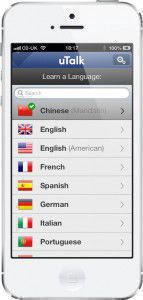
5. Apps
There are some amazing free or cheap apps to download on iPhone or Android. I’m using a combination of DuoLingo and uTalk to learn basic Italian. DuoLingo is free and gives you a good grounding in grammar and basic vocab, whilst uTalk features native speakers for all (70 and counting) languages, and has real audio for all the phrases and vocabulary, so I can pick up on the accent and pronounciation as well. I normally play a couple of the games on the bus to work, although I save the recording quizzes for the privacy of my room!
6. Books
If you’re more of a paper and pencil type, then there are plenty of language-learning books on the market, and they’re mostly cheap to buy, or you can track some down second hand. I think there’s something to be said for having a paper dictionary if you’re a serious language learner (what if leo.de is down!?) – even if you just decorate your shelves with them to look intellectual (or is that just me?).
Have you got any more tips for people learning a language on a budget?
Alex
Next week: our guide to learning a language when you’re short of time. If you’ve got any particularly useful tips you’d like to see included, please let us know below!
Quote of the week: 28 Jun 2014
“Learning is not attained by chance, it must be sought for with ardor and attended to with diligence.” Abigail Adams
 For more like this, find us on Pinterest.
Embed This Image On Your Site (copy code below):
How much money are you wasting on language software?
So, you’ve decided to learn a language. Great! Now what?
If you’re anything like me, you’ll have gone straight to the Internet in a fit of great enthusiasm, and bought yourself a language course – whether that’s in an app, on a CD or online. You might even have gone a step further and enrolled in a class.
But then the sun comes out, or the World Cup kicks off, or you decide to start reading the Game of Thrones books (only recommended if you have nothing else to do with your time for at least six months), and that passion for your new language starts to fade a little bit. Suddenly there are other things to do with your time, and although you definitely still want to be able to speak the language, you just don’t seem to have the time or enthusiasm to actually learn it.
And so that language course you bought, which promised so much, is forgotten and unused, and your dream of going travelling and fitting in like a local remains just that – a dream.
Can anyone else hear violins…?
It might sound obvious, but the thing about language courses, whether it’s EuroTalk, Rosetta Stone, Duolingo or any of the other multitude of programs out there, is that they’re only as useful as you allow them to be. I wish I could tell you that simply by downloading uTalk to your iPhone, the vocabulary will magically find its way into your brain while you’re sleeping, but it’s just not true (although if you want to try it, it’s available from the App Store).
 Let’s look at this another way. You want to lose weight, so you join a gym. Logical. Maybe you even go along a few times after work. But then six months later you’re still not skinny, and on top of that you’re out of money and you probably feel pretty bad about yourself too. According to research by online accountants Crunch.co.uk, here in Britain we were wasting £37m a year on unused gym memberships in 2011. Just think what we could have been doing with that money. Or how fit we could all have got if we’d kept going to the gym.
The fact is, gyms don’t magically make you fit, or thin. (If it were as easy as that, I’d have joined one a long time ago.) They just provide the conditions you need to get yourself there. Even a personal trainer, whose job it is to help you, will only get so far if you’re not willing to meet them in the middle. And it’s the same with language software – if you don’t use it, it can’t help you. We’d all love a big red button that will get us instantly to where we want to be, but life isn’t like that.
And that’s not necessarily a bad thing. Learning a language isn’t just about being able to speak that language. It’s also about the things you’ll discover along the way. You’ll learn to appreciate your own native tongue, understand the culture of the language you’re learning; you might even make a whole new group of friends. And personally, I think the satisfaction you feel the very first time you manage to speak to someone in another language, even if it’s just to say hello or thank you, is much greater than the pleasure you gain from becoming fluent. In the same way, reaching your target weight will feel amazing – but nothing will beat that first pound you lose.
So my advice is this – don’t buy language software, unless you’re going to use it. Because as the late Maya Angelou once said, ‘Nothing will work unless you do.’ And we don’t want your language app gathering virtual dust on your iPhone, until one day you realise you don’t need it any more and quietly delete it.
But if you do decide to invest in a course (hopefully EuroTalk!), and you follow through on that crazy plan you had one day to learn Russian, or Korean, or even Klingon, that’s great. I guarantee you won’t regret it – and it’ll definitely be less painful than going to the gym.
Liz
10 reasons to visit… Guernsey
I recently visited a friend in Guernsey, one of the Channel Islands. Not really knowing what to expect, I loved it from the moment I got on the Blue Islands flight from Southampton and was offered a free glass of champagne (can’t think why). Here are my top ten reasons to visit this small but lovely island.
1. It’s English, but not England
The Channel Islands don’t belong to the UK, but they are part of the British Isles. (Technically they’re British Crown Dependencies.) When you come out of the airport, everyone speaks English, cars drive on the left, and the whole island has a very quaint English village feel to it. So if you want to experience England without actually going to England, Guernsey is the perfect place.
2. It’s French, but not France
Having said all that, geographically Guernsey is much closer to France than it is to England, and you don’t have to go far to stumble upon a French café or boulangerie. There are also, unsurprisingly, a lot of French residents and visitors. Many of the place names look very French too, although confusingly most of them are said with an English accent. Castle Cornet is pronounced like the musical instrument, for example, rather than ‘cornay’, as you might expect.
3. The sunset
I’m a bit of a sunset addict, so my friend made sure to include a trip to Cobo Bay, on the west coast of the island, where we bought some fish and chips and settled down to watch the sun set in the sea. Although we had to move several times to avoid getting washed away by the tide, the view was absolutely stunning, and it was well worth the epic walk from the bus stop to Cobo, which turned out to be a bit further away than we thought…

4. The history
If you’re a history buff, there’s plenty to keep you occupied on Guernsey. Evidence of the German occupation during World War 2 is everywhere, from the concrete fortifications all around the coast, to the huge monument marking the island’s liberation in St Peter Port. There’s also La Vallette, the underground military museum, the 13th century Castle Cornet and the Victoria Tower, which was constructed in honour of a visit from Queen Victoria and Prince Albert in 1846.
5. Le Petit Café and Bistro
My friend told me shortly after my arrival that I couldn’t come to Guernsey and not visit Le Petit Café, her favourite restaurant on the island. In fact during my three-day stay, we ended up going twice, once for dinner and then, not too many hours later, for brunch. It’s really cosy, with friendly staff and great French food. It’s also really easy to find, right at the bottom of the main shopping street in St Peter Port. Try the coq au vin!
6. The views
Guernsey is far more than just sunsets. I’m not much of a photographer, but even I came away with some spectacular pictures, which could easily have been taken somewhere far more exotic. Both the island itself and the views across the sea, to the other Channel Islands, are amazing; you can even see across to France on a clear day. We were lucky because we had great weather, so were able to spend the whole weekend outside exploring and enjoying the sights.

7. The people
Within minutes of my arrival, we’d made friends with the taxi driver, who insisted on giving me a selection of maps and brochures to allow me to make the most of my stay, even though I was visiting someone who lives there and knows her way around. The following morning, as I walked into town along the seafront, I was greeted repeatedly by people passing me. As someone who’s used to the stony silence of the London Underground, this was a pleasant, if slightly disconcerting, change.
8. Victor Hugo
Best known as the author of Les Misérables (the book, not the musical) and The Hunchback of Notre Dame, Victor Hugo spent several years in exile on Guernsey, and his house is now a museum. Don’t be put off by the slightly tense atmosphere in the waiting area before your tour; it’s well worth a visit, if only for the spectacular view from the top floor. And if you’re lucky you’ll get the tour guide who likes to tell colourful stories about Hugo’s mistress.
9. Herm
On my last day, we took a ferry across to the small neighbouring island of Herm (20 minutes away), which is just beautiful. No cars are allowed and the island only has about three shops, so it’s not the place to go if you want action, but if you’re looking for a lovely beach to relax on, I recommend Herm. We couldn’t stay long because I had to catch my flight home, but we spent an enjoyable couple of hours on Shell Beach, musing about what it must be like to live on a private island (like Jethou, very close by and shown in the photo below) and which kind of boat we’d buy if we could afford it (which we can’t, sadly).

10. The weather
Typically, Guernsey enjoys more sunshine hours and has a milder climate than the UK, so it’s a great place to go if you enjoy a bit of summer sun. When I visited, although the weather forecast predicted 14 degrees and cloudy, it was more like 22, with not a cloud in the sky. Not ideal when you’ve packed for cooler conditions, but I wasn’t complaining.
Overall, Guernsey was a lovely surprise, and just goes to show you don’t always have to travel far to find somewhere amazing to visit. If you’re over in this part of the world (whether on holiday or because you live here), I definitely recommend checking Guernsey out.
Liz
By the way, we’d love to add Guernésiais to our range of language learning programs. If you, or anyone you know, can help with translation or recording, please get in touch. Thank you!
Quote of the week: 21 Jun 2014
“Translators are like ninjas. If you notice them, they’re no good.” Etgar Keret

For more like this, find us on Pinterest.
Embed This Image On Your Site (copy code below):
