Can language ever be gender-neutral?
Recent news that the German Justice Ministry is pushing for the German language to be made more ‘gender neutral’ will probably bring a sigh of relief to us German-learners the world over. Don’t get me wrong, I love German, but years of grappling with genders (a girl is ‘it’, whilst a table is ‘he’ and a bag is ‘she’!? – what’s going on here!?) doesn’t always feel worth it, when I’m constantly asking ‘is it der, die or das App?’ only to be told by native Germans ‘I’m not really sure!’
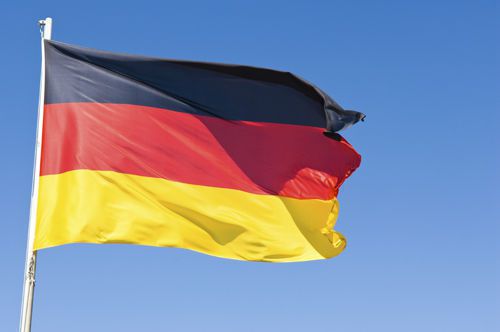 For us English speakers, the idea of allocating an arbitrary ‘masculine’, ‘feminine’ or ‘neutral’ to random objects around us just doesn’t feel right, and causes many a problem for learners of all nationalities. Screwing up the gender isn’t going to cause an international incident, but the bad news is that you have to get the gender right to get any other aspect of grammar right as well, so it really is a necessary part of learning the language.
But maybe not for much longer! The current campaign intends to do away with overtly gendered ways of referring to people and professions. Currently, Germans have the (rather archaic-sounding) convention of referring to all professions, for example, as gender-specific, e.g. der Arzt / die Ärztin (doctor), der Student / die Studentin (student) or der Manager / die Managerin. It is common to see an endless array of forward slashes (‘der/die Bewerber/in’ (applicant) or the bizarre-looking ‘die TeilnehmerInnen’ (participants) as a way of getting around the modern need to incorporate both male and female variants into job ads etc. This is basically just a headache for everyone involved. Yes, we get that the job can be done by men and women! We don’t need a special word for everything that can be done by a woman. Instead, some suggest a gender neutral equivalent, such as ‘das Bundeskanzler’ (Federal Chancellor – i.e. Merkel) instead of the current feminine form (die Bundeskanzlerin) which draws attention to the fact she is a woman, rather than just being the leader of one of the world’s most powerful countries.
This is all hypothetical, and some theorise that the language might do away with all gender articles (der/die/das, ein/eine/ein) and simply refer to everything as ‘das’, or maybe the more commonly used ‘die’. But it certainly would be helpful to anyone trying to get their head around these rather arbitrary distinctions.
It’s not really just German that struggles with these gender distinctions though. Even when writing English there are some tricky situations to get around. Endless use of ‘he/she’ sounds just as awkward as constant ‘der/die’ or putting ‘In’ on the end of everything, but simply using ‘he’ all the time feels like a somewhat unsatisfactory solution. I often resort to writing ‘they’, as the closest to a gender-neutral equivalent that we have, although this can often sound odd, and is technically a plural. Fortunately, although we do have female versions of some professions (e.g. actress, policewoman), mostly you can just say ‘doctor, dentist, teacher’ and no one bugs you to put ‘female’ in front – which actually feels a whole lot more sexist than simply implying that gender has nothing to do with it. Perhaps we could do with a generic word that implies ‘he and/or she’ without needing to be too finicky about it every time. Somehow, though, I don’t see ‘it’ catching on as a way to refer to people! For now, we’re probably stuck with either slightly awkward or slightly sexist – but it’ll be interesting to see if the Germans manage to find a better solution.
Alex
Quote of the week: 22 Mar 2014
For more like this, visit us on Pinterest.
Embed This Image On Your Site (copy code below):
The oddness of English
I don’t know about you, but I think one of the challenges about language learning is knowing how to spell a word you hear spoken and knowing how to pronounce a word you see written down. Some languages are more phonetic than others, which makes things a bit easier, but then some don’t have any standardised spelling, which makes things very hard. English, luckily, has standardised spelling, but its pronunciation lacks some logic and so it can be a nightmare knowing where to stress a word – and often if you get it wrong you say something you don’t mean to!
 A few words in English have optional pronunciation, like ‘harass’, which can be either ‘harAss’ or ‘hArass’, but the majority of words have a standardised pronunciation. This can cause problems when the spelling is the same for several different words that sound different. You can’t guess these things, they just have to be learnt. ‘Bow’ is a great example: depending on how you pronounce the vowel it can either mean the bow that an archer uses or the bow of a boat. Then, to confuse matters more, a bow (lowering your head to show someone respect) has the same pronunciation as the boat bow. Some other common examples include ‘minute’, which can be either a division of time or an adjective for ‘very small’, and ‘wind’, can be a strong breeze or the action of twisting something around. People row amongst themselves and row in a boat. And, although there’s a capital to help distinguish them, lots of tourists (understandably) pronounce ‘Reading’ (the city) as they would ‘reading’ (a book).
So, fine, we accept and conquer these challenges and push on with the language learning. But then there’s a new pitfall: words which sound exactly the same but have multiple spellings, each one indicating a totally different meaning. Depending on whether you learn better from listening or reading, you’ll probably be more flummoxed by one of these caprices of the English language than the other, but they’re both pretty challenging. Plenty of native English speakers, especially at the end of a long day when the concentration is waning, will find themselves putting ‘whether’ when they mean ‘weather’, ‘their’ when they mean ‘there’, ‘where’ when they mean ‘wear’. These are the ones that always spring to mind, but when you start thinking about it you’ll find a huge list of potential stumbling blocks. ‘Hey’ is a greeting’ whilst ‘hay’ is dried grass; ‘wine’ is a drink and ‘whine’ is the sound of a petulant child; ‘sails’ belong to a boat whereas ‘sales’ are discounts in the shops; you drink a ‘draught’ of something or use it to describe the depth of your boat, but a draft is a first copy of something.‘Hour’ is a division of time but ‘our’ belongs to us all. You grow ‘leeks’ and have ‘leaks’ in your roof. You ‘knead’ bread and ‘need’ air to survive. A plant has ‘roots’ but a road is a ‘route’.
I could go on, but the list is very long and I also want to mention the third group of confusing words, the ones which both look and sound exactly the same but have two completely different meanings, which have to be divined from context. So, a ‘coach’ both trains athletes and is a large vehicle. Fish have ‘scales’ and ‘scales’ are used to weigh things. A ‘stable’ houses animals and describes how sturdy something is. ‘Second’ is both a division of time and comes after first. ‘Bark’ belongs to a tree and is the sound of a dog. And ‘port’ is either a fortified wine, a harbour or the left side of a boat.
I’ve only mentioned a few of them and they’re the ones I’ve noticed causing confusion, but if you have any you’d like to add, whether in English or any other language you may know, we’d love to hear them!
Nat
10 reasons to visit… Luxembourg
Having just returned from a short trip to Luxembourg, I thought I’d continue with our ’10 reasons to visit’ series by giving you a few reasons why you should consider a trip to this central European country.
Luxembourg may be small, but it’s certainly worth a visit, and here’s why:
1. Great links with the rest of Europe
Luxembourg is just a short, hour-long flight from London, with several airlines and airports serving Lux airport. Our return flights were only £60 with BA. Or you could easily fly or drive from most big cities in Europe. Luxembourg also uses the Euro, which is convenient for other European visitors.

2. It’s quick and easy to visit France/Germany/Belgium
Ok… so my second reason to visit a place probably shouldn’t be that it’s easy to leave it again, but hear me out! I spent five days with a friend who lives in Luxembourg city, and during that time we hopped on the train over to the border to Trier in Germany and Nancy in France for just 10 euros a time. Luxembourg’s central location and small size means it’s easy to get two or three countries for your money by taking a short drive or train ride to one of the nearby cities, and fit as much as possible into your trip.
3. Linguistic diversity
Of course, my next reason has to be language-related! This small country has THREE official languages: Luxembourgish, which is spoken as a mother tongue by almost all residents; French, which is commonly used in restaurants, shops and cafes, and German which is frequently heard in the media. English is also widely spoken. So while you’re there, you can easily practise your French or German, as well as maybe picking up a few phrases of the local language. It was definitely a good opportunity for me to use a bit of French when ordering food and drinks. (By the way, EuroTalk offer all three official languages.)
4. Food and drink
Luxembourgish cuisine is very similar to German/Austrian, with plenty of meat and potato-based dishes. I came across plenty of my favourite German dishes such as Kaesspaetzle (an egg based dish which is a little like pasta or dumplings, with plenty of cheese!), Schnitzel (breaded pork fillets) and Rosti (Swiss-style potato cakes), not to mention Apfelstrudel and cheap beer. But if heavier dishes are not to your taste, there are plenty of French and Italian influenced restaurants in the city as well.
5. Amazing architecture
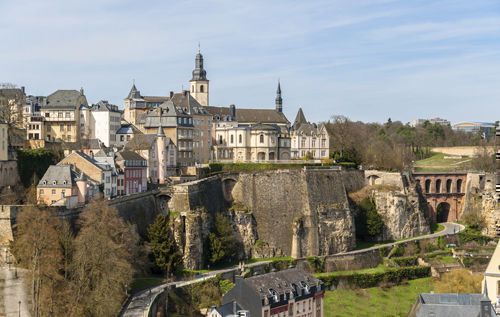
Luxembourg City used to be a fortress city which was completely surrounded by high stone walls. Those walls are still there, and you can climb to the top and walk around them for an incredible view of the city. The architecture is also beautiful, with many typical cone-shaped roofs and an architectural style that mixes French and German traditions. Planning and building laws in Luxembourg are also much looser than in many other European countries, meaning almost all the houses are built in different styles and colours.
6. Museums and culture
We visited the Luxembourg City History Museum, which is only 3 euro entry, but worth every cent. The museum covers every aspect of Luxembourgish life, from exhibits on the city’s architecture, with models of the city during different periods of its existence, to an entire floor dedicated to shopping and consumer culture, a basement level which is cut into the rock that the city is built on, and loads of fascinating information about the city’s occupation by the Nazis during the WW2 era. It also has great views over the city, especially from the glass lift. The museum is a proper maze and you can get lost in there for hours and find out about all sorts of aspects of Luxembourg City.
7. Landscape and cityscape
Interestingly, the city is built around a huge canyon (for want of a better word!). You must therefore either take one of the city’s many bridges to get to the other side, or you can walk down into the canyon and explore the park, which has a small river and beautiful views. Many people go running or cycling down there, and it’s a great place to chill out or take a walk.
8. Nature is close at hand
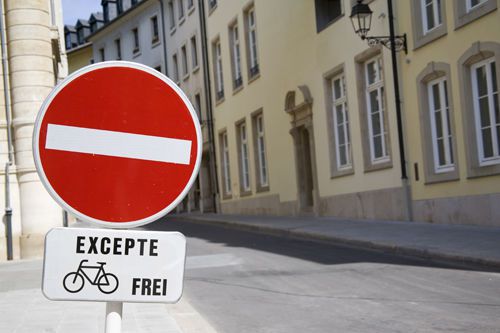
The city is full of green spaces, including parks and the river, and you’re never more than short walk from a green area to chill out and relax. However, a short trip outside the city and you’ll be in the midst of the country’s miles and miles of relatively unspoiled countryside. Luxembourg is great for cycling, hiking and fishing or boating. There are also 400 square kilometres of nature parks, many lakes and rivers and miles of cycle routes and hiking trails. As a bonus, the city is also very bike-friendly. You can rent a bike from the Veloh scheme, and there are bike lanes everywhere so you can cycle safely.
9. Shopping!
Unfortunately, Luxembourg isn’t the cheapest place to go on holiday. Wages there are high and the city’s livelihood is largely based on banking. As a result, food prices, for example, are relatively high. However, Luxembourg City and some of the surrounding cities are great places to shop, especially if you’re interested in high-end boutiques and designer labels. If you’re looking for flea markets or bargain hunting then it’s probably not the place for you, but there are several quaint little artisan chocolate, cheese and wine shops, as well as a wide range of designer stores which are worth a look, even if you’re only window shopping.
10. Visit the only remaining grand duchy
Luxembourg is not only one of the smallest sovereign nations in Europe, it’s also the world’s only remaining grand duchy, meaning it’s headed by a grand duke rather than a king/queen or president. You can see the grand duke’s palace in the centre of the city, and his son was recently married in a huge public ceremony which was watched by most of the nation. You can also see the country’s main legislative building, the Chamber of Deputies, right in the city centre.
Alex