15 cultural faux pas to avoid when travelling
Before you go on holiday, or on a business trip abroad, it’s a great idea to learn a little of the local language. But getting along with people is about much more than just the words you say. There are other rules too, so here are our top tips to avoid misunderstandings abroad.
1. Be very careful when exchanging business cards in Japan: they aren’t just cards, but representations of the giver and should be handled with some ceremony. NEVER write on a business card or put it in your back pocket, as this is considered disrespectful.
2. Don’t talk about work over dinner in New Zealand, even if you’re having a meal with your colleagues. It’s fine to talk business over lunch, though.

3. In Muslim countries it’s considered an insult if you show the soles of your feet, so watch how you sit.
4. If you’re in Hungary and you’ve been told your meeting is at ‘fél négy’ (‘half four’), don’t turn up at 4:30 – ‘fél négy’ actually means half an hour TO four, so you’ll need to be there at half past three.
5. On the other hand, if you’ve been invited to a gathering in France, always aim to arrive 15-30 minutes late, to allow the host time to get ready.
6. Making a circle with your forefinger and thumb as another way of saying ‘OK’ is seen as an extremely offensive gesture in Brazil. As is the ‘thumbs up’ gesture in Iran, and showing your palm in Greece. It might be better to just avoid hand gestures altogether…
7. In Germany, not making eye contact when you clink glasses is considered very rude. It also, apparently, means you’ll have seven years’ bad luck in the bedroom. So even if you’re not worried about being thought bad-mannered, it might be worth making the effort. Just in case.

8. In Bulgaria, nodding your head means no, and shaking your head means yes, which is the opposite of what most of us are used to. This is worth remembering or you could get yourself into all kinds of trouble.
9. It’s been illegal to bring chewing gum into Singapore since 2004, because of the damage being caused to public buildings and facilities by people leaving their gum behind. You can also be fined for not flushing a public toilet.
10. In Russia, if you’re giving someone flowers, make sure you give them an odd number. Even numbers are for funerals.
11. It’s important to show respect to your elders in Asia, so don’t call them by their name; instead use ‘Auntie’ or ‘Uncle’, even if you don’t know them.
12. When eating a meal in Spain, you’ll be expected to clear your plate, and leaving some food is seen as rude. In Russia, on the other hand, you’re expected to leave a little as a sign that your host has provided enough to fill you up. And in China, a polite belch when you finish eating is considered a compliment to the chef, although it’s frowned upon in many other countries.

13. Never say anything disrespectful about the king in Thailand, as this could land you in prison for several years.
14. Make sure you’re appropriately dressed before going to church in Italy. This means your shoulders, knees and midriff should all be covered, or you won’t be allowed in.
15. In Malawi, it’s common for people of the same sex to hold hands; this is a sign of close friendship, so don’t worry if someone tries to take your hand. It’s a compliment. Men and women holding hands is rare, though, and may be frowned upon.
As always, if anyone has any others, we’d love to hear from you!
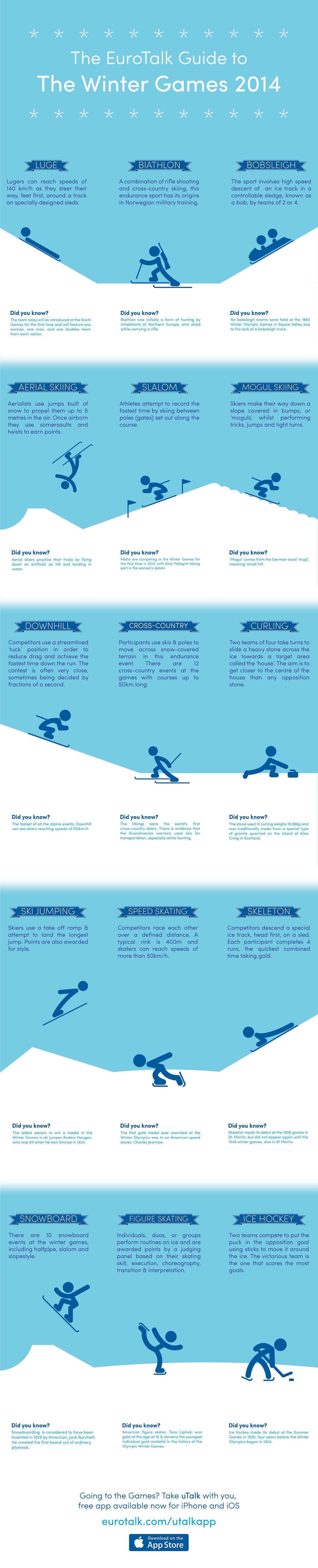
The EuroTalk Guide to the Winter Games 2014 [Infographic]
If you follow us on Facebook or Twitter, you’ll be aware that over the last couple of weeks, we’ve been enjoying the Winter Olympics, and we’ve been sharing our guide to the different events. Some of them were quite new to us and we had fun discovering what they were all about. So if you’ve been mystified by any of the sports, we hope this complete guide will help.
Embed This Image On Your Site (copy code below):
Quote of the week: 22 Feb 2014

For more like this, visit us on Pinterest.
Embed This Image On Your Site (copy code below):
Why Fluent English Language is Important for Business
Today we have a post by guest blogger Jeff Peters on the importance of the English language in the business world.
Globalization is a dominant feature of post-modern industrial and developing societies and is being led by multi-national corporations. Whether it is high tech companies such as Apple, automobile manufacturers like General Motors, or even much smaller firms that specialize in one-off items manufactured throughout the Far and Near East, business has managed to overcome trade and regulatory boundaries in order to sell wares through free markets. Communication is paramount; imagine the difficulties if no efforts were made to establish a cohesive way by which businesses communicated. This is perhaps the over-riding reason as to why English has been chosen to be the de facto language of the business world.
Why English?
 We may have Hollywood to thank for the predominance of the English language throughout much of the world today. Distribution of American movies, television programs and music has allowed many peoples, even in so-called third world nations, to at least become somewhat familiar with spoken English. A large percentage of multinational corporations originated in the United States and continue to be headquartered in this country and their influence throughout the global community is quite predominant. Perhaps most important of all is the emergence of the Internet, where the English language predominates and is evidenced by the fact that many foreign language websites provide the means for translation into English.
English as the Model of Efficiency
While English may not be easy to learn, it has been adopted by foreign companies as the most effective means of gaining access to global commerce and trade. This is reflected in the fact that worldwide, close to two billion people are currently learning English. According to language experts at SolidEssay.com, which is a college paper writing service, having effective English language skills will not only allow for access to commerce and trade, it also provides an efficient way by which business is conducted. Cultural differences aside, the predominance of English has allowed for an efficient means to conduct business throughout the world, and has also provided an effective tool used to deal with political differences, also viewed as barriers to trade.
Why is this Important to Individuals?
With the rise of English as the language of choice throughout the global business community it is important for non-English speakers to understand that without the necessary language skills they run the risk of being left behind. Each must adapt their skills to business needs and to be a cog in this dynamic world it is important to learn the lingo. Hence, learning English is primary to individual success and should be given to anyone wishing to gain access to the corporate world of today. As the spread of English continues, learning the language appears to be one of the most productive means to meet the demands of a rapidly changing world.
Jeff provides essay writing tips through SolidEssay.com. One of his recent publications is on how to write a rhetorical analysis essay.
Remember with Talk Business, you can learn English from over 70 other languages.
How to say ‘I love you’ in 99 languages [Infographic]
Happy Valentine’s Day everyone! To help you celebrate, here’s how to say ‘I love you’ in 99 world languages…
(You can click the infographic to have a closer look.)

Embed This Image On Your Site (copy code below):
