Don’t give up: New Year’s Resolutions
We’re now a week and a half into the New Year, and it’s safe to say a lot of people will already have given up on the promises they made to themselves when the clock struck midnight on January 1st. Whether you’re trying to lose weight, quit smoking, learn a new skill or save money, here are our tips to help you stick with it.
1. Set yourself manageable goals. Instead of saying ‘I’m going to lose weight’, decide how much you want to lose in a set time frame, and reward yourself when you get there.
2. Focus – don’t try and do everything at once. Choose one or two changes you want to make to your life and concentrate on those.
 3. Write your resolutions down. Seeing them in black and white will help you to establish exactly what you want to achieve.
4. Only set targets that you really care about. If it’s not important to you, it’s so much easier to lose interest. Think about why you’re doing it – if you can’t think of a reason, it’s probably not worth doing.
5. Tell friends and family what you want to achieve. It’ll be harder to give up if other people are keeping an eye on you.
6. If you do have a wobble, don’t use that as an excuse to give up. Put it down as a one-off and start again.

7. Take your time. You don’t have to achieve all your goals on the first day. If your goal is to exercise more, start by going for a run to see how you feel, before you rush out and spend lots of money on a gym membership.
If you didn’t set any New Year’s Resolutions this year, it’s not too late! If you want to make some changes in your life, you don’t have to wait for January 1st to roll around again. Why not make a start today?
Learning a language is often a popular New Year’s Resolution, so if you’ve decided 2013 is the year to brush up on your German, or start learning Japanese, have a look at our website to see how we can help you get started.
Good luck!
Join the revival – learn Cornish
Today we have a guest post from Elizabeth Stewart, from the Cornish Language Partnership, on why Cornish is a great language to learn.
The Cornish language, or Kernewek as it is known by those who speak it, is enjoying a hugely successful revival. Those who are fortunate enough to live in the Duchy, or visit it on holiday, have only to look around them to see proof of this, with bilingual road signs springing up on street corners and businesses proudly asserting their origin by naming their products in Cornish. It’s an exciting era for the language, and learning has just become easier and more enjoyable with the release of three new EuroTalk resources in Cornish.

Cornish is a Celtic language and is most closely related to Welsh and Breton, though it also has strong links to the other Celtic languages of Irish Gaelic, Scots Gaelic and Manx. Up until the mid sixteenth century it was the main language spoken across Cornwall but pressure from English caused Cornish to decline and retreat to the far west. By the beginning of the nineteenth century Cornish had all but died out as a community language, but in 1904 Henry Jenner published a Handbook of the Cornish Language which kick started the revival of Cornish as a living, spoken language.
Since then the number of people learning and using the language has escalated, with Cornish receiving official recognition as a minority language in 2002 under the Council of Europe’s Charter for Regional or Minority Languages.
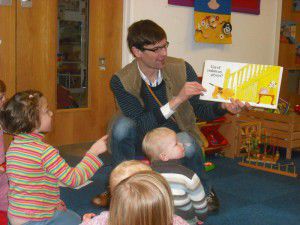
Skol Veythrin Karenza - Pre-school in Pool (photo Emilie Champliaud)
Today Cornish is one of the fastest growing languages in the world, and this is set to accelerate with more schools than ever choosing to teach Cornish, from pre-schools (including a fully bilingual one that teaches through the medium of both Cornish and English) right through to secondary schools.
Businesses are also embracing the use of Cornish. Local enterprises such as Polgoon Vineyard have made a point of choosing Cornish branding as a mark of local origin and several of their products are named in Cornish. Meanwhile national companies such as JD Wetherspoon have a policy of putting up bilingual signage in their Cornish pubs, as well as giving them names in Cornish such as “Try Dowr” (Three Rivers) in Truro and “Chapel an Gansblydhen” (Centenary Chapel) in Bodmin.
Cornish is also used in the community, with Scouts and Guides learning their motto and promise in Cornish, gig rowers naming their gigs in Cornish and an increasing number of individuals using Cornish for everything from house names to children’s names, wedding vows to tattoos.
If you would like to join the growing number of people who are taking an interest in Cornish, order your copy of either Talk More (suitable for adult beginners) or Talk the Talk (suitable for younger beginners) from EuroTalk today, or if you’ve already been learning for a while try taking your Cornish a bit further with Talk Business.
For more information about the Cornish language, visit www.magakernow.org.uk.
Encouraging English learners in Ethiopia
Our guest post today is by Elizabeth Horsefield, a volunteer with the VSO in Ethiopia.
Ethiopia was perhaps not the intended market for a EuroTalk Interactive Learn English CD-ROM. But it’s going down a storm. I work as a VSO volunteer in a Teacher Training College in a rural area of Western Oromia, Ethiopia. We have an English Language Improvement Centre (ELIC) which recently acquired two new desktop computers complete with headphones and speakers. Perfect.
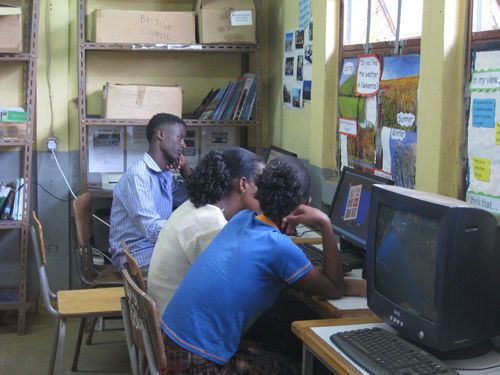 The students are desperate to improve their English. For most of them this usually involves sitting silently in front of an old copy of some estranged grammar book and making notes. Others even read the Oxford dictionary in the hope that it will one day magically transform their communication skills in English. Many of them went to school in remote areas with very few educational resources. Often their experiences in the ELIC provide a first opportunity to use a keyboard and mouse, so operating an interactive CD-ROM in their second or maybe third language might have been beyond their capacity. It would appear not.
 Every afternoon (hours scheduled for computer use outside of their regular classes), the students come and learn. Sitting alone or in pairs, I allow them half hour slots to navigate around the different activities and keep score. The cultural context of the material is apparent. These Ethiopian students are not familiar with eating roast chicken, going sailing or playing the trombone. But this only serves to highlight how culture and language are two halves of the same whole and they are quick to overcome any misunderstandings with the help of the pictures and a little guidance from the native speaker (me).
The local language in the area I live and work is Afan Oromo. I have been making a concerted effort to speak and understand something of this wonderful language with its complex history and rich sense of identity. If only an interactive CD-ROM existed for Afan Oromo, I suspect I would be making nearly as much progress as my students.
Elizabeth Horsefield, Nekemte, Ethiopia
A visit to Malawi
I visited Malawi for a week last month. My first impressions were the enthusiasm and happiness shown by so many Malawians. But real problems are just under the surface. For example, a serious petrol shortage means at least eight-hour waits at petrol stations.
During my visit, we installed gadgets (iPod touches) in two locations:
Primary school
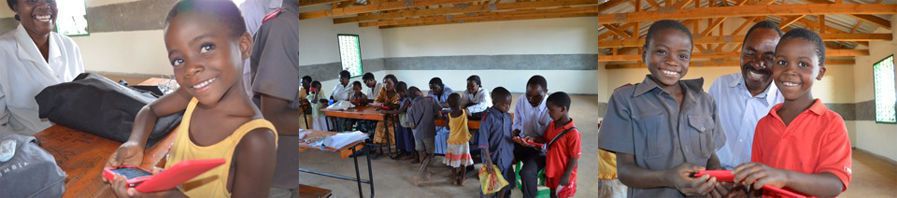
Here we supplied the iPods to ten Standard 1 and 2 teachers (the first two years of Primary education) in a primary school with 5,000 children. Each teacher has a class of more than 250 children. The whole school has 24 teachers – including the head and deputy. The deputy head is paid £80 a month – and needs to spend £40 a month on rent. He has to buy everything for his children and extended family on £40 a month.

Since I got back, the headteacher has written to me:
“How is London these days? Malawi is good and we are waiting for the first rains ready to plant crops since Malawi depends on farming. Andrew I’m pleased to tell you that our pupils have started scoring the stars on the charts using the devices. We are now giving the stars, which is encouraging and interesting.”
Hospital
Here I met with some women who had had a fistula operation.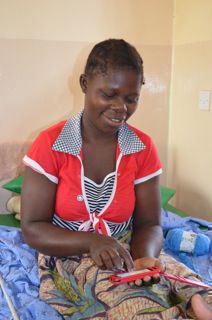 These are women who have had problems giving birth. They not only lose their baby but are damaged – and become incontinent. As a result they are often rejected by the village society and treated like “modern day lepers”. I met one woman who got a fistula as she gave birth 45 years ago. Her whole life changed, as she suffered first the trauma of losing a baby and then being rejected by all around her. The operation takes about three hours, but all the ladies need to be in hospital for a month. Their lives are transformed in the most profound way. EuroTalk have donated software and gadgets for these ladies to use while in hospital. These gadgets had preinstalled language learning and maths apps in English and Chichewa, as well as Malawian music, photos, video clips, lesson plans etc.
The hospital anaesthetist has written:
“… the mothers really like the iPods to the extent that when I am busy they even call for them. Some of our young patients are turning into teachers of elderly patients.”
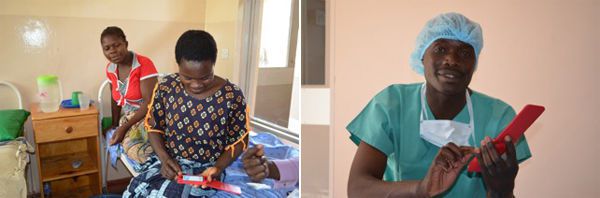
We are planning an update to the digital resources for the school and the hospital early next year.
I also met with members of the Scottish Government, who were visiting Malawi. The SG and EuroTalk are jointly funding the devices and software for these gadgets to go into 30 schools. It’s a really exciting project!
On a personal note, I was really encouraged by this visit. It follows so much work done by so many people. The potential for low cost digital devices and software in local languages to deliver education is enormous. Thank you to so many at EuroTalk, past and present, who have turned ideas into a reality.
Andrew (EuroTalk Managing Director)
From Advanced Course to “um …” and “er …”
Our post this week is by Lisa Erne from Germany, who’s spending a few months with us at EuroTalk as an intern. Lisa’s been in London now for six weeks, and here she shares some of her experiences so far.
When I arrived in London a few weeks ago I expected a tough start but people here made it very easy for me to feel comfortable. I moved to Brent where I supposed to live with four other housemates, I was really nervous, but there was no reason for that. I was very welcome.
I noticed really fast that the English are always easy-going like always saying sorry, even when you hit them by accident. Every day in the morning on my way to the tube I got like three “Good-Morning’s” from people, who are just passing my way. And everyone here is always pleased to help.
When I started school in the Central School of English near Tottenham Court Road I made easily friends with people from all over the world.
I felt quickly that I “improved” my English. After a few days I lost the habit of saying “um…” and “er…” all the time when thinking about the right words when having a conversation. I mean, home in Germany at my school I was in advanced course of English but you never had like a real conversation situation. The teacher asks you something and you will answer in a few sentences. There has never been real circumstances like this for me. When you’re here you’re forced nearly all the time to speak English. Even a little chat with the cashier in the Tesco supermarket can be a good practice.
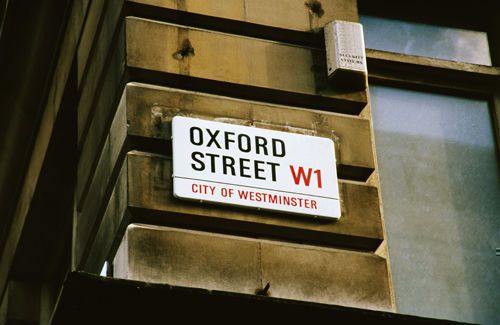 London is a varied city, even if I didn’t do any sightseeing yet, I saw a lot of different attractive areas here. There is Camden Town, where you can find a lot of markets and Tattoo & Piercing Shops. Oxford Street became one of my favourite places to be. When the temperatures were still warm, my friends and me walked from our school over Oxford Street to Hyde Park to enjoy the sun. While walking we did window shopping a lot, or just enjoyed everything else around. Also one of our favourite places became the Thames in general, just sitting at the water hanging out.
I already love London, but there are things that drive me mad. One of these things are the tubes. Tubes are always crowded and always late and they stop driving around midnight, but I got already used to it. Buses are the essential alternative to that, but I couldn’t really make friends with them either, because the timetables are sometimes very confusing. And the prices such as for tube tickets and cigarettes are an essential difference to for example in Berlin. Now I’ll really appreciate the prices there when I come back.
A great difference to Berlin is that shops here are opened on every Sunday, even till late hours. In Germany we have just a few weekends when the shops are open on Sundays like some weekends before Christmas, so people can do their last minute present shopping.
As well I enjoy the pubs pretty much. We don’t have a lot of them in Germany, but if it is no spot for young people, more for elder people who want to have a drink on their own after a stressful working day. Here it is a lot more fun, you always get to know new people. My favourite became The Green Man near Oxford Street, because you can also dance there, and The Crown, where many students of the Central School go on Fridays and the drinks are also very affordable.
After all this adventures and experiences yet I can say that London is a place, where I never learned so much about people and life.
Since the six weeks that I’m here I feel pretty much adapted to the lifestyle here and also a little bit of a part of London. I can already say that I won’t forget the time here ever.
Lisa
Has anyone got any suggestions for places that Lisa should visit while she’s in London?
