Learning Latin with Harry Potter
Just before Christmas I helped our language producer record Latin, which will be coming to uTalk later in the year. Whilst listening to the Latin speakers I found I recognised some of the words (although I have never learnt Latin before). And then I realised this was due to my love for/slight obsession with Harry Potter.
As a child I would read every Harry Potter book that came out (this could take some time, as my mum would read it first, followed by my sister, then my dad and then finally me; by which point my mum would have already disclosed a summary of the book including 100 different spoilers!). The extremely clever use of Latin has helped to allow the Harry Potter stories to become even more accessible worldwide, as Latin runs through many modern romance languages, such as French and English. It is also a language that isn’t as widely used or known in modern society anymore.

A few examples of J.K.Rowling’s use of Latin:
- ‘Protego’, which is a shield charm that creates a magical barrier, literally means ‘protect’ in Latin.
- ‘Lumos’, which produces a burst of light, is related to the Latin word lumen – which directly translates into light.
- ‘Crucio’ one of the ‘forbidden curses’ which causes a lot of pain, means ‘I torture’ in Latin.
- ‘Expecto Patronum’ which is used to produce a spirit animal to shield you from dementors, translates into ‘I wait for a patron’ in Latin.
- ‘Levicorpus‘, which is a spell that suspends someone from their ankles in mid-air, is a combination of two Latin words: levare, which means ‘lift’, and corpus translates as ‘body’.
These spells are pretty self-explanatory when you know Latin!
Again, the Latin theme can be found across names used in Harry Potter, often describing their personality or role in the books.
- Remus Lupin – his surname means wolf (which Hermione worked out early on in the third book).
- Draco – means dragon although the character’s surname, Malfoy, is actually French for ‘bad faith’.
- Severus (Snape) – means ‘stern’ in Latin, which is an appropriate word for Hogwarts’ meanest teacher!
- Sirius Black – it’s no coincidence that this character’s named after the Dog Star.
- Ludo Bagman – he’s the head of the Division for Magical Games and Sports, so it makes sense that his first name, Ludo, means ‘I play’ in Latin.
Can you think of any more examples of Latin in Harry Potter?
Alex
Rockin’ around the Christmas tree
Have you put up your Christmas tree yet?
Christmas trees are an iconic part of the festive season. It has become a tradition in many towns and cities to place a decorated tree in a central location for all to see, and many people also have a Christmas tree in their own homes.
The Christmas tree custom is believed to have started in Germany, with people bringing decorated Christmas trees into their homes. This became a trend across Europe with Queen Victoria decorating the first Christmas tree in Windsor Castle; with sweets, fruits and gingerbread.
In Trafalgar Square, London, receiving a Christmas tree from Norway has been a wonderful tradition since 1947. This is a gift to symbolise friendship and thanks, for Britain’s support during World War Two. The British Ambassador attends a ceremony in Norway during November, before the tree’s shipped to London for the festive season. This year @trafalgartree even has its own account on Twitter!

Another iconic Christmas tree is the one that stands at the Rockefeller Centre in New York. For those of you who love holiday films, this is the tree where the Christmas tree loving Kevin is reunited with his mum in Home Alone 2. 2015 marks the 83rd year of lighting this 10-ton Christmas tree with over 45,000 lights.
Last year Rio De Janeiro unveiled the world’s largest floating Christmas tree. It was 85 metres tall and had over 3.1 million lights! The lighting of the Christmas tree is the third largest annual event in Rio and each year carries a different theme; last year’s symbolised the importance of light in people’s lives. Unfortunately this year the tree’s metal structure was damaged and it’s had to be reduced to a mere 53 metres…
Here at EuroTalk we love to put up a Christmas tree in the office, it may not be 28 feet tall or have as many lights but it’s still fabulous 🙂
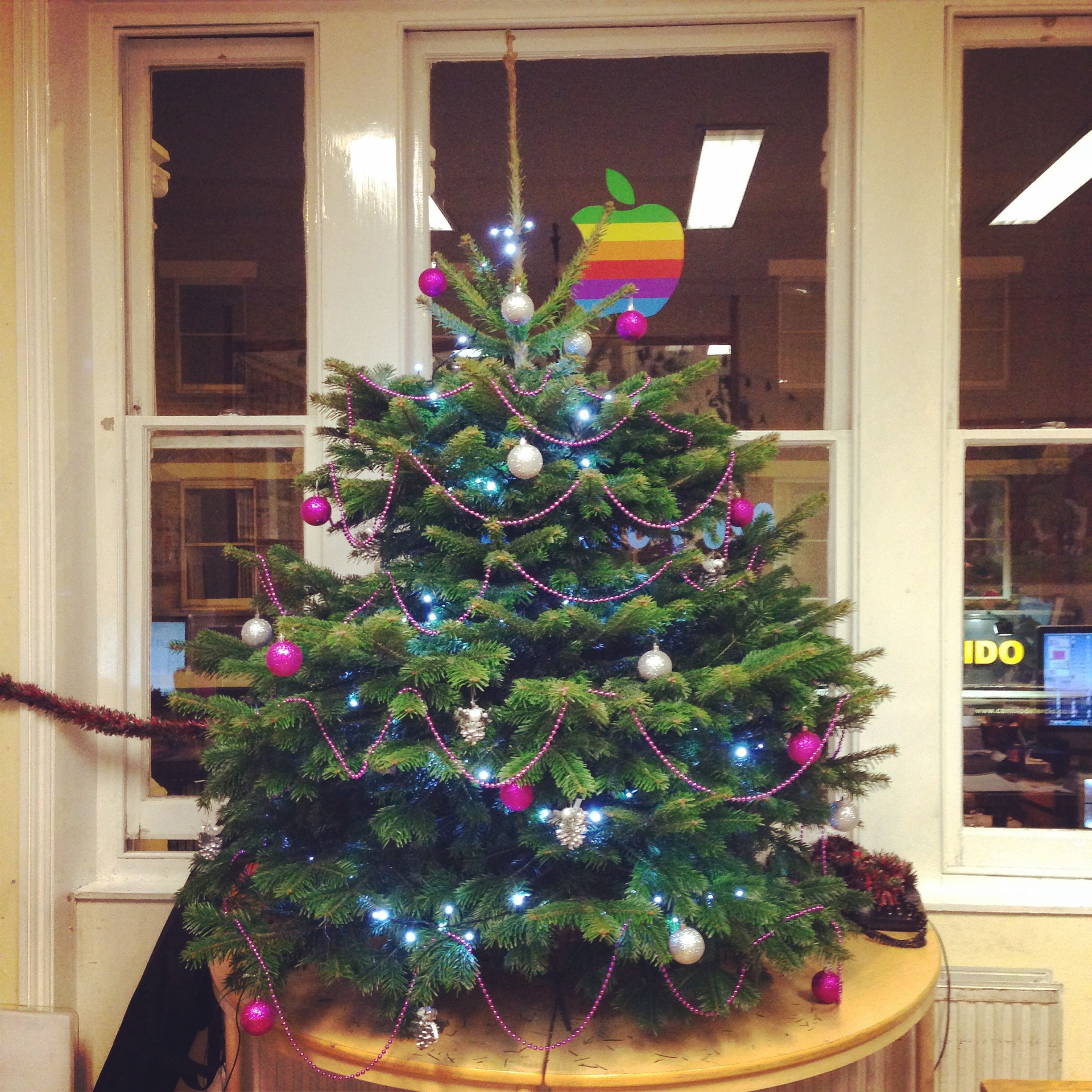
Do you have any Christmas tree traditions? Tell us about them on Facebook or Twitter.
Taking the Stress Test: how emphasis can change meaning
One of the hardest things to grasp when learning the English language is emphasis. Emphasising a different word in the same sentence, each time can completely change the meaning of it. Some people make the emphasis on a certain word very clear. This can give you the general feeling of the sentence.
Other times it can be harder to pick up the meaning of a sentence and this can lead to you misinterpreting what the speaker means. Emphasis is normally used when someone wants to convey how he or she feels about something; this could be something they feel emotional about.
For example my mum could say to me ‘you’re not doing that tomorrow’.
This could be her checking with me ‘you’re not doing that tomorrow?’ implying that I am, or might be doing it on a different day. However, it is more likely that she is saying to me ‘you are not doing that tomorrow!’ – using this emphasis would make it clear to me that there is no chance I will be doing whatever I wanted to do tomorrow.
Emphasis is used by:
- Stretching out the vowel sound.
- Pausing after the word that is being emphasised is spoken.
- Speaking slower when saying the word they want to emphasise.
- The first syllable is pronounced louder than the other syllables.
Try emphasising a different word in this sentence each time you say it.

‘She isn’t flying to Hawaii tomorrow’
- By emphasising the ‘she’ it implies that it is someone else that is flying to Hawaii tomorrow.
- The ‘isn’t’ shows that she’s not doing this anymore.
- Emphasising the ‘flying’ means that she’s not flying, she may be getting there another way instead.
- ‘To’ this could mean she is flying from or by Hawaii not to.
- Emphasis on Hawaii shows that it could be a different location, not Hawaii.
- Finally, ‘tomorrow’ could mean that it’s actually a different day, not tomorrow.
Isn’t it strange how one sentence can be used in so many different ways?
Alex
10 Years with the JLC – a Teacher’s story!
Here at EuroTalk we love hearing feedback from participants of the Junior Language Challenge! So when runner-up Aalaya Sanjeeva’s teacher Jackie Gliniecka from The Hawthorns School sent us this wonderful message about how she’s found being involved in the competition over the years, we had to share it with you 🙂
10 years ago, in 2005, we received a flyer from EuroTalk telling us about this competition, and we encouraged the children to enter it. It was an exciting adventure and we have repeated the experience every year since.
I remember so clearly, when we reached the semi-finals and I met Dick Howeson for the first time. His passion for languages and education, together with his compassion and drive to change the world, completely bowled me over; when talking about the competition to anyone and everyone who stands still for long enough to listen, I feel compelled to try and include a description of Dick. The best I can manage, to convey his wonderful energy, enthusiasm and gentle treatment of these young children combined with the fantastic difference that he encourages them all to make in the world, is a sort of cross between a kindly mad professor and a true saint! And what a fantastic team he has built up around him, too; Liz, who is always there to answer all queries in an incredibly efficient and kindly way so as to not scare the teachers and parents; Franco, who has the unenviable task of running the semi-finals and the finals with a rod of iron, yet maintaining a kindly, gentle, friendly demeanour so as not to scare the children; and countless others who make taking part in this competition a real joy.
Over the years, so many of my pupils have benefitted in so many ways from this wonderful competition; not only do they get the chance to try lots of different languages, thereby deepening their general knowledge of language and developing language learning strategies, but also it opens windows onto the world, helping to turn them into good global citizens, sowing the seeds that will encourage them, like Dick, to make a difference in the world. It is all done in such a gentle, fun way, encouraging independent learning, allowing the children to push themselves as far as they want to and at the same time helping the amazing work of the charities that the JLC support.
Aalaya has entered this competition 3 years in a row and has made the final each time. She was ecstatically happy to have come second this year and the whole school is so proud of her. This competition requires so much more than just the ability to acquire huge amounts of language in a very short space of time; you need a brilliant memory, a very cool head, nerves of steel, the ability to stay calm and focused and the faith to persevere under extreme pressure. What a brilliant set of skills to develop, and, although Aalaya has all these skills in bucketfuls, it has been so rewarding for me to see her develop and hone them enable her to achieve such a high standard in your competition.
The great thing is, though, as Dick always tells them, just to have entered makes them winners because of the good they are doing for others and the fun they have along the way!

Jackie (left) with Aalaya and her parents, alongside JLC champion Tudor Mendel-Idowu and fellow runners-up Cassandra Emmanuel and Isobel Eason
Look out for next week’s blog post to find out what second place finalist Aalaya and her mum Priya think about the Junior Language Challenge!
If you were part of the Junior Language Challenge in 2015 – or any previous year – and you’d like to share your story, please email us at jlc@eurotalk.com; we love hearing from our JLCers 🙂
Junior Language Challenge 2015 – The Final!
On Friday 16th October, our 33 Junior Language Challenge finalists came to London to battle it out to win the trophy. The children have learnt three languages during the course of the competition, with Portuguese being the first language, moving onto Mandarin for the semi-finals and Arabic being chosen as the final language.
All three heats at the final were extremely close, with several children having nearly perfect scores! Once all three were completed we paused for a lunch break, where a second competition took place… This year we decided to give the parents and teachers a chance to experience the JLC for themselves, and to see how they got on with the tricky Arabic language. This was as tense as the children’s rounds (with the parents obviously feeling pressure to do well!). It was clear to see many parents had been practising with their children, as some of the scores were amazing – congratulations to Sarah, who did brilliantly and definitely earned the bottle of champagne she took home with her!

The final round for the children got away and the top five places were constantly changing. Our resident evil genius, Franco, added to the suspense by keeping the top two scores a secret, so the winner wouldn’t be known right until the end. We were extremely lucky this year to have the winner of Channel 4’s Child Genius, Thomas Frith, to announce the winner of the JLC 2015….
Congratulations to Tudor Mendel-Idowu, the winner of this year’s Junior Language Challenge! Tudor gained over 300 points during the final round and won the top prize of a family trip to Malawi. This gives Tudor and his family the opportunity to see the excellent work that our charity, onebillion does there. Tudor, who like Thomas has been on Child Genius, has entered the Junior Language Challenge three times, coming third in 2013. “I’m very proud,” he told us afterwards. “All the hard work has paid off, because it’s been quite a long time! My favourite language this time was Mandarin, because I enjoyed the way it related to other languages I’d learnt before.”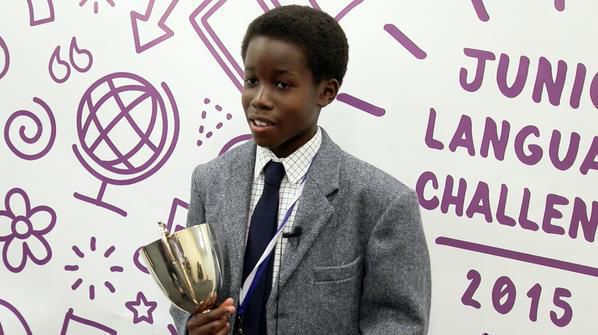
Tudor’s prize was awarded by 12-year-old Thomas, who knows exactly how he feels after winning Child Genius earlier this year. Thomas also presented a cheque for £5,545 to Andrew Ashe from our charity, onebillion. The money will go towards the development of a solar-powered projector for teachers to use in primary schools in Malawi.

Our runners up this year also did amazingly in the final, with Aalaya Sanjeeva who came second and Isobel Eason who was just behind in third. The final was an excellent example of how brilliant all the children who took part in the JLC are at picking up languages – and also of the importance of perseverance; our top three had all taken part in the JLC in previous years. Every one of the 33 children that made it to the final should be so proud; you were all incredible! So thank you to: Olivia, Severin, Benjamin, Andrey, Gavin, Farah, Ritisha, Leyah, Saskia, Isobel, Aalaya, Nithya, Cristina, Cassandra, Anais, Isabella, Laura, Jamie, Reuben, Lydia, Aurelio, Rona, Ethan, Abigail, Monisha, Ben, Benitto, Grace L, Grace B, Louis, Sumayyah, Emma and Tudor, for taking part and putting so much effort into the JLC!
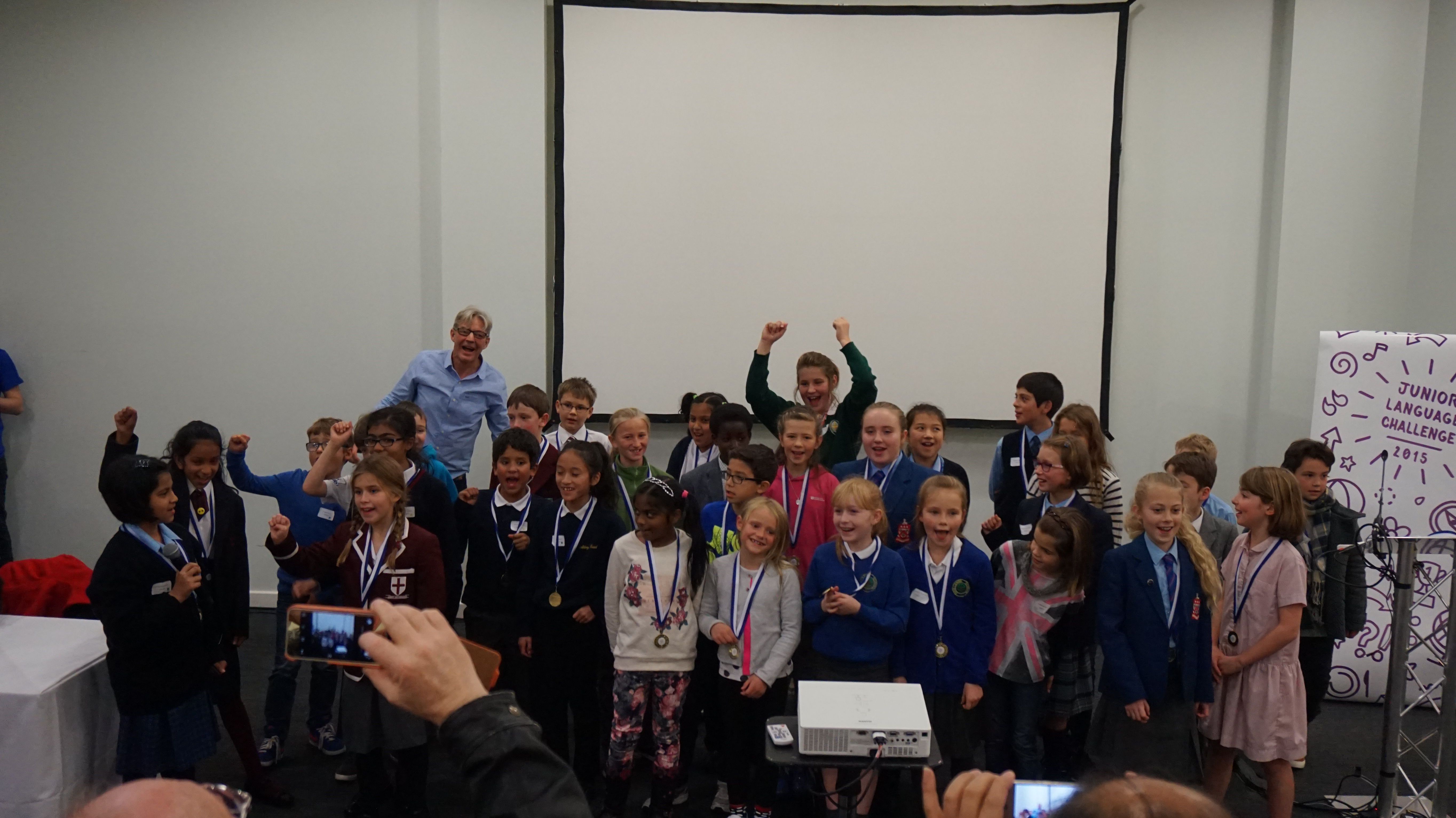
If you would like to know more about the Junior Language Challenge and how to take part in 2016, please sign up to our mailing list on the JLC website; you can also find out more about the JLC there too, or email us with any questions.
In the words of our brilliant guest, Thomas: “Languages are really important, they’re fun, they stretch your mind and let you talk to other people, which I feel is polite, rather than expecting everyone else to learn English.” We couldn’t agree more.
The JLC will return in March 2016 and we hope it’ll be bigger and better than ever!
