Innovative Language Learning Initiative for Haiti
Guest post by Sheri Colas-Gervais, Vice-President of the Le Flambeau Foundation
The launch of two new sets of language learning CD-ROMs has many excited. The new products are the result of a unique relationship between Le Flambeau Foundation – a U.S. non-profit organization providing educational programming and scholarships to youth in Haiti, and London-based EuroTalk. The new language learning CD offerings include the American English language learning set, which features special Haitian Creole help, and the Haitian Creole language learning set. Each set has five CD-ROMs. These are part of an innovative fundraising initiative designed to assist young people in Haiti to earn sustainable educational assets that will prepare them for the effective rebuilding of Haiti.
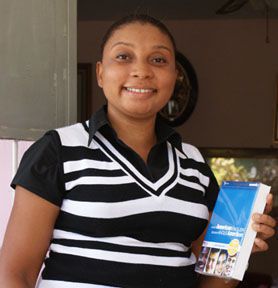 These CD sets are unique in a number of ways. The special feature of having the help guides for the English language learning CDs spoken in Haitian Creole offers a significant advantage to the many youth in Haiti who speak Creole but are not fluent in French. By reducing the number of steps, students are able to accelerate their English learning… and have fun doing it via the highly entertaining and engaging EuroTalk format. For young people in Haiti looking for jobs and for those aiming to attend higher learning institutions in the U.S., this advantage is invaluable. It opens the door to a whole new world. The Haitian Creole learning CDs offer similar advantages to a U.S. audience (and other countries) aiming to become fluent before visiting Haiti and making sustainable contributions. We are pleased to be working with the EuroTalk team on this initiative and applaud the commitment. Sending the next student to school on scholarship, resulting from the funds being raised via this initiative, is already within reach. The future is bright!
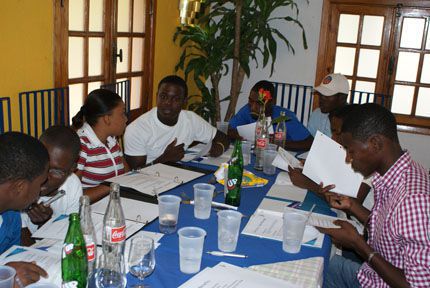
The Le Flambeau Foundation assists Haiti via Intellectual Infrastructure Development – the provision of a solid education foundation for the brightest youth and future leaders of Haiti. The Foundation serves as a portal providing the youth of Haiti with educational opportunities, such as college scholarships and preparatory programming, that will prepare them to rebuild and lead the country’s transition from poverty to prosperity, with dignity. Le Flambeau Foundation scholars have a track record of graduating in the top tier of their class, including a scholar who is now attending graduate school at Harvard University. The Torch is lit. We carry it forward and pass it on!
The special CD sets are available to youth groups in Haiti and in the U.S. and serve as vehicles for meeting educational and funding needs. For more information on getting involved or on purchasing these special CD sets, please contact Le Flambeau Foundation Inc. (www.leflambeau-foundation.org) at scg@le-flambeau-foundation.org, or call (001) 305.596.2819. EuroTalk is making a donation to the Le Flambeau Foundation for every CD purchased from this special collection. This is innovation in its best form, as the wheels are in motion for making a significant sustainable difference for the people of Haiti. Rebuilding moves forward.
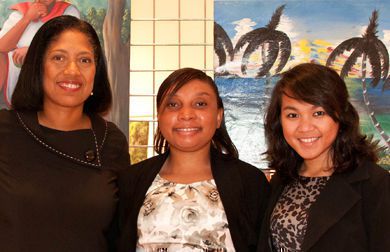
Example of a successful language exchange partnership which resulted in a student in Haiti receiving a scholarship. Both students remain involved and are excited about the new CDs, as these will increase access and accelerate the learning benefits.
There’s something different about this one…
I see myself as a moderately well-travelled person, having visited most of Europe, Hong Kong, Japan and the southern states in the USA. Many memories are made on each trip, whether they are about trying strange food, meeting friendly locals or even having the odd moment of hilarity – but one thing I always find is that confusion crops up about my ethnic appearance. I’m not even sure if it’s in a good or bad way.
I’m a British Born Chinese, speak English fluently and studied Spanish at university, so I am pretty comfortable with visiting most parts of the world. I don’t have any qualms about learning even more languages, if it helps me get by. But my appearance seems to evoke different…. responses.
 For instance, a short conversation while getting coffee at a gas-stop in New Mexico left a cashier confused when she said I (apparently) spoke like the Queen. Flip side to this: during a night out in Acuña, Mexico, a bartender was surprised to be able to talk to me in great detail about how film director Robert Rodriguez used his tavern to film a part of his feature Desperado, as I was the only one who could speak and understand Spanish – something that also helped make a complaint about a dirty and unmade hotel room in Las Vegas.
A weird occurrence was when a tourist wanted a picture taken with me during a visit with friends to the Carlsberg Museum in Copenhagen. The reason? He had never seen a Chinese person before.
Multiculturalism is growing everyday and so more people are becoming accustomed to different ways of life. But there are parts of the world that are not so used to ethnic diversity, and particularly given Asians’ distinctive appearance, seeing someone different walk through the door will always have that element of surprise. Even more so if that person can talk and understand you – that always raises a smile… or perhaps a furrowed brow.
Do you find yourself surprising people on your travels with your linguistic abilities? Or have you met someone who catches you unawares by conversing in your native tongue?
Katie
You look the same – you talk the same?
There is a never-ending stream of book-to-film adaptations. Those that quickly come to mind include The Shawshank Redemption, the Harry Potter series and the Twilight series.
One film that struck a chord is the 2005 film Memoirs of a Geisha. Based on the book of the same name by Arthur Golden, it depicts the tale of a young girl who grows up to be one of the most prominent geisha in Kyoto.
As a big fan of the book, I was curious as to how it was going to be made. However, I ended up being disappointed. I was confronted by a feature with three distinguished Chinese actresses in the lead roles, speaking English. The only Japanese native speakers had secondary roles, yet they were also speaking English.
From the initial news on its production, I envisioned the film to be a celebration of Japan – from its language to its culture. There was an opportunity to use undiscovered talent speaking Japanese, taking pride in a film about one of the most culturally significant aspects of their country.
The use of English may have increased the appeal and accessibility of the film but the fact that they used Chinese actresses to represent Japanese characters with English dialogue lacks originality. It is like a McDonalds film – it appeals to the masses with very little taste.
For this reason, I enjoyed Lost in Translation. You learn about different aspects of Japan – the culture, the country, the people – and most importantly, Japanese actors speak Japanese. So what if you do get lost in translation? That’s all part of the fun 🙂
So everyone, how do you feel about films with clashing cultures? Do culturally relevant films need English? Thoughts on a postcard (or in the comments!) please…
Katie
Lost in Translation – literally
A few weeks ago I wrote about my plan to get back into speaking Spanish regularly. First off, a confession – I haven’t actually spoken Spanish to anyone yet, but that doesn’t mean I haven’t been busy!
I’ve always been pretty fluent at reading Spanish. One of my proudest achievements is reading Lord of the Rings in translation – although I think I might be prouder of getting through the books (especially the end of the third volume, which, in my opinion, was hard work) than of understanding the Spanish. To be honest, a lot of the made-up words are the same or very similar – an orc is un orco, a hobbit is un hobbit… You get the idea. My point is, I still try and read books in Spanish quite often, and generally find I can read at much the same speed as I do in English. (My book club were impressed with me recently when I read our chosen novel for that month, Eva Luna by Isabel Allende, in the original Spanish – and was even able to have a semi-intelligent conversation about it.)
Unfortunately I can’t say the same for my writing, listening and speaking skills. I decided to start by tackling the listening, which has always been my main problem and is probably why I avoid conversation when I can. Spoken Spanish tends to be very fast and my poor, out-of-practice brain takes a while to catch up and process what’s been said. This generally means me standing there looking slightly baffled for a few seconds before formulating a response, which isn’t fun for anyone. To avoid that unfortunate scenario, I decided to start by watching some movies and TV shows in Spanish before I risked talking to real people. Yes, it’s a cop-out, but I felt I needed a little confidence boost before venturing out into the 3D world.

I started by watching Pedro Almodóvar’s 1988 classic, Mujeres al borde de un ataque de nervios (Women on the verge of a nervous breakdown), featuring a fresh-faced Antonio Banderas, who always brightens my day 🙂 It’s a very funny film, but with real emotions at its heart, so if nothing else it was an enjoyable 90 minutes. Unfortunately my copy of the movie has English subtitles which can’t be turned off, meaning I had to concentrate twice as hard to understand the Spanish whilst making a conscious effort not to glance at the bottom of the screen (which wasn’t always successful). But it didn’t go too badly and I was more or less able to follow what was being said, so, feeling a little better about my abilities, I decided to try a new challenge.
I don’t know about anyone else but I found the TV series Lost really confusing, and I still don’t completely understand what happened at the end (don’t worry, I won’t reveal any secrets, in case anyone hasn’t seen it yet – but if you can explain it to me, let me know!). So maybe deciding to watch it again in a different language isn’t one of my smartest ideas, but I figured it couldn’t be any more confusing in Spanish than it is in English. I also thought it would be a good place to start – I’ve seen all the episodes before, so I know the context, but not so recently that I can remember what the characters are saying. So far I’ve watched about six episodes and it seems to be going pretty well. I’m managing to follow the majority of the dialogue and my brain isn’t hurting too much, although it’s early days; I know when I reach season 5 I’ll struggle, as I can’t get my head around the concept of time travel in any language! In between episodes I plan to watch more films that are originally in Spanish rather than dubbed (top of my list is the fantastically random Jamón Jamón). It’s definitely encouraging to know that I haven’t forgotten everything I learnt at school and university, so I think the confidence boost is working.
In my next post, I’ll be writing about … er, writing. And perhaps (just perhaps) by then I might be brave enough to actually talk to someone…
Liz
Mysterious Albania
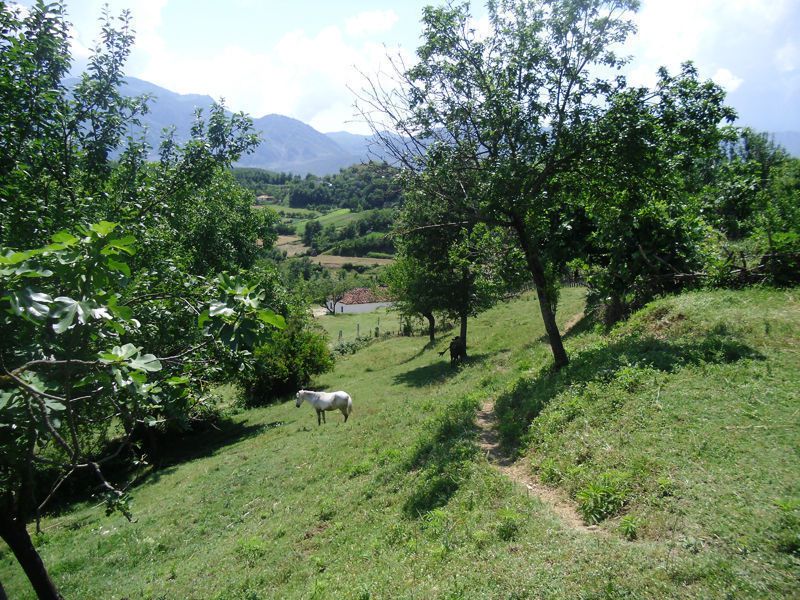 Nestled in the heart of the Mediterranean with Greece, Macedonia, Kosovo and Montenegro as its neighbours, most people still don’t know much about this amazing country. Influenced by the Greeks, Romans, Italian and Turks, Albania does have a long and troubled history. But since communism ended in 1992 and the Republic of Albania was founded, it has remained more or less settled and it was chosen as the top country in the Lonely Planet list of ten top countries to visit for 2011.
To be honest, when I first met my Albanian husband Remzi, nearly five years ago, I did not know much about Albania myself – and I still meet people now who are not even sure where it is and think it is run by the Albanian Mafia! But I have now been fortunate enough to visit seven times, I’ve met all of Remzi’s family and friends and experienced the warm hospitality of the Albanian people and the beauty of the landscape. You also feel very safe; I remember on my first visit in September 2006, Albania were playing the Netherlands in a friendly football match in the capital Tirana and we happened to be walking past when the Dutch team’s coach got stuck on the turning into their hotel. The players decided to get out and walk – there were no police or security around and they just casually made their way to the hotel entrance. Cars on the main road did not even slow down; it was all very bizarre but typically Albanian – they do not like to make a fuss.
We have spent time in the mountainous North (where Remzi’s family are from) and the scenery is breathtaking, but I am yet to go to the beautiful and still unspoiled beaches in the South along the Ionian Coast, which is known as the Albanian Riviera. There are quite a few historic sites to see, like the ruins of Krujë Castle where General Skanderbeg fought off the Ottomans in the 15th century, and the many Byzantine churches and cobbled streets found at Berat Castle.
I have to admit I was quite slow off the mark in trying to learn the language, being a typical Brit and expecting everyone to speak English. The younger generation do but the majority of the population don’t, so it has been quite a struggle trying to communicate with most of Remzi’s family. But two years ago I started working at EuroTalk so had no excuse not to use the resources readily available to me! And it made a real difference on my last visit in June, which was just as well as we stayed with Remzi’s parents for most of the week. I have now decided to go to evening classes in the autumn where I hope to improve further and meet other people in the same situation as me with an Albanian partner. I find some words and phrases easy but just the basics like hello (‘tungjatjeta’) and goodbye (‘mirëupafshim’) are a bit tricky. So hopefully by my next trip I will have improved enough to have a proper conversation with my in-laws and get even more out of visiting such a wonderful country.
Do you have a partner from another country? How have you coped with learning their language?
Lotta
