How do you learn a language? (Win an iPad mini!)
The survey and giveaway have now closed. Thank you to everyone who took part!
 Language learners! We need your help. We want to know the different method(s) that you use whilst learning a language to accomplish your goals. This will enable us to improve and adapt to what you want.
The survey only takes approximately five minutes depending on how much you want to tell us (we are hoping lots). To say thank you for taking up your precious time, we’ll enter you into a prize draw to win an iPad mini, pre-installed with our app, uTalk, in the language of your choice. There are several different ways to enter, the more you do the greater your chance of winning the iPad mini.
Thanks for your time 🙂
And please share the link with friends and colleagues too – thank you!

The giveaway ends at midnight on June 17th 2015 (UK time), and is open worldwide to anyone aged 18 or older. The winner will be selected at random and notified by EuroTalk within 48 hours of the closing date.
Quote of the week: 11 Apr 2015
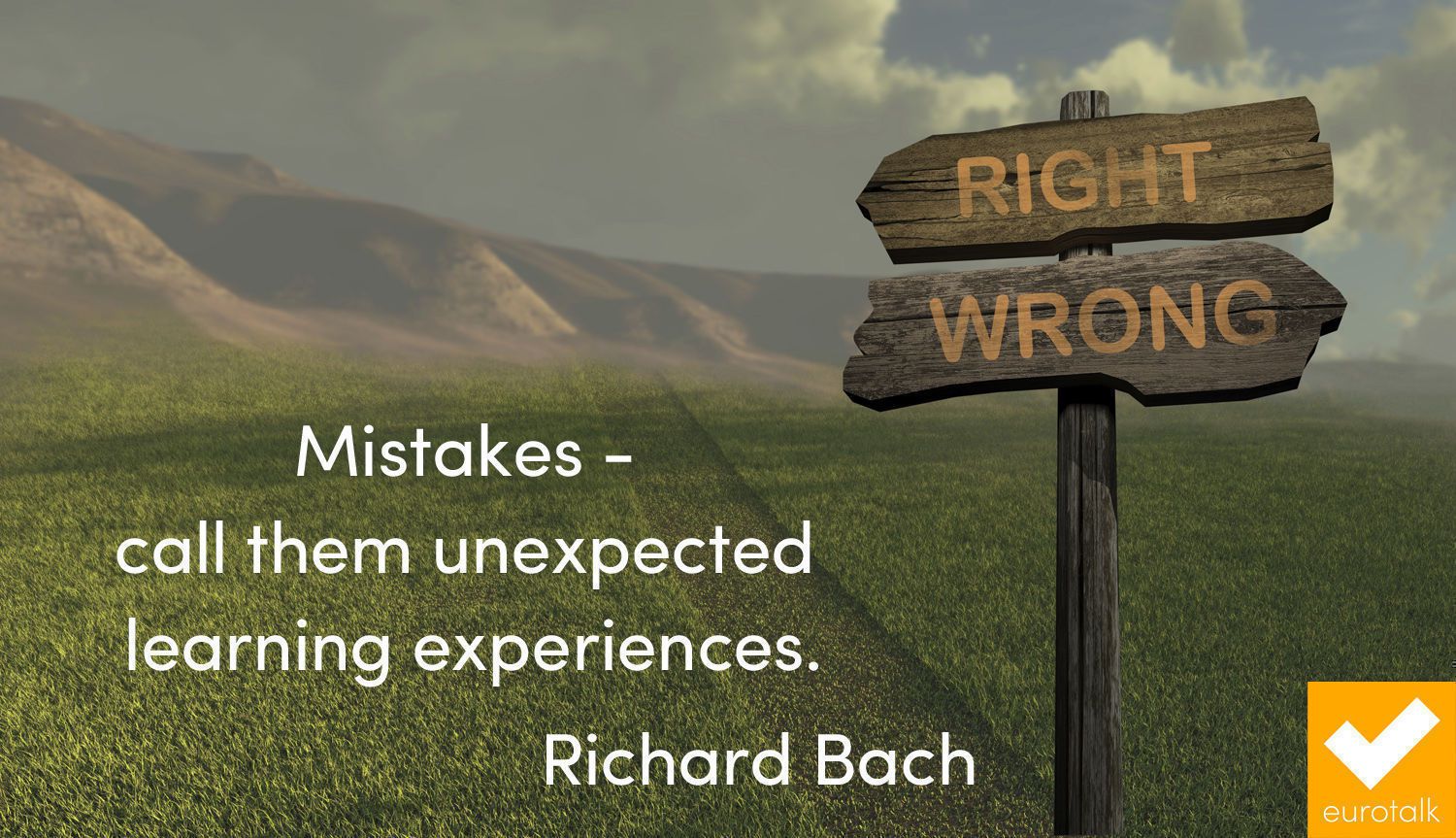
“Mistakes – call them unexpected learning experiences.” Richard Bach
 For more like this, find us on Pinterest or We Heart It.
Embed This Image On Your Site (copy code below):
A Language Journey
Today we’ve got a fantastic guest post from Kelly Wang – English teacher, accidental traveller, cake whisperer, dinosaur believer – on her personal language learning journey.
If you’ve got a language story to tell, we’d love to hear it! Now over to you, Kelly…
My journey through languages began in sequins and shoulder pads.
At the age of seven I remember clutching a Pot Noodle (Chow Mein flavour, if you must know), with an A4 pad in front of me and one of those 10 coloured pens ready and poised, waiting for the Eurovision Song Contest.
It has long been a tradition in my family to watch the Eurovision together, and to give marks out of ten to the acts. And at that age, I was of the opinion that English was the only language in the world, so my marking scheme would include whether or not the songs were in English. No English? Nil points.
I even took exception to the fact that each country when giving their own points spoke in their own language. How rude.
Fast forward to the last year of primary school and we learnt a few French words like bonjour and le livre and la fenêtre.
I still thought English was the best language.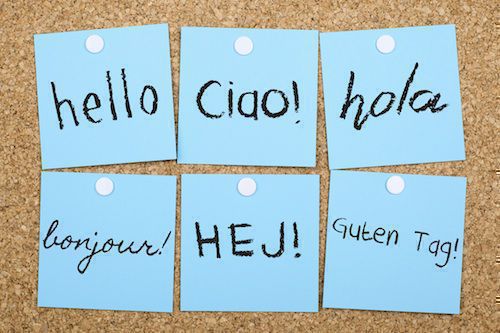
But then, on reaching secondary school, when we started to learn a ‘modern foreign language’ regularly (in my case, French), I loved it. I loved the idea of being able to speak to everyone, no matter the language. And better than that, I was picking it up pretty easily.
The following year there was a repeat performance with learning German, and I remember a sort of teenage arrogance of thinking that languages were going to be ‘my thing’, because by the time I was sixteen I could also say Θέλω να πάω σπίτι in Greek – Thélo̱ na páo̱ spíti (I want to go home).
Over the years I’ve flirted with a lot of languages. I tried Chinese for a while, but with the complicated tonation, I was more worried about causing offence with the way I said a word, and less worried about actually stringing a sentence together.
And then, I found my true language love. The one language I could lose myself in and spend hours learning just for fun. The one language I would squeal over if I heard it spoken in public. Which is Finnish. Naturally.
Finnish may sound like an odd choice, but it made perfect sense to me. What started with a passing interest listening to Finnish metal music erupted into a bit of an obsession when I found myself frustrated that I couldn’t understand the Finnish ice hockey commentary.
For almost two years, Finnish became my number one hobby. Being relatively self-disciplined when it comes to studies, I decided to learn through a mix of self study and online language exchanges. Many an adventure was had along the way, and that perhaps is a story for another time, but I loved it. No prepositions to learn because everything was a suffix, and by changing the word ending you could say a whole range of things about it: saunassa, saunasta, saunan (in the sauna, from the sauna, for the sauna). No articles, no need to wonder if your table was a girl and your chair was a boy, it didn’t matter. Neither did you have to refer to a person as he or she, one simple han and it was covered! Beautiful.
Fast forward another year, and I found myself attempting to get to grips with Hungarian. Now for those of you who don’t know, Finnish and Hungarian are cousins of the language world, and it depends on which scholar you speak to as to how close a family they are. My experience was that whilst it sounded an awful lot like Finnish, Hungarian was nothing like it at all, except for the odd words like toilet: Hungarian – vécé, Finnish vessa.
And currently, I find myself in Spain. Adamantly not learning the language.

Because the problem now, with being a ‘jack of all trades, master of none’ when it comes to language, is that they all get tangled up. A waiter asks me if I want a refill, I answer in a mix of Spanish and Hungarian. I overhear staff in my local Chinese supermarket and confuse them – and myself – by responding in Chinese rather than Spanish. And recently on a stopover in Paris, I managed to respond to questions in French but found myself asking questions in Finnish.
What I really could do with is a babel fish. Or to live in the TARDIS. Unfortunately, I am in the wrong reality for that. But. I still love languages.
So. I don’t know what the foreign language for me is going to be. Should I return to French, attempt to master Finnish, or take up something new like Dothraki? Or will that lead to more unnecessary tongue twisting? I just don’t know. Would you like to join me on my journey?
Kelly
8 ways to remember new vocabulary
Let’s start with a bold statement: everyone is good at languages.
I know lots of people are probably disagreeing with me right now. But the fact is, we all learnt our own language, so technically we should be able to learn another one. Right?
Of course there are lots of elements to becoming fluent in another language. Grammar. Sentence construction. Tones (for some languages). Perfecting your accent. Reading. Writing. Learning colloquial expressions. I could go on.
But let’s start at the beginning. Before you tackle any of this daunting list, you need to learn some words, or you’ll never get anywhere. And for a lot of people, a little bit of vocabulary is often enough to get by with – I survived a weekend in Naples with just a handful of essential Italian words, like ‘please’, ‘thank you’, ‘water’ and ‘cake’. (What do you mean, that’s not an essential word?)
And having spent January learning German with the uTalk app, I now feel like I could at least make myself understood in a restaurant, a shop, the hospital – although let’s hope that’s not necessary! – and I also know how to buy a train ticket or ask for the nearest cash machine. I might be far from fluent, but this is a big step for someone who knew no German at all a little over a month ago.
So, learning vocab is important. But what happens if you’re not very good at remembering stuff? Another language can look pretty terrifying at first, particularly if it’s one that bears no resemblance at all to your own. So here are a few tips for memorising new words.
The facial expressions are optional…
Start with the basics
This probably makes sense anyway – why would you learn how to say ‘Do you prefer reading or TV?’ before you’ve figured out ‘Hello’? But it’s amazing how much of a boost it is just to have a few simple words under your belt. That way, you know at the very least, you can greet someone in their own language, even if you don’t know how to say anything else.
Take it a bit at a time
Don’t try and learn everything at once. Even if you remember it at the time, by the next day your brain will almost certainly have rebelled and forgotten it all. So break it down into topics, and focus on one a day, or a week – whatever works best for you – remembering to come back to it at regular intervals to revise and make sure it’s all still in there.

Try to link it to a memory
When I find myself in a real-life situation, I try to think of how to describe it in the language I’m learning. The other morning, for example, when my train was delayed, I amused myself by remembering how to say it in German. (Yes, I’m that cool.) And now when I think of that phrase, it springs more readily to mind because I can imagine shivering on the station platform, waiting for a train that may or may not show up. It did… eventually.
Associate words with images
Another good tip – try and link words to an image or object in your mind, as it makes them easier to recall later. Even better, stick notes on things you see every day, so that when you need the word you can visualise the object with its translation attached.
Make it a game
This could be a game against someone else – see who can remember the most words, you or your friend – or against yourself, but it’s amazing how effective it can be at hardwiring the vocabulary into your brain. And the best bit is you don’t even need to win the game to be successful… The memory game in uTalk is notoriously difficult, particularly if your memory isn’t the best. I struggled with the fruit and vegetables sections, for some reason; I just couldn’t remember where they all were when the cards were covered, and after the tenth attempt, I was ready to throw my phone across the room. But by the time I was done, I knew all the names of the fruits and vegetables forwards and backwards, and can’t see myself forgetting them any time soon.

Try and connect it to your own language
Even if the language you speak every day is completely different to the one you’re learning, use your imagination. For ‘I had a good time’, which is ‘Mir hat es sehr gut gefallen’ I found the only way to remember it was to think of it as ‘my hat is very well fallen’. It makes no sense, but it works for me!
Talk to other people
Sometimes, telling someone else how to say something can help to cement it in your mind, even if they have no idea what you’re saying. I’ve been cheerfully saying random German words to my startled family and friends for a month now, and although most of them have no idea what I’m talking about, it helps me to say the words aloud to someone other than myself.
Study before you go to sleep
I don’t know if this will work for everyone, but I found it was quite effective. By revising the vocabulary at night before I go to sleep, I find it’s fresh in my mind when I wake up. Probably not recommended if you have trouble switching your brain off at night (not something I have a problem with, clearly).

Does anyone have any other tips for remembering vocabulary?
Liz
My uTalk Romanian journey so far
Having a look at the uTalk challenge scoreboard in the EuroTalk office, it looks like I’m some way behind with my Romanian learning. But I haven’t give up yet! Here’s what I’ve learned so far about this language.
1. It’s a lot like Italian
This is very helpful for me, as I already understand a reasonable amount of Italian (even if it’s only from watching too many episodes of Inspector Montalbano…), so words like ‘la rivedere’ (goodbye, like the Italian arrivederci), ‘buna seara’ (good evening, like buona sera in Italian) and many colours and adjectives are very similar (‘urata’, ugly, sounds like the Italian word brutta, and many others like ‘plin’/pieno, ‘trist’/triste, ‘rapid’/rapido, ‘negrul’/nero or ‘verdele’/verde). Numbers are also very close to those in Spanish or Italian.
2. Sometimes you can make words just by adding ‘ul’ to the end
Ioana helpfully informs me that this is just the masculine ‘the’ (the feminine is ‘le’), but it still seems like a reliable strategy to guess words. After words such as ‘trenul’, ‘aeroportul’, ‘pasaportul’, ‘doctorul’ and my personal favourite ‘biscuitul’, I started guessing other words like ‘vinul’ (correct!) and ‘mapul’ (sadly incorrect), which occasionally works.
3. The speaking game is really fun and addictive, and probably the best way to learn
I don’t know about other people, but for me, producing the language is the key to remembering it. So, speaking or writing the language is key. Repeating the phrases and then using my own recordings to identify the pictures is weirdly fun and helps me to remember better than simple guessing of pictures in the easy or hard games, which encourage recognition but not reproduction. Of course the ultimate test is the recall game, where you have to remember and say the word or phrase yourself and then check it. These games can take a while to get 100% on, but are an excellent tool.
4. You have to learn to make some brand new sounds
Romanian has a few fun letters that we don’t have. ‘â’ (with a little hat) sounds like an ‘uh’, not an ‘a’ at all. So ‘Cât e ceasul?’ (what’s the time) isn’t pronounced how it looks to English speakers, but like ‘Cuht e chassul’, because the â is a different letter, and ce is a ‘ch’ sound like in Italian. It also has a funny ‘I’ which looks like this: î and sounds like another ‘uh’, which is difficult to describe. This sound is in words like ‘închis’ (closed) which sounds more like ‘unkees’. These sounds are pretty fun to pronounce if you ask me, and Ioana says I sound ok, which I put down to repeating after the native speakers in uTalk.
5. They invented crazy words for vegetables that make no sense!
Ok, maybe that’s a bit harsh, but my knowledge of French, Spanish, Italian, English and German can’t help me when it comes to learning the names of vegetables that have names like ‘bamele’, ‘ardeiul’, ‘porombul’ and ‘varza’, which don’t relate to any language I know. They can’t even call zucchini zucchini: it’s actually ‘dovleceii’.
Somehow I don’t think I’m going to beat Nat in the uTalk challenge, but I’m having fun with Romanian anyway!
Alex
(Editor’s note: it turns out nobody could beat Nat, who completed the challenge in Icelandic a couple of days ago. She’s now considering which language to learn next – any suggestions?)
