How do you choose which language to learn?
Everyone’s always talking about how useful it is to speak another language – and they’re right, for so many reasons. There’s lots of advice too on how to get started and how to stay motivated when it gets tough. But the first question any aspiring language learner should ask themselves is, ‘Which language do I want to learn?’
Sometimes this is easy, because you’re moving to another country, or you’ve met a new partner who speaks a particular language. Even if this means you end up learning a language most people would consider unusual, to you it has a purpose and that makes it anything but obscure.
But what if you’ve just decided you want to learn a language, because you’ve heard that people with a second language earn more, or that learning a language makes you cleverer, and don’t have a particular one in mind?
 At EuroTalk, we offer nearly 140 different world languages. It’s a pretty daunting selection to be greeted with when you’ve just Googled ‘I want to learn a language’ and stumbled on to our homepage, or downloaded the uTalk app. And that doesn’t even come close to the total number of languages spoken in the world. So how is anyone meant to choose one to learn? Do you just close your eyes and point at one?
Well no, we don’t recommend that approach; you could end up with something really fun that way, but at the same time, learning a random language just for the sake of it, when there’s very little chance you’ll ever get a chance to speak it, seems a shame. Half the fun of learning a language is getting to share it with other people.
So here are our recommended criteria for choosing a language:
Number of speakers
Generally, a language with more speakers is going to be more useful to you, because you’re going to have more opportunities to speak it. According to Ethnologue, the top five most spoken languages in the world are Chinese, Spanish, English, Hindi and Arabic, with a total of 2.4 billion speakers between them, so knowing one of these languages is going to guarantee you lots of people to talk to.
On the other hand, it depends on your reasons for wanting to learn a language. If it’s to make friends all over the world, one of these five languages will stand you in good stead. But if it’s to improve your employment prospects, bear in mind that you might face more competition if you’ve chosen a popular language. I studied Spanish at university, which is in great demand with employers. But so did lots of other students. We’ve got five people who speak Spanish at EuroTalk – two of them are native speakers (there are less than twenty of us in total, to put that in context) so it’s rare for me to be called on to use my language skills. Something like Portuguese or Japanese, which are still in the top ten in Ethnologue’s list, might offer fewer opportunities but when one comes along, you’re probably not going to face as many rivals for the job.
Where it’s spoken
Another important factor. Firstly, you don’t want to learn a language that’s spoken in a country you never intend to go to, or in which you’ve no interest. Secondly, some languages, like French, Arabic or English, are spoken in many different countries. So if you’re going travelling and want a language you’ll be able to use in more than one place, one of these will be more useful to you. But if travel’s not top of your agenda, this might not be such a big consideration.
Similarity to other languages
Most world languages are organised in families, which means they come from the same root as the other languages in that family. This means often, although you may only speak one language, you can probably at least make yourself understood in another. Hindi and Urdu, for example, are mutually intelligible, as are Czech and Slovak. If you know Spanish, you can make a reasonably decent attempt at Portuguese or Italian, and although you might make a few mistakes, chances are you’ll be understood. I’m not suggesting you should go around speaking the wrong language at people, but if you do make an honest slip-up, or just can’t think of the right word, you’ll probably be ok. I’m fairly sure I spoke quite a bit of Spanish when I was in Italy earlier this year, but everyone seemed to understand what I was getting at.
Some languages, though, don’t have any close neighbours, or indeed any neighbours at all. Basque, for example, is what’s known as a language isolate, as is Korean. This means they don’t belong to a family, but stand alone, so if you’ve chosen one of these languages, it’s worth remembering that it won’t help you with any others.
Your interests
Partly, this is to do with your travel interests. If you’ve a particular interest in Russia, for example, we’d recommend you learn Russian. But even if you’re not particularly interested in travelling, there are other things to consider. Are you a fan of opera? Maybe give Italian a go. Anime? Japanese. Star Trek? Klingon.
Or maybe you’ve got a particular interest in endangered languages, in which case you might want to learn Cornish or Sardinian, not necessarily for the wealth of communication opportunities it offers, but to help save a valuable world language from extinction.
Your commitment
You know yourself better than anyone. How motivated do you feel? Is this just a passing whim that you’re likely to give up the moment it gets difficult, or are you prepared to stick at it? The fact is, some languages are harder than others, and this is different for everyone, depending on your native language. For Europeans, Dutch is considered quite an easy language to learn, while Mandarin Chinese is very difficult. But someone living in Japan may find Chinese much easier to learn than any European language.
So if you’re living in Europe and intending to learn Mandarin, you’ll need to be pretty dedicated. And if you know you don’t have it in you, it might be better to try something else rather than face disappointment when it doesn’t work out. Nobody’s bad at all languages – you just need to find the right one for you.
If you’re still undecided, and in need of some inspiration, take our quiz – it’s not at all scientific, but might give you some ideas!
Or even better, why not try a few out? You can do this for free on our website, or by downloading uTalk for iOS.
If you have any other tips or suggestions for readers trying to choose a language, please share them in the comments.
Liz
Which language are you learning? The results!
We had a great response to our recent language learning survey; thank you to everyone who took the time to complete it. First things first: we’re delighted to announce that the winner of the iPad mini prize draw is Konstantia Sakellariou. Congratulations, Konstantia – your iPad is on its way!
We wanted also to share a few of our findings with you. Some of the results from the survey were as we expected, others were quite surprising. Here are just a few of the things you had to tell us. Thanks again for all your thoughtful responses, we’ll put them to good use.
Which language(s) are you learning (or would like to learn)?
The first question was pretty straightforward. A couple of people ticked every language on offer (over 100) – now that’s what we call ambition! – but most chose between 1 and 5. Here are the top ten most popular languages: 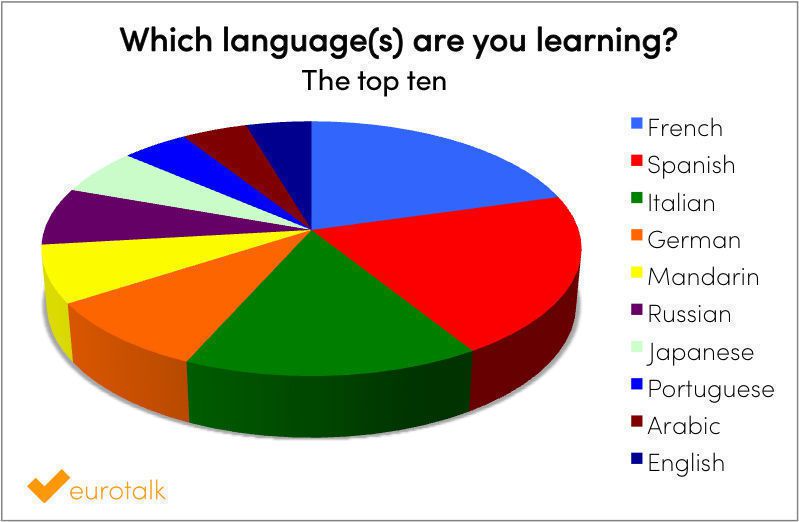 Other popular choices included Greek, Swedish, Dutch, Brazilian Portuguese, Norwegian, Irish, Polish and Icelandic. We also got some requests for languages we don’t yet offer, like Guernésiais and Twi – we’ll do our best to add those languages to our list, so watch this space!
Why are you learning a language?
Next, we wanted to know why you’re learning a language. Nearly half of the respondents chose travel as a reason, and almost as many said they were learning a language just for fun. 36% of respondents said it was for family reasons or for a relationship, and 27% for work. The results were quite evenly split though, showing that there’s no one overwhelming reason – everyone has their own motivation. 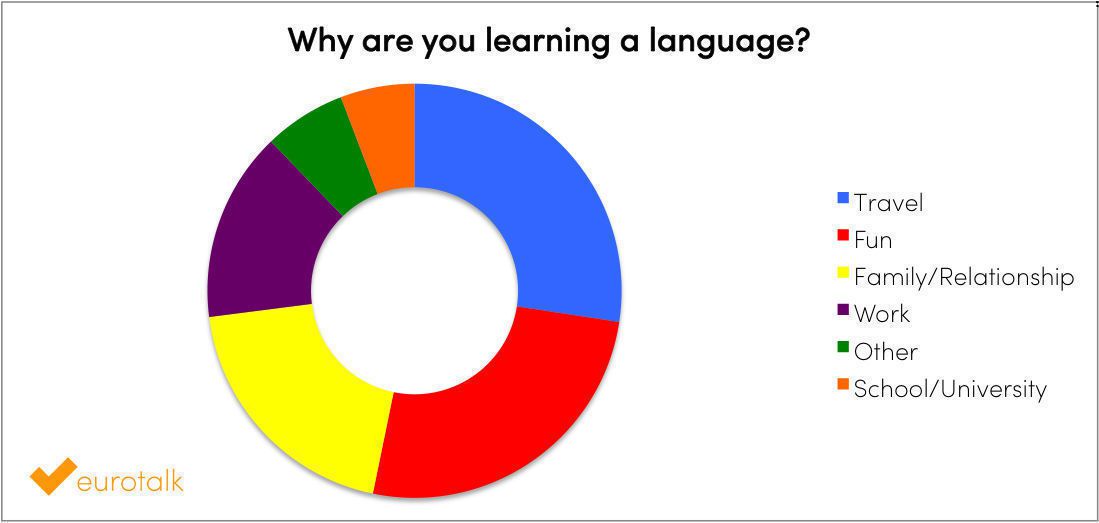 Among the other reasons, we had a range of answers, including an interest in the culture of the language, personal challenge and wanting to follow literature, film and music in other languages. Many people are living in another country, which was their main motivation for learning the local language. And one person said that their heart asked for the knowledge, which we loved 🙂
What prevents you from learning a language?
We were also interested to know what stops people from learning a language, so we asked you to rate the following reasons out of 5. The most common barrier to learning is a lack of time, followed by not having found the right method, and then the cost involved. 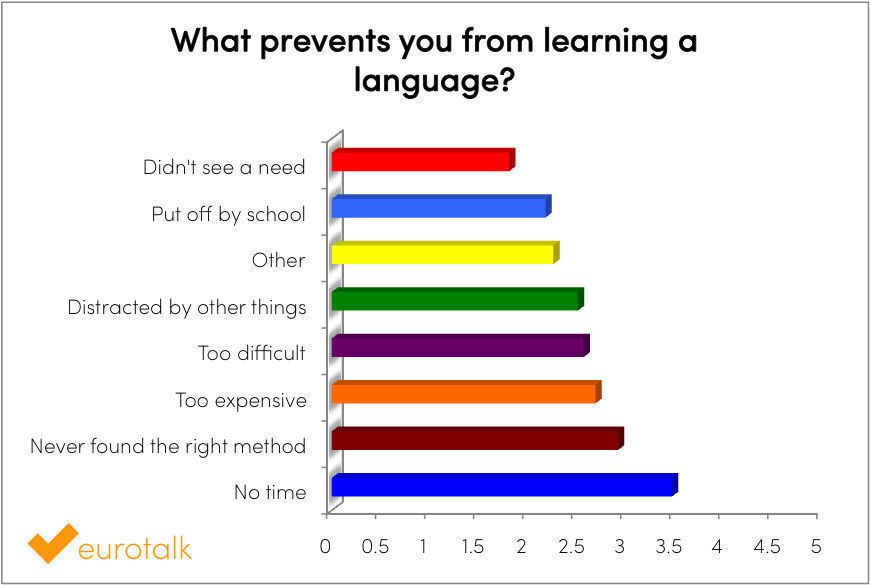 Incidentally, if you’re facing any of these barriers, you may like to check out our recent posts, on finding time to learn a language and learning on a budget. And if you’re looking for resources, did you know you can try out the EuroTalk learning method for free? Either visit our website, or download our free app, uTalk for iOS, to give it a go. We believe learning a language should be fun, because our research shows we learn much better if we’re enjoying ourselves, and this in turn makes it a lot easier to overcome the obstacles that get in the way. See what you think! Other answers included not having an opportunity to use the language, a lack of motivation and difficulty finding resources for the particular language they wanted to learn (we may be able to help there – we’ve got 136 languages and counting…).
How have you used your language when travelling?
Finally, we asked how knowing another language has been useful when you’re travelling. There was no clear winner here, which just goes to show knowing a language is always useful! But the top response was that it gives you the ability to talk to locals in their own language; many people added that they felt more welcome as a result and that it gave them independence so they could make the most of their trip. There were lots of practical reasons too, with getting around and eating out narrowly beating shopping in the poll.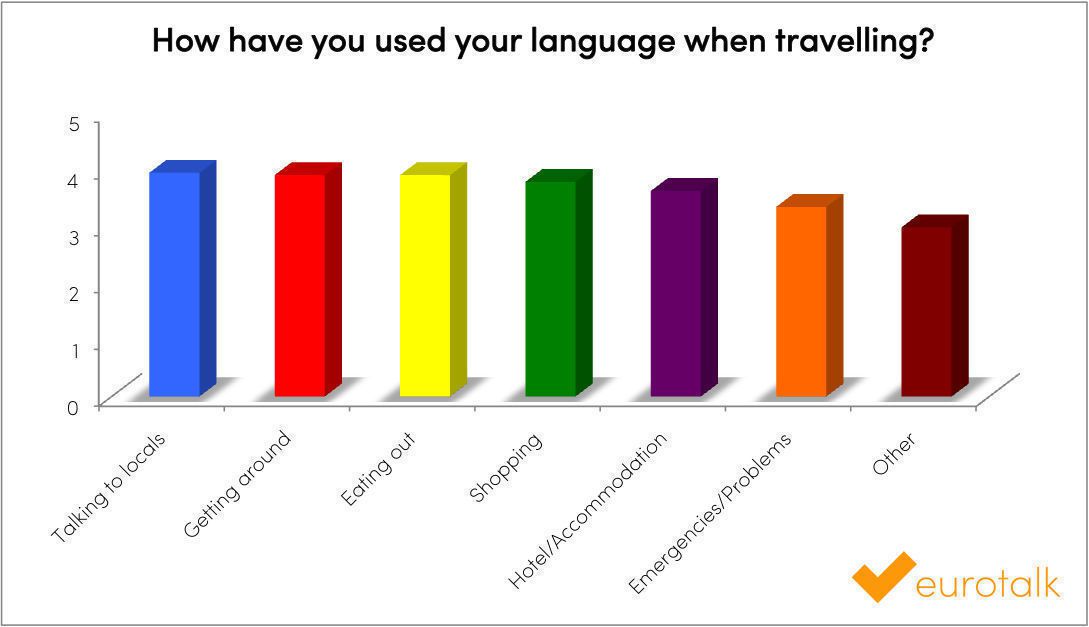 If you missed out on the survey this time, don’t worry – we’re planning another one soon, so keep an eye on the blog (you can subscribe by email above to get the latest updates), or follow us on Facebook or Twitter. And if you didn’t answer this survey but would still like to have your say on any of the questions, you’re very welcome to email us or add your thoughts in the comments below.
Liz
Data above based on 877 survey responses.
Quote of the week: 19 Jul 2014

For more like this, find us on Pinterest.
Embed This Image On Your Site (copy code below):
Learning Mandarin: Never call your mother a horse, and other tips
Cameron’s spending a couple of weeks with us here at EuroTalk for work experience. In today’s blog post, he explains why he chose to learn one of the world’s most difficult languages, and gives his suggestions for anyone who’s thinking about taking up the challenge.
Are you learning Mandarin? What drew you to the language? And do you have any tips of your own to share?
 Mandarin is recognised as one of the hardest languages to learn in the world, but with great difficulty comes great reward, as Mandarin is also one of the most useful languages in the world. Mandarin is so useful because it is spoken by almost 15 percent of the earth’s population natively, which is almost 1 billion people, and this figure does not include non-native speakers like myself. Also, China is one of the economic and industrial giants of the 21st century, and it’s still growing. Therefore Mandarin is very useful if you want to do business with the people involved in the global superpower that is China. As well as the practical reasons, Mandarin is also a great language to learn for cultural reasons, because, as you probably know, when learning any language, the culture of that country comes hand in hand, and China has a fascinating culture with a rich history.
Furthermore, if you learn Mandarin, that adds an extra incentive to make a trip to China to practise your newfound passion, and what’s a better way to spend your holidays than walking the great wall of China or paying a visit to the Terracotta Army? Additionally, if you’re the kind of person who relishes a new challenge, Mandarin is the perfect language for you, because, as I previously stated, it’s one of the hardest languages to learn in the world. On top of this, Mandarin will also appeal to you arty types out there in the form of calligraphy; this is a form of Chinese writing that involves painting the characters onto special paper called Xuanzhi (宣紙).
The most important thing to remember when learning Mandarin is not to get overwhelmed by the vast number of characters in the language; in fact I wouldn’t even worry about characters until you become more advanced in the language. Instead, begin by focusing on the oral side of the language, in particular, the pronunciation of words. In Mandarin pronunciation is key, for example, the word ‘ma’ can be said in four different ways and means four different things, so be careful not to call your mother a horse by pronouncing this word wrong!
A good thing to use to mark your progress of learning Mandarin is the HSK exams. These exams are held once a month and there are numerous different levels to work through, ranging from beginners exams to exams for people who are almost fluent, as well as the added bonus that they are recognised qualifications throughout China.
Good luck!
Cameron
If you’re interested in learning Mandarin, you can get started completely free with uTalk for iOS. Enjoy!
Quiz: Which language should you learn?
Want to learn a language but not sure which one to go for? Try our new quiz for inspiration…
Did you get a good one? Tell us what you think in the comments, and don’t forget to share with your friends to see if they get the same!
And if you’re still a bit undecided, download our free uTalk app for iOS and try out 111 different languages, to see which one you like 😉
