The benefits of exposing younger children to multiple languages
Today we have a guest post by Stephen Thomas, on behalf of Pearson PTE, on why it’s important to expose children to other languages at a young age.
Why expose children to other languages?
Communication is fundamentally part of what makes us unique organisms on earth. The way that we have developed language to exchange concepts, ideas, narratives and so on with sounds that are culturally recognised to the degree of complexity we have, is distinctive and unmatched by any other organism.
Clearly then, learning a language reaps obvious benefits: we can learn and understand new things with ease, retain ideas throughout decades, make each other laugh and cry, discuss, debate and develop the most fundamental questions of philosophy – all through using just one language. So aside from the want or need to communicate with speakers of a different language, is there any benefit of being bilingual or raising children that are bilingual? Well, Pearson PTE spoke with Dr Catriona Morrison, senior lecturer in psychology at The University of Leeds who advised that there is evidence to support the notion that merely exposing children under the age of five to other languages has benefits, regardless of whether or not they become bilingual.

Between the age of 3 and 6 is a vital stage of childhood in terms of language learning and development. The malleable mind of a child
at this age is like a sponge and Dr Morrison advises that “after the age of five, it is highly unlikely to acquire the mother tongue of a language if it is not yet already acquired”. Although in later childhood or adult life we may learn a new language, we can be sure that we do not learn it with anything like the same ease that we would as a child. After this crucial point in child development there begins a change in the human brain that effectively shuts down the ability to ‘naturally’ learn language. Of course that doesn’t mean you can’t learn a language in adulthood, but if you have, I’m sure you will agree that it is much more difficult in contrast to a truly bilingual person (who learned two languages before this crucial stage) whereby the two languages are seamlessly managed within the brain as though they were one.
Beyond the communicative advantages, research suggests that bilingual children have better capacities for storytelling and interpretation. The processing of information seems to happen at a deeper level and they will think through and into the story more. So for example, statistically if we were to take a group of monolingual children and a group of bilingual children and tell them a story, when we ask them to recount the narrative and characters, the bilingual children will show evidence of deeper understanding and a higher level of information processing.
Furthermore, Dr Morrison suggested that bilingualism seems to act as a preventative mechanism against the onset of dementia or Alzheimer’s disease. Although it will not create immunity and one may still fall to the condition, statistically if it is going to happen it will happen later in life, when compared to monolingual sufferers. In layman’s terms this could be because one is using more of the brain when accessing two or more languages and thus the brain is more active, and an active mind is a healthy mind.
How can we help children to discover languages?
So if you are a monolingual parent and you see the benefits of bilingualism in younger children, how should you go about helping your child? Realistically, a child of monolingual parents isn’t going to become bilingual, even with partial immersion in other languages through accessing foreign television radio or sending them to a nursery that caters for multiple languages. This is why Dr Morrison agrees that it is such a tragedy that the UK’s schooling system doesn’t introduce children to other languages as it is at this vital time of youth that we have the change to expand their minds in a way that isn’t possible at any other stage of life.
However, this doesn’t mean that the exposure is pointless or irrelevant: “I have a lot of faith in the idea that the more languages a child is exposed to, the better,” says Dr Morrison. Part of what makes language learning hard is that a new language draws on an entirely alien phonemic inventory to what we are used to hearing. When we try to listen to and learn these sounds, our brain simply isn’t accustomed to hearing them. So there is definitely a benefit for parents endeavouring to expose children to these sounds that they would otherwise be starved of and therefore selectively excluded from the brain; absolutely do allow your children to watch foreign TV shows or listen to internet radio form other countries and if possible encourage human interaction with your child and other language speakers. This will only help and bolster their learning and development.
Stephen Thomas
If you’d like your children to start learning a language, why not try our Vocabulary Builder program? With its colourful characters and fun games, it’s a great start for young learners – and it’s available in over 100 languages.
Business or pleasure – it makes no difference
In an earlier post, I talked about the importance of learning a little bit of the local language before visiting another country. Not only is it the respectful thing to do, it also saves you from embarrassing misunderstandings or spending your entire holiday communicating through pointing and exaggerated mimes.
A few years ago, I visited Lithuania for a weekend. It was for a one-off sporting event and was therefore likely to be my first and last time in the country. I didn’t need to become fluent in Lithuanian, but thought I should make an effort (particularly given where I work!) so I spent a bit of time using Talk Now before I left, learning the words for ‘yes’, ‘no’, ‘hello’, ‘thank you’, ‘hotel’, and a few others. This allowed me to greet people, explain to taxi drivers where I wanted to go, and thank the staff in restaurants and shops in their own language. It wasn’t a lot, and there was still some pointing and gesturing required, but I felt better about myself and the locals seemed to appreciate my efforts.
I recently learned the story of how the idea for EuroTalk came about. One of our founders, Dick Howeson, was on a business trip in Hungary, waiting for a flight. He desperately needed to use the bathroom, but unfortunately, instead of pictures, the airport had used the words for ‘male’ and ‘female’ on the doors. This was a small problem for Dick, who didn’t speak any Hungarian, and had no way of knowing which was which. Unluckily, the airport wasn’t very busy at the time, and he had to wait twenty minutes for someone else to come along, so he could see which door they used.
 At the time, a lot of people had been asking Dick for a language program specifically for business people, but his experience in Hungary made him realise that those travelling for work needed to start with the basics just like everyone else, rather than going straight to learning the words for ‘invoice’ or ‘contract’. That’s why EuroTalk software starts by teaching you the essential first words you need to get by – including ladies’ and gents’ toilet!
Our newest iPhone app, uTalk, is based on exactly the same thinking. It’s free to download and gives you 15 words in 25 languages (with lots more on the way). And not only that, it also contains all the EuroTalk games you know and love, plus some new ones, to help you remember them. If you decide you want to learn more, there are upgrades available to unlock loads more vocabulary.
So if you’re planning your summer holiday – or a business trip – now is the perfect time to download uTalk, and wherever you go, you’ll be prepared.
Liz
The challenges of translation
Over the last six months we’ve had our new free app uTalk translated into over 30 languages, and dealt with over 120 native language speakers who’ve either translated or performed the scripts. Along the way we’ve confronted many challenges which really emphasise how one language can be ambiguous whilst another is precise, and vice versa.
In English, for example, we can go to the shop and ask for a pepper without having to specify the colour, or order a boiled egg without stating whether it should be hard or soft; we refer to brothers and sisters without having to qualify their age; we talk about grandparents, uncles and aunts without saying which side of the family they are on and, perhaps most infuriatingly for non-native speakers (those inclined towards a bit of juicy gossip), we can refer to friends and partners without having to say whether they are male or female. We can be elusive and a little bit mysterious through the vagueness of the English tongue. This is not always the case in every language, and here are a few examples of what we’ve learnt so far:
 – In Vietnamese, you don’t just have a brother or sister: there is no general word. Instead, you specifically have an older or younger brother or sister. In Basque, too, there is no generic word, but the difference depends on the gender of the speaker rather than age: my Mum’s word for her brother (neba) will be different to my Dad’s word for his brother (anaia).
– Danish has two words for a wall, depending on whether it is an outdoor, brick-built wall or an interior wall.
– In Polish, we debated the straightforward English phrase He scores (a goal), which can be translated with a variety of terms depending primarily on whether he scores visibly, in the eyes of the spectators, or definitely, after verification from the referee.
– The Romanians use two words for snow – one to describe the falling droplets, one to refer to the layer already on the ground.
As well as these difficulties in trying to get different languages to correspond to each other, we’ve come across some interesting stylistic issues which don’t exist in English:
– In languages such as Czech and Slovak, our translators worried over the best way to tell the time, since it is common to express twenty-five past two as five to half past two, a construction which may initially confuse learners who have never encountered it. (English speakers may also be surprised when they first learn the time in many Slavic languages, where quarter past four is, literally, quarter of the fifth, the implication being that we are in the fifth hour).
– In Chichewa, our translators opted for entirely different and equally valid counting systems: one went for the traditional Chichewa way of counting based on the numbers 1 to 5, followed by increasingly complex and lengthy sums which require quick thinking and an aptitude for arithmetic in everyday transactions; the other opted for the commonly used English loan words- twente eiti (28), faifi (5) etc. Both systems are equally used, understood and widespread in Malawi.
 – Our Honduran consultant objected slightly to the inclusion of the word ketchup in the Latin American Spanish script, saying that la salsa de tomate would be more appropriate in his country. But this clashed with our Peruvian consultant’s advice, since ketchup is a widespread word in Peru and the salsa de tomate could refer to any other tomato-based sauce. Our Mexican translator chipped in that in Mexico ketchup is indeed commonly used, though catsup would be equally widespread… In the end, we settled on ketchup as the most generally acceptable in the largest number of places.
– In Polish, there is no good way to translate the phrases at the top of the stairs and at the bottom of the stairs: they would just say on the stairs in both cases. Part of the reason for this is the strange repetition you get if you specify at and on – na górze na schodach. The same odd-sounding repetition caused problems in the Spanish translation of I’m leaving tomorrow at eight in the morning, since the words for tomorrow and morning are identical, thus Me marcho mañana a las ocho de la mañana. It sounds so strange that people would prefer to leave out the first mañana.
These are just a few of the little points of interest we encounter on a regular basis in our translation project, and we’re looking forward to finding more and sharing them with you!
Nat
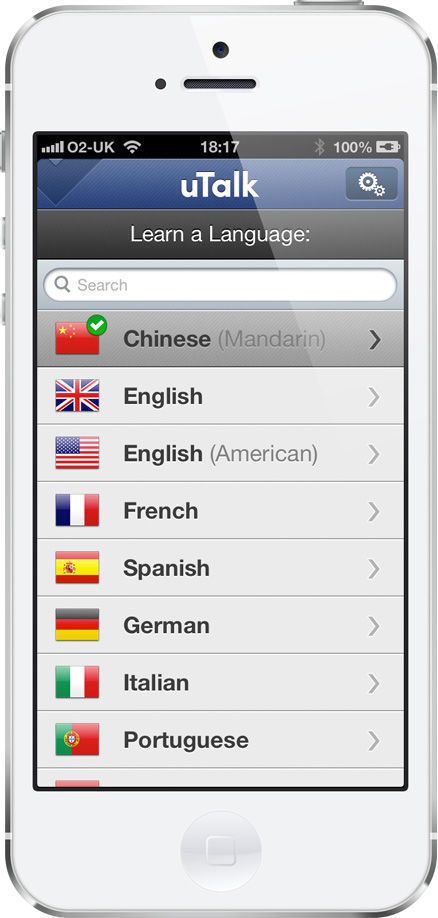 uTalk is now available from the App Store – it’s free to download and includes basic words in 25 languages, with options to upgrade for more vocabulary.
