uTalk Cockney launches in the East End
If you follow us on Facebook or Twitter, you’ll know that last week uTalk became the world’s first Cockney language learning app! The traditional East London rhyming slang was launched at G Kelly pie shop on the Roman Road by the Pearly King of Forest Gate and Pearly Queen of Old Kent Road.
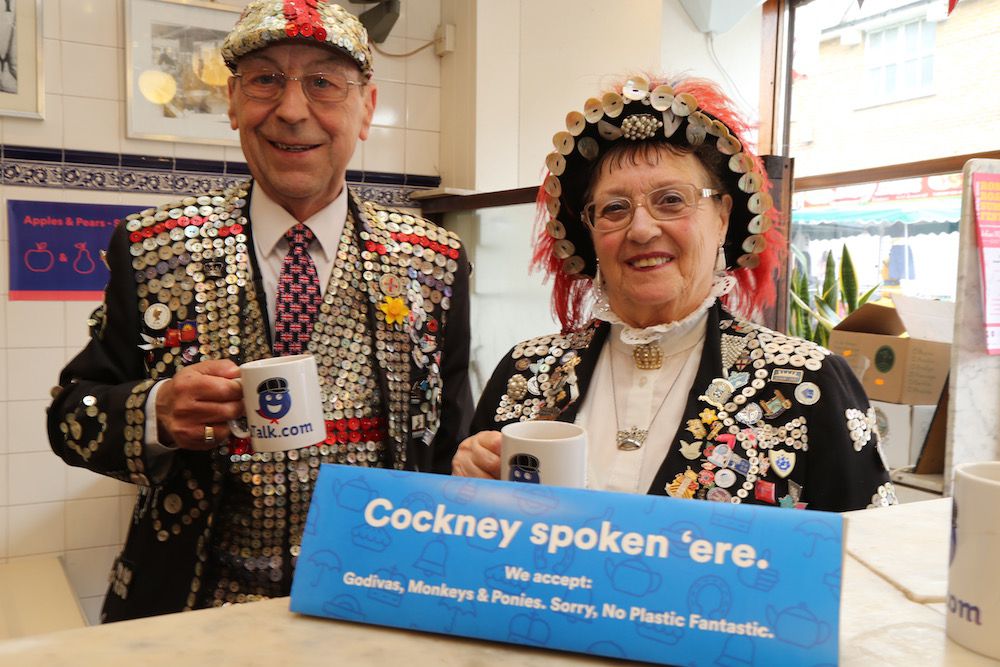
The Pearly King and Queen learned how to use the app, and were impressed!

Some children from Olga Primary School popped in to put the uTalk app to the test. They had fun playing the games, and were keen to show our chairman Dick what they’d learnt.

And we finished with a good old-fashioned East End knees up, led by our Pearly King and Queen, pianist Mick Yarrow and the voice of uTalk Cockney, Patrick Mackervaie.
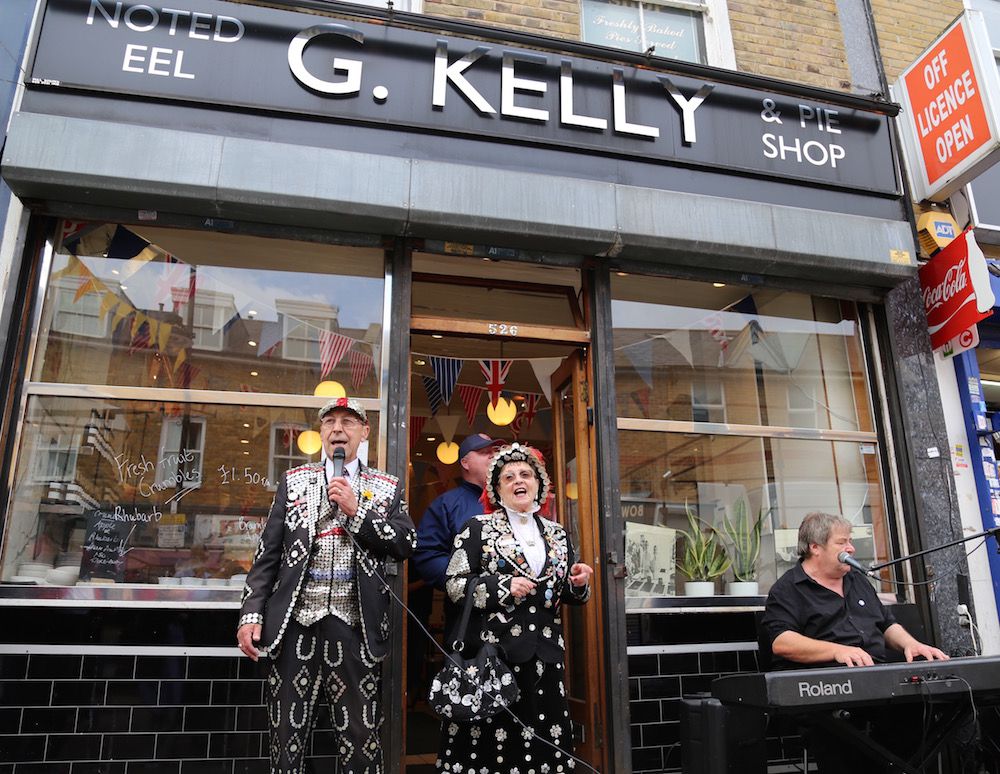
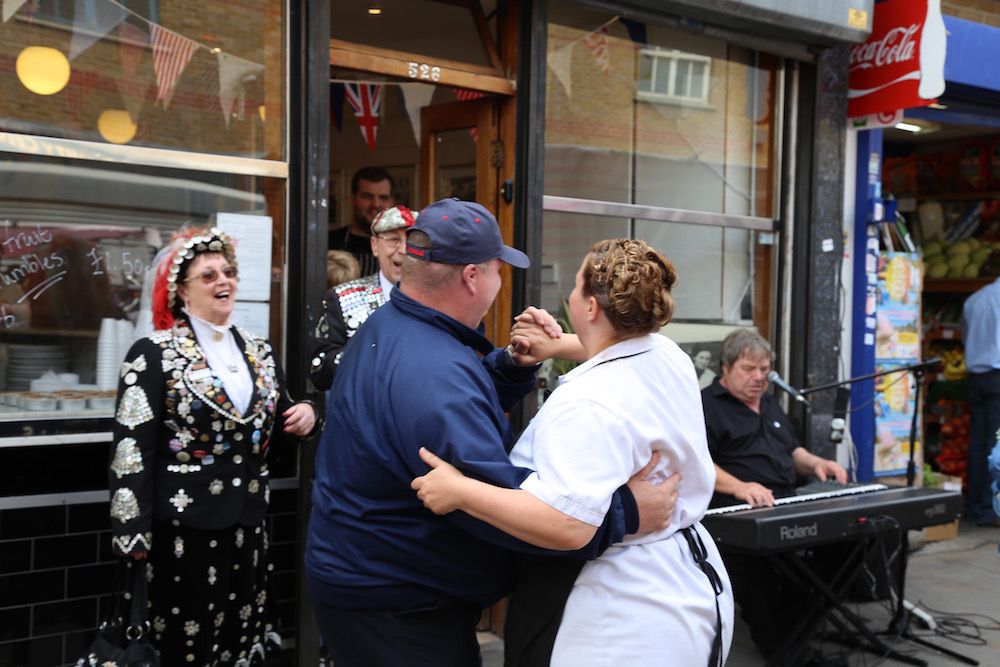
It was a fantastic day – thank you to everyone who got involved. Check out our video for more!
Our launch even made the news! As well as a feature on ITV London News on Thursday evening, our language expert Nat appeared on London Live with chairman Dick to talk about the app, and was interviewed with actor Patrick by Robert Elms on Friday morning for BBC Radio London (listen from 1 hour 40 mins onwards).
On Sunday we were back in the East End, giving Cockney lessons to visitors at the Roman Road Summer Festival. Patrick, who’s from Hackney, got the crowd warmed up with some Cockney quizzes (some harder than others), before inviting everyone to come and have a go with the app.
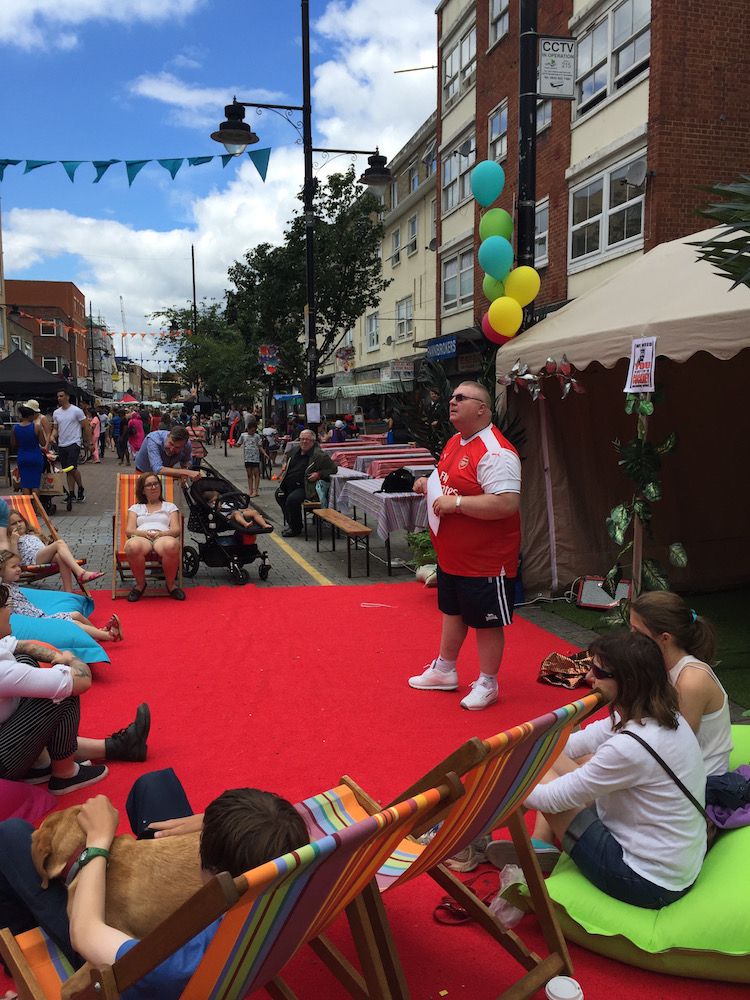
Want to have a go yourself? We’re giving away uTalk Cockney with the Evening Standard – and you get a free month’s subscription to all 133 other languages as well! Just visit eveningstandard.co.uk/offers to get started.

Enjoy! And we’d love to hear what you think – we know Cockney is constantly changing, and that not everyone has the same way of saying things. Email us at mycockney@utalk.com or tweet us with #myCockney to join the discussion!
The Difficulties of Translation: Love Translated
To language enthusiasts, it’s sometimes a bit of a shock to see how a favourite book or film title is rendered in another language. A common phrase, especially since the film which took it as a title, is ‘Lost in Translation’, the idea of some slight nuance being dropped between one language and another.
But sometimes it’s more than just a little nuance. Sometimes it’s a total transformation of the title, and a total change in meaning. Consider the phrase ‘lost in translation’ itself: a clever play on the idea of physical loss and metaphoric loss, it contains both the sense of merely overlooking something, and of being geographically lost- as well as emotionally bewildered. It’s a poignant phrase. Now consider the title of this blog post: ‘The Difficulties of Translation’ (Трудности перевода) is the Russian title for the same film, while ‘Love Translated’ (L’amore tradotto) is the distinctly simplified Italian variant.
Italian also simplifies one of the most beautiful film titles of this age: ‘Eternal Sunshine of the Spotless Mind’. The original title conjures images of endless hope, while the Italian ‘Se mi lasci ti cancello’ (If you leave me, I’ll delete you) narrows the ambit significantly and reduces the complex plot to the mere idea of a lovers’ tiff. Similarly, ‘The Catcher in the Rye’, the incredibly evocative title of Salinger’s great classic, certainly loses its panache and the protagonist’s sense of anonymity in the Italian edition, ‘Il giovane Holden’ (The Young Holden).

Needless to say, this works both ways, and anyone who is familiar with Proust’s famous work ‘À la recherche du temps perdu’ will be disgusted by the rather trite English version, ‘Remembrance of Things Past’ (thankfully renamed in more recent publications to ‘In Search of Lost Time’). Similarly, Camus’ ‘L’Étranger’ is only ever translated as ‘The Outsider’ or ‘The Stranger’ in English- unlike the French, English lacks a word which encompasses both nuances at once.
Got any favourite translations of titles in other languages? We’d love to hear them, whether you think they’re better or worse than the original!
Saving the Cornish language: Kernewek Fights Back!
Kernewek in Kernow
When I was back home the other week, I was surprised to see the Cornish language supporters out in force at several major Maytime festivals. Back in the day, you wouldn’t tend to see much Cornish language at a public parade. In fact, back in the day, you could easily come to Cornwall and miss all the Celtic language completely, except for the odd place-name translated on road signs.
Not so now! I go to a festival in London every year where all the Cornish ex-pats gather to celebrate St Piran’s Day, and at this festival of modern music and comedy (no folk element to it), it’s very normal for the presentation to be at least partly in Cornish. Last year, at the Falmouth Sea Shanty Festival, an entire group of about 20 people came into one of the pubs and were talking exclusively in Cornish, albeit with varying levels of fluency. And most Cornish people nowadays are at least familiar with the essentials- Mitten Da, Nos da, pasti, Fatla Genes, Kernewek.
Putting Kernow back on the map!
So something’s happened between when I was at school and now. And in large part it’s down to the Cornish Language Partnership, who have been promoting and supporting the Cornish language since 2005, coordinating languages societies, local authorities and other cultural groups. It also offers a translation service and online audio dictionary for all those eager learners. They’ve put Cornish back on the map in a big way, and helped to standardise a language which, divided into many dialects, was actually officially dead.
The bad news is that the Cornish Language Partnership relies a lot on government funding, and the government has recently cut £150,000 of annual funding for the Cornish language. This is terrible news for supporters of Cornish (and worrying news for other minority languages), and a petition has been launched to reinstate the funding (with currently over 8,600 signatures).

Not taking it lightly, me lovers!
The good news is that Cornwall’s not backing down! A local (and well-loved) ice cream firm, Kelly’s, has recently launched an advert all in Cornish (with the odd cheeky nod to English thrown in here and there). In the Kelly’s ad, a young man extolls all the virtues of the Kelly’s ice cream entirely in Kernewek – quite ambitious considering Cornwall only boasts about 2000 fluent speakers – yet the simple message of this ad is completely conveyed. Have a look for yourselves:
We’re proud to do our bit to support the Cornish language – check out our Cornish programs
Nat
Ramadan: what’s it all about?
Eid Mubarak!
Today marks the start of the holy month of Ramadan, where millions of Muslims around the world will spend the month fasting and praying. It is believed that 1400 years ago the Quran was shown to the Prophet Muhammad in this month. The start of Ramadan varies around 11 days each year, as it is all to do with the lunar cycle; this year the new lunar moon was seen on Sunday evening in the Middle East.
Potentially the most well known part of Ramadan is the fasting that happens. Muslims are not allowed to eat or drink during daylight. For those who miss a day of fasting they have to make up for this on another day, for example those who are travelling a long distance are allowed to eat and drink; but must make up for this another time. During Ramadan, breakfast or ‘Suhoor’ as it’s known, must be eaten half an hour before sunrise, this is also where people have the chance to drink water to be hydrated for the day ahead.
At the end of the day after sundown a communal meal is made, called ‘Iftar’, which literally translates into ‘break fast’. This is where people come together and they can eat until the next morning’s Suhoor. At both meals, fresh fruit and vegetables are served, along with halal meat, cheeses, breads and sweets. The meal caters for all of the food groups needed for a healthy body. Following the main meal different snacks can be prepared such as dates.
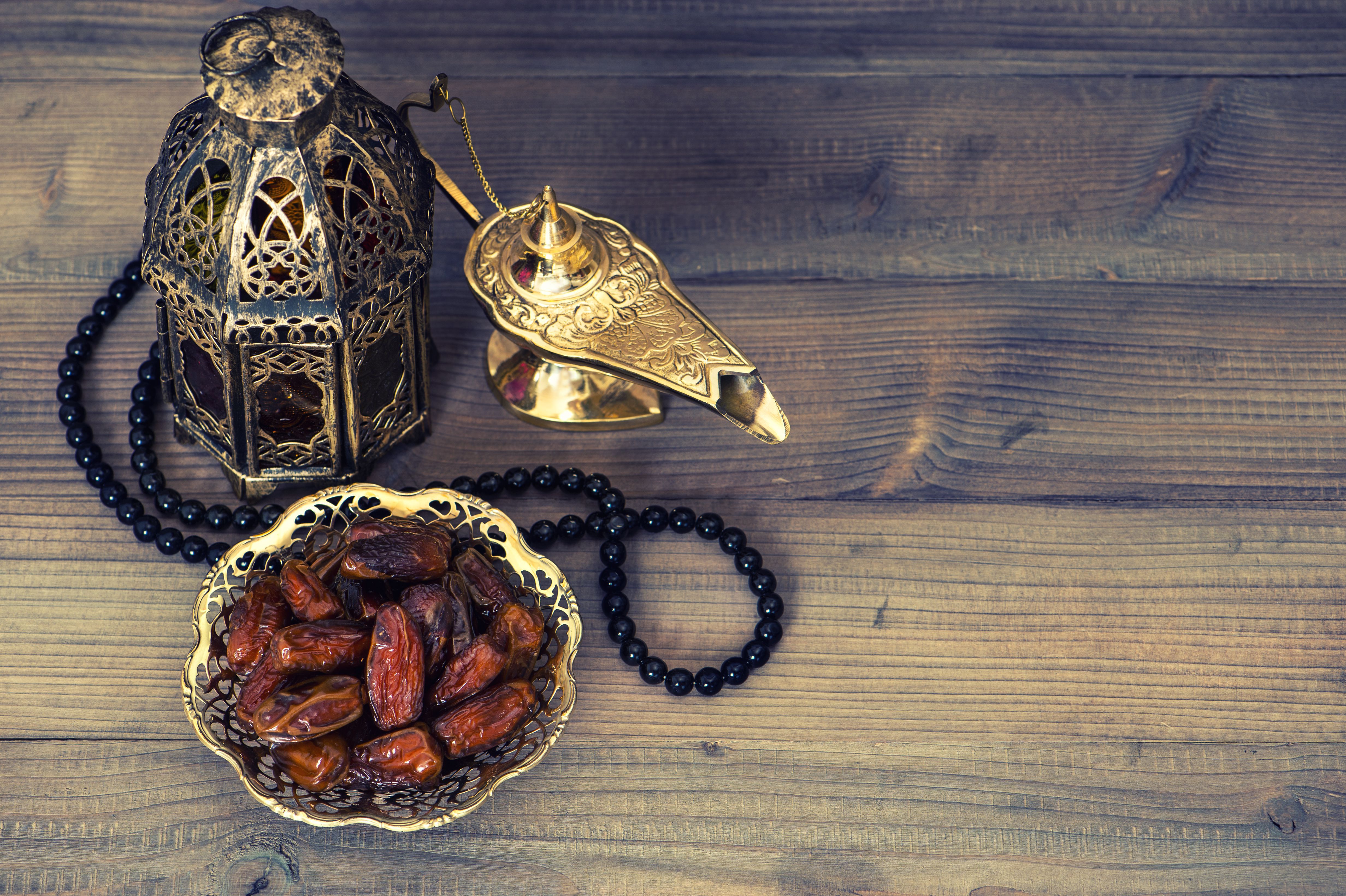
As well as having to follow strict eating and drinking guidelines, during the month of Ramadan, Muslims will visit the Mosque regularly. The month is used as a way to improve morality and work on themselves. Last year 14 million Muslims visited the city of Mecca within the first 2 weeks of the holy month. Mecca is the holiest city in the Islamic religion, and is the place where Muhammad first saw the Quran.
At the end of Ramadan, Muslims celebrate ‘Eid al-Fitr’ which translates as the ‘festival or breaking the fast’; here they gather at the Mosque for a prayer and spend all day with family and friends. The celebration goes on for three days and marks a new beginning for each individual.
The weird and wonderful language of tennis
I’m not generally much of a sports fan, and the less said about my sporting ability – or lack thereof – the better… but I do love a good tennis match. I’m a regular supporter of the British Davis Cup team (which is a lot more fun since they started winning; our humiliating weekend in Lithuania back in 2010 is, thankfully, a distant memory). I’m going to the US Open for the first time this autumn (squeal), and don’t even try booking me for any social engagements during Wimbledon fortnight – if anyone needs me then, I’ll be in front of the TV drinking Pimm’s, eating strawberries and cream and biting my nails every time Andy Murray’s on court.

Wimbledon, summer 2013
Like any sport, tennis has its own unique language and growing up watching it on TV, I had to get fluent at an early age. Besides a frankly baffling scoring system (15, 30, 40, advantage… it makes no sense at all) the game features a good few terms that may not mean a lot to newcomers, and take a while to get used to. So as the French Open comes to a close and we look ahead to the grass court season, here’s a quick guide to Tennis-ese for the uninitiated:
Love: ironically this is not something you want in a tennis match, because ‘love’ means a score of zero points in a game (or games in a set). It’s generally assumed that this comes from the French word l’oeuf, which means ‘egg’ – the same shape as a zero.
Deuce: when the score reaches 40-40 in tennis (3 points each), one player must score two consecutive points in order to seal the game. If they only manage one, the score returns to deuce, and keeps doing so until someone wins the game. ‘Deuce’ could derive from deus, Old French for two, or from à deux de jeu (‘two points from the end of the game’)… and yet, ironically, in France 40-40 is referred to as quarante à the first time, then egalité after that.
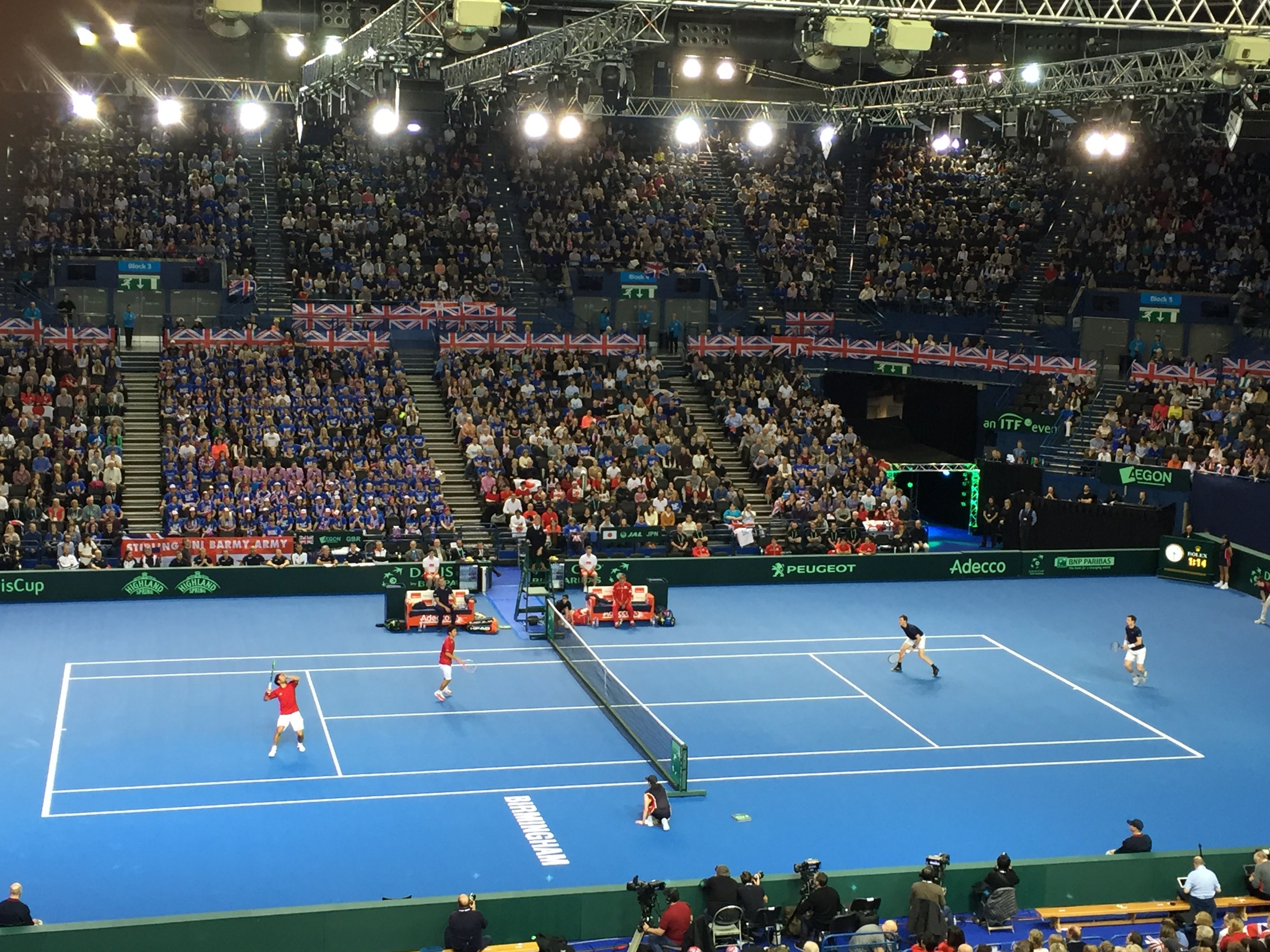
Davis Cup, GB v Japan, in Birmingham, March 2016
Let: when a player serves, the ball must pass over the net and bounce in the service box diagonally opposite. If it goes into the net, or misses the service box, this is a fault; do two faults in a row and you forfeit the point. But if the ball touches the net and still lands in the correct service box, this is called ‘let’. Nobody seems quite sure why, although one possibility is that it’s a shortened version of the French word for ‘net’, filet. Or it could just be because if this happens when you serve, the umpire lets you try again as many times as you need to 😉
Bagel: depending which side of the net you’re on, this is either something to celebrate or a very, very Bad Thing. A bagel occurs when one player wins a set 6-0. If this happens twice in a match it’s a double bagel. I’ve also heard a set that’s been won 6-1 referred to as a breadstick. Who knew so many tennis terms were named for the shape of food?
And finally, a couple of tennis terms with less interesting linguistic origins:
Break and Hold: the players in a tennis match take it in turns to serve. If a player wins a game on their own serve, this is called ‘holding serve’ or just ‘a hold’. On the other hand, if they manage to win a game when their opponent’s serving, this is called a ‘break’, or ‘breaking their serve’. To win a set, a player must be ahead by at least two games, so a break often proves crucial. During a tiebreak, you can also get a ‘mini-break’, which is not, as one might suppose, a short holiday but just means you’ve won a point on your opponent’s serve.
Ace: a serve that goes in but is untouched by the opponent’s racquet, automatically winning the point for the server. John Isner currently holds the record for the most aces in a match, at 115, but then again, that was also the longest singles match ever played – 11 hours, 5 minutes – at Wimbledon 2010, so perhaps it’s not so surprising.
These are just a few examples of the weird and wonderful language of tennis. What’s your favourite tennis term? And – far more importantly – who will you be cheering for at Wimbledon this year?
Liz
