Overcoming anxiety when speaking a foreign language in public
Thanks to guest blogger Eve Pearce, who’s written today’s really helpful article about something every language learner has had to deal with at some point – overcoming the fear of actually speaking it. If you have any other top stress-busting tips, we’d love to hear about them in the comments!
Seasoned foreign language teachers will probably tell you that one mark of a successful student in terms of language learning, is ‘openness’, ‘daring’ and sometimes, even ‘cheek’. The more free of self-consciousness and shame a student is, the more likely they are to progress, since one vital part of language learning is using it – having conversation with other speakers, communicating, living the language one is learning.
It is easier said than done for some learners, however, especially those suffering from anxiety. Far from being an exotic condition, anxiety is actually the most common mental condition in the US, the UK and many other countries. The daily stresses and demands of life can invoke our ‘fight or flight’ response, raising our heart and breathing rates and sometimes, even causing debilitating panic attacks.
As a language learner, anxiety may have stopped you in your tracks. It may have made you fear situations and people you do not know well. It can stop you from making many important changes in your life, or from learning a new language and interacting with other students and foreign language speakers. Anxiety can play big tricks on body and mind; excess oxygen levels (produced by breathing too rapidly) can cause muscles to cramp and can cause hyperventilation. Sometimes, the problem is mild but still uncomfortable – for instance, a person may fear having to get up in front of a class and make a speech in another language.

If you are suffering from anxiety, and you feel like it is interfering with your ability to progress as a foreign language learner, try some of the most effective relaxation techniques known to those who have recovered from this condition. Foremost among these techniques is abdominal breathing. It is quite simple – just breathe in a large amount of air through your nose, allowing your abdomen to expand. Keep the breath in for a few seconds then exhale, slowly, through your mouth. Do this various times and you will note that your heart rate drops, even when you are very stressed.
Yoga is another highly successful technique at quelling anxiety and stress, so much so that it is offered at practically every top rehabilitation centre for addiction and for eating disorders. Yoga is such an excellent way to battle anxiety because it can be practised by people of all fitness levels and ages, it is cheap, and also a proven method of lowering stress hormone (cortisol) levels. It involves a connection between body, mind and spirit. Controlled breathing is also used, and various poses (asanas) are performed.
Sometimes, mindful meditation can be practised during a yoga session, yet meditation is also useful on its own to calm stress. If you have anxiety, you should definitely set aside a few moments during the day to meditate. There are numerous free online meditation sessions lasting minutes, as well as meditation and breathing apps for your phone, which you can follow while you are in the car or on the bus to work or school.
If you try these methods out and you do not improve, or your anxiety is very severe, then expert help may be required. A good therapist will be able to help you in a handful of session, by utilizing techniques such as CBT (Cognitive Behavioral Therapy), which aims to help patients identify stress triggers and find positive ways to channel tension.
If you have an upcoming talk in a foreign language and you are worried about what others will think if your delivery isn’t perfect, remember that most speakers make mistakes and even suffer from nerves before they begin. Language isn’t a competition; it is a progression and it pays to keep in mind that even if the worst possible outcome occurs (e.g. you forget your speech or you feel too nervous to speak), the event is not the be-all, end-all of your language learning experience. There will always be another chance, further down the line, to do that exam or speak before an audience.
Through relaxation techniques, breathing and therapy, you soon discover that anxiety is little more than a trick – it is your body’s way of choosing ‘flight’ (escape) when the ‘fight or flight’ response kicks in. By simply breathing for a few minutes until your heart rate settles, you can stop anxiety in its tracks – and begin to view language learning as the enjoyable pursuit it really is.
Eve Pearce
Beginner’s guide to Latin
Last week, Latin became the 133rd language to be added to uTalk, our app for iPhone and iPad. (Don’t have an iOS device? You can also learn Latin on your computer.)
And to get you started with Latin, we’ve put together this beginner’s guide with a few essentials – some basic greetings, colours, numbers and parts of the body, along with some Latin phrases we still use in everyday English. As always, please feel free to share!
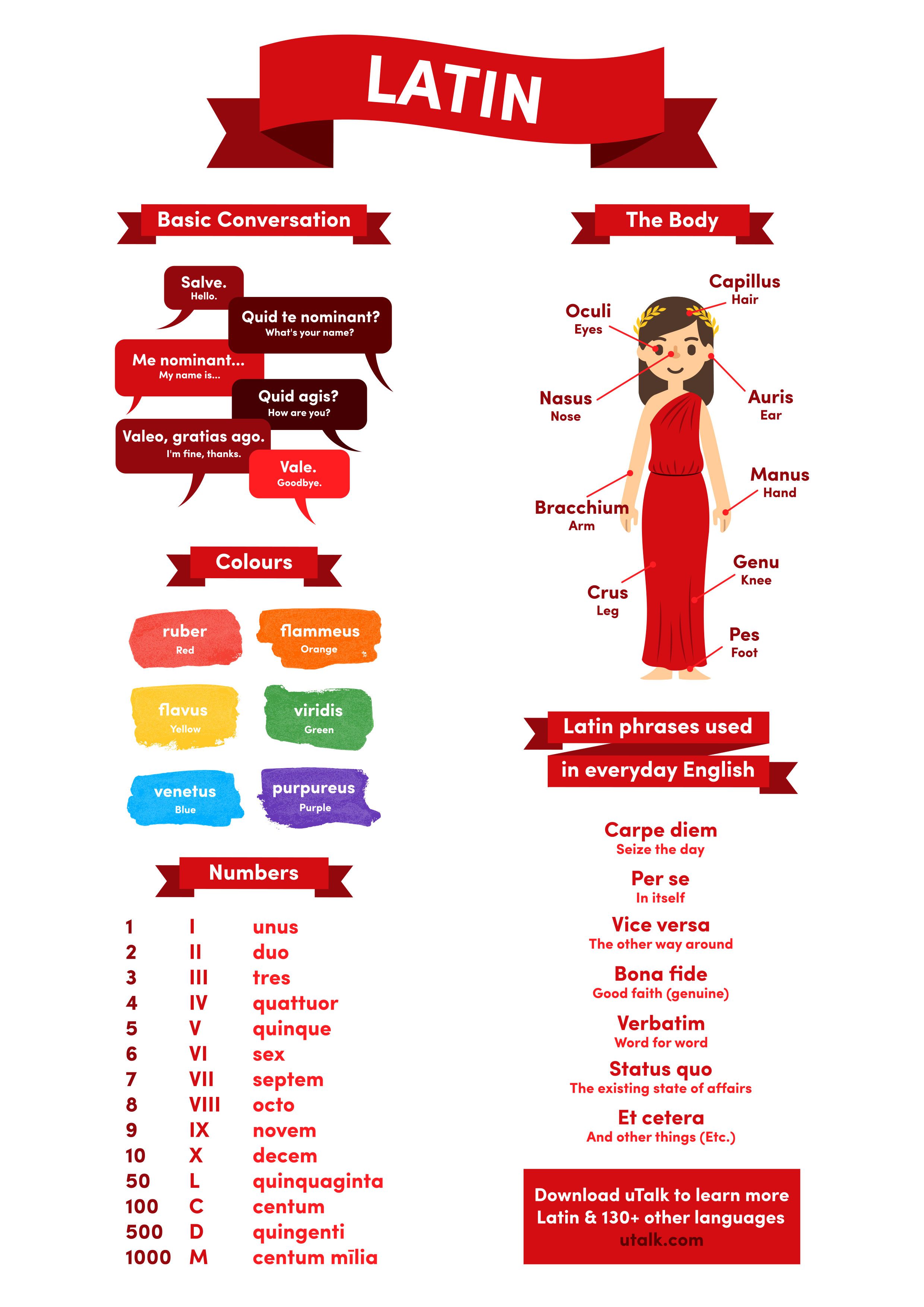
Embed This Image On Your Site (copy code below):
Can you write a language limerick?
Today is apparently National Limerick Day. We had no idea this was a thing, but since it is, we threw out a challenge to the EuroTalk office to write a language limerick – and we now extend that challenge to you 😉
A limerick is a five-line poem in which the first, second and fifth lines must all rhyme, as must the third and fourth. Edward Lear is probably the best known writer of limericks; here’s one that was published in his Book of Nonsense in 1846:
There was an Old Man with a beard,
Who said, “It is just as I feared!
Two Owls and a Hen,
Four Larks and a Wren,
Have all built their nests in my beard!”
So now it’s your turn – can you write a language inspired limerick? Add them in the comments or send them to us on Facebook or Twitter, and we’ll share our favourites!
Here are a few that we came up with, to inspire you:
Safia
Fell in love with a girl who spoke Saami
Asked her out but it sounded quite barmy
EuroTalk to the rescue
Their language apps help you
Get the girl of your dreams in a jiffy
Steve
A very nice geezer called Paul
Got lost on the way to Nepal
He learnt some Chinese
uTalk made it a breeze
But he got eaten by a tiger in Bengal
Nikolay
A bloke from the Isle of Man
Was travelling all through Japan
He wanted some noodle
But ordered a strudel
For he wasn’t a languages fan
Luke
There once was a man called Ray
Who travelled a very long way
He thought “now I’m here,
I’ll order a beer”
But Ray wasn’t quite sure what to say
Over to you – have fun!

Did you know you can speak Latin?
Last week we added our 133rd language to the uTalk app – and it’s a good one!
Latin has been around ever since the year 75 BC and it has evolved from Old Latin to Classical Latin, to Early Modern Latin and finally Modern Latin. Along with Greek, its roots are used in theology, biology, and medicine right up to the present day. Romance languages, such as Italian, Portuguese, Spanish, French, and Romanian have developed from Latin. Later on, many words from all these languages were taken into English, so even if you’ve never actively learned it – you might actually speak Latin.
Here are a few examples of Latin words and phrases that we use regularly:
1. ad hoc: to this
Ad hoc refers to something that was created for a specific purpose or situation as the need arises, without previous planning. An ad hoc political committee, for instance, is formed specially to deal with a specific situation.
2. vice versa: the other way around
For example: “I like you and vice versa” means that you also like me.
3. carpe diem: seize the day
This phrase comes from a poem by Horace and is used to encourage people to enjoy the moment without concern for the future.
4. sic: thus
Sic is used with square brackets [sic] after a quotation indicate that an odd or unusual phrase was reproduced exactly as it was in the source, and therefore it is not an editorial error.
5. per se: by itself
Per se is used to refer to a particular thing by itself. For example: “The idea, per se, wasn’t bad; it was just the way he said it.”
6. mea culpa: through my fault
You might say this if you were admitting guilt, or owning up that something went wrong because you made a mistake.
7. circa: around
If you hear “circa” before a date or other fact, it means it’s an approximation – so for example, “This church was built circa 1600”.
8. in loco parentis: in the place of a parent
When an individual or organisation acts in loco parentis, they assume legal responsibility for a child in the absence of their parents.
We’re really excited to finally add Latin to our uTalk app. Take a look – it’s a great way to see how Latin would sound in modern day society and also to better understand how the language works.
10 famous faces who speak other languages
We’ve posted previously about movie and sport stars who speak other languages. But it turns out they’re not the only famous linguists, so here are a few more. Prepare to be impressed…
Audrey Hepburn
There was much more to the star of Roman Holiday and Breakfast at Tiffany’s than her movie career. Audrey Hepburn was well known for her charity work with UNICEF, and after spending her childhood in Belgium, Britain and the Netherlands, she was also fluent in English, Dutch, French, Italian, Spanish and German.
Rita Ora
Rita Ora was born in Kosovo (then called Yugoslavia) to Kosovar-Albanian parents, moving to London when she was a year old. The pop star, model and X Factor judge speaks Albanian fluently and is proud of her heritage; last year she was named an honorary ambassador for the Republic of Kosovo.
Ellen Macarthur
Former yachtswoman Dame Ellen Macarthur learnt to speak French when she was 21 and living in a French boatyard while she prepared for a solo transatlantic race. She’s now fluent and says she would never have been so successful in her career without knowing the language, which helped her build relationships with other sailors and gain sponsorship.
Eddie Izzard
Comedian (and record-breaking marathon runner) Eddie Izzard is currently touring with his stand-up show Force Majeure, which he performs three times a night, in three languages: French, German and English. In 2014, he was named the Guardian’s public language champion, and told the newspaper: “There’s a political basis for me to learning other languages, because if we don’t come together in the world then the world’s not going to make it.”
JK Rowling
JK Rowling studied French and Classics at university, and when she came up with the idea for the Harry Potter series in 1990, she was working as a bilingual secretary for Amnesty International. She later moved to Portugal and split her time between teaching English as a foreign language and writing the best-selling books.
Mark Zuckerberg
The Facebook founder surprised everyone in 2014 when, during a visit to Tsinghua University in Beijing, he started speaking Mandarin – and continued for half an hour. Though his efforts got a mixed reception from the press, the audience seemed delighted – and we were pretty impressed, too.
Jon Heder
The star of Napoleon Dynamite is a member of The Church of Jesus Christ of Latter-day Saints, and served a two-year religious mission to Japan after high school, where he became fluent in the language. And though he now describes himself as “a little rusty”, he still sounds pretty good to us.
Tim Peake
Tim Peake is the first British astronaut to go to the International Space Station – but before leaving Earth he had to learn Russian (the language of the controls in the Soyuz capsule used to get to the ISS), and has described this as the hardest part of his 14 months’ training.
Tom Hiddleston
Okay so we already mentioned Tom Hiddleston in our last post, but frankly, we never get bored of listening to him speaking loads of languages – among them French, Spanish, Greek and Italian, plus some Mandarin, Russian and Korean. And he studied Latin at university…
Viggo Mortensen
The Lord of the Rings star was born in New York, but spent his childhood in Venezuela, Denmark and Argentina, leaving him fluent in English, Spanish and Danish. He also speaks some French and Italian, and understands Norwegian and Swedish.
Does your favourite celebrity make the list?
