Beginner’s guide to Romanian
The Junior Language Challenge is a national competition for children aged 10 and under across the UK. One of the goals of the competition is to give young learners the chance to discover exciting new languages, and this year we’ve chosen Romanian as the first language.
But how much do you know about this European language? Here’s Ioana’s introduction to her mother tongue…
Some other fun facts about Romanian
- The Romanian language is 1,700 years old and is the only Romance language spoken in Eastern Europe. That’s why you’ll be surprised how many similarities it has with French, Spanish, Italian and Portuguese. However, it also retains a number of features of old Latin and also contains many words taken from the surrounding Slavic languages, as well as from German, Greek and Turkish.
- The name “Romania” comes from the Latin word “Romanus” which means “citizen of the Roman Empire.”
- Something that might come in handy is that Romanian is a phonetic language, so words are pronounced as they are spelled. Yay!
- A foreigner trying to learn or speak Romanian can expect positive reactions from native speakers. Most Romanian will certainly appreciate the fact that you are making an effort to speak their language.
- Romanians tend to be very good at foreign languages, they start learning as early as 6 years old in school either English, French or German and they add a second language at the age of 11. The majority of young people speak very good English and some of them even another one or 2 languages.
- Romanians love meeting new people and making friends; they are also renowned for their hospitality, so if you speak Romanian you have a pretty good chance of having a blast if you’re visiting this country.
- And speaking of travelling, Romania has amazing landscapes. In fact, Romania’s Carpathian Mountains are home to the largest undisturbed forests in Europe.
- Don’t deny yourself the ease of ordering delicious Romanian food that comes in generous portions, and you’re guaranteed to remember a trip to Romania as one of the best you’ve ever had.
La revedere și mult succes (goodbye and good luck)
If you’re a parent or teacher of children aged 10 and under in the UK, visit juniorlanguagechallenge.com to find out more about our annual competition, which is now open! Entry costs just £5, which is all donated to our fantastic charity, onebillion.
‘Something I’ll always be very proud of’: Shane’s JLC story
Shane came in 3rd in The Junior Language Challenge in 2014 and is now in year 7 studying German and Latin. Below he talks about the wonderful JLC experience and why any teacher/parent should register their kids.
If you’re a parent or teacher of children aged 10 and under in the UK, visit juniorlanguagechallenge.com to find out more about our annual competition, which is now open! Entry costs just £5, which is all donated to our fantastic charity, onebillion.
In 2014 I entered the JLC for the second time, having got to the final the previous year. This time I knew what to expect and was really keen to get going. The first language was Italian, which was probably the language I found the easiest (of the 6 over 2 years). Two pupils from my school, Denmead, got through to the semi-final and we were told that we would be learning Japanese. I knew one word of Japanese already, but this wasn’t going to give me any advantage! It proved to be a very interesting language to learn, but when it came to the quick fire round this was the most challenging.
At the semi-final it all seemed much quicker than the previous year. During the final round, I managed to resist the temptation to look up at the leaderboard before I had finished. My dad compared the leaderboard to the football league tables when a goal is scored, a couple of wrong answers can move you up or down several places very quickly. I think it is much more nerve racking for the teachers and parents than the children as they watch this. I was lucky and saw my name stay in the top three so knew I had qualified for the final.
The language for the final was Somali and although it was completely new to me I knew that the app and website were the only tools I needed to get me through. The combination of games, the increasing level of difficulty and the chance to hear the words pronounced correctly meant it worked for me. I actually enjoyed practising, learning and the idea of preparing for a competition.
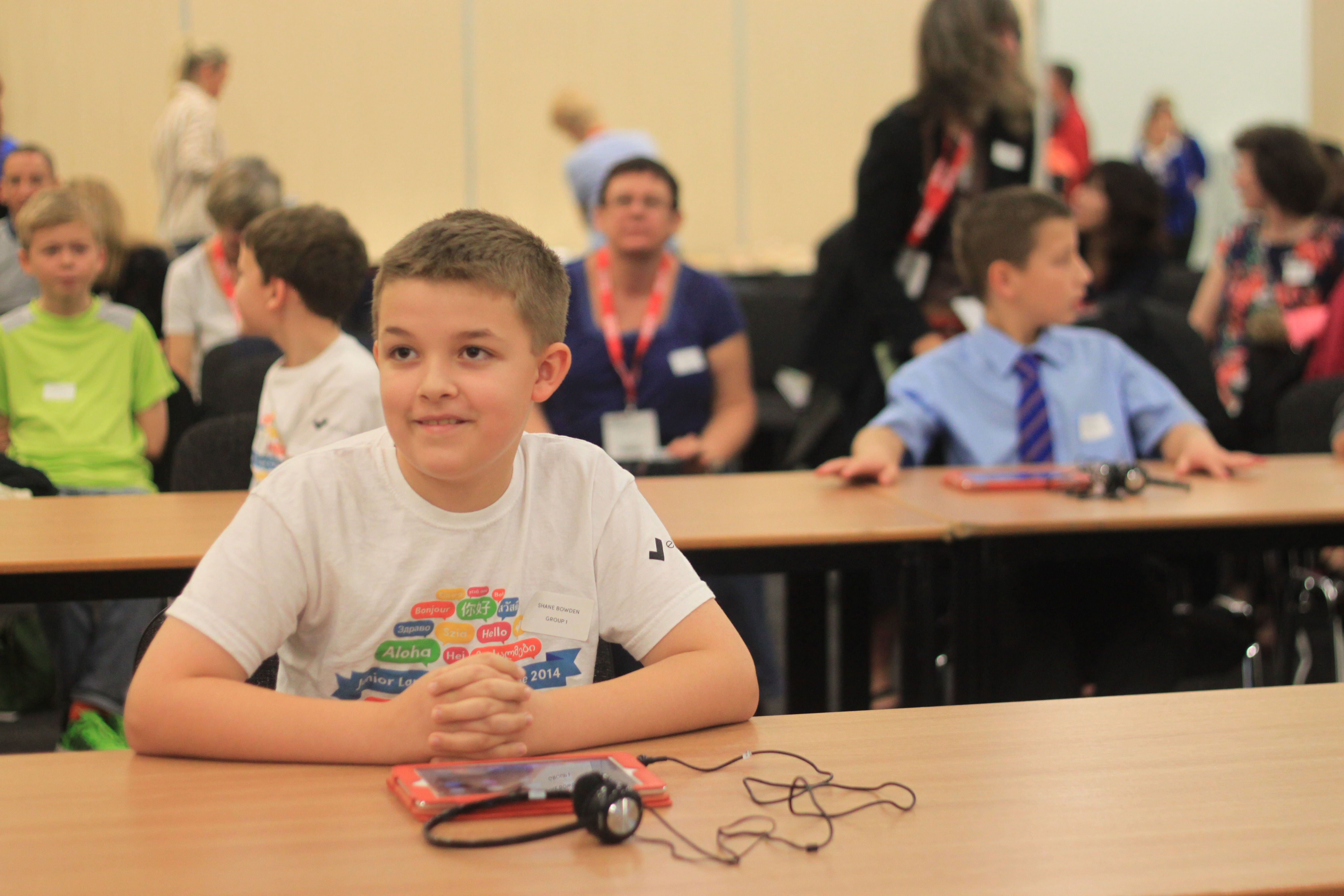
When it came to the final, I probably had my best round to date and as I was answering the last couple of questions my eyes were drawn towards the big screen displaying the leaderboard. I saw I was in third place with a few points to spare so knew I had done it. I felt speechless for a few minutes after we stopped, I had hoped to improve on the year before but didn’t think I would manage to get the bronze medal! My top tip for anyone getting through to the final is to stay calm and distract yourself with some great music and a good book. Calm parents and teachers (like mine) help you relax, just enjoy the experience and do the best you can.
To be part of a national competition is great and to gain third place is something I will always be very proud of. During the competition Franco (part of the JLC team) was always really kind and understanding with the children who needed help with their equipment and his good humour made sure everyone attending felt relaxed. We were always made to feel proud of what we’d achieved.
If your school isn’t yet involved in the JLC then I suggest you ask your headteacher to sign you up. It raises money for a great cause, introduces a fun and easy way to start learning different languages (some you might never have heard of before) and gives you a chance to compete against school mates and then possibly children from other schools if you are lucky enough to get through to the next round.
Junior Language Challenge: fun for the whole family!
Isobel Eason from Hartlepool qualified for the Junior Language Challenge final two years in a row, and came third last year, with her proud family cheering her on. Here her mum Vickie shares their experience of the competition…
If you’re a parent or teacher of children aged 10 and under in the UK, visit juniorlanguagechallenge.com to find out more about our annual competition, which is now open! Entry costs just £5, which is all donated to our fantastic charity, onebillion.
The Junior Language Challenge has been an amazing experience from start to finish. My daughter Isobel thoroughly embraced the challenges and new languages that it offered.
Isobel qualified for the final in each of the last two years. The first year was a daunting experience but being one of the youngest to qualify that year did not put her off. As a family we all learnt along with her, even creating songs and rhymes to help her learn some of the trickier phrases. We sometimes still all sing them on the way to school on a morning whenever something reminds us of the languages she studied. She did really well in the final that year, finishing just outside the top 15.
The following year was a different story for Isobel. We noticed a real difference in the way she approached learning the new languages and every spare minute she had she spent practising. Mandarin has to have been one of her favorites. The final was very different as we all knew what to expect. I was dreading the leaderboard the most, it’s horrible to see the children moving up and down and I don’t know how Isobel managed to block it out. We were overjoyed when she made the final round, though we spent the entire final on the edge of our seats! I was so nervous for her but she was amazing, and her face when she had finished and looked at the scoreboard was an absolute joy. She had finished third! All of her hard work and determination had paid off.
I was amazed throughout at how quickly she picked up the different languages. The JLC and their fantastic team of people has provided Isobel with an invaluable experience, learning six languages over the last two years whilst also supporting the very worthy onebillion charity. It’s been an adventure that none of us will ever forget and one that we can’t recommend highly enough.

Mum’s the word! How different languages say ‘mother’
Today is the day we celebrate ‘Mother’s day’ or ‘Mothering Sunday’ here in the UK.
Mum is one of those words we start to use from a young age; perhaps you used ‘mumma’, ‘mother’, ‘mam’ or ‘mummy’ instead; there are many ways to say it! Some languages offer a similar word to English, like ‘la madre’ in Spanish and in Italian. Typically the word for mother does start with an ‘m’ or a ‘b’ as these are soft and easy sounds when you’re a child, creating the ‘m’ noise is one of the easiest ones to make. In Afrikaans the word for mother is just ‘ma’ and in Swahili it’s ‘mama’.

My mum and me enjoying the sunshine!
However, that’s not always the case: in Fijian the word for mother is ‘tina’, in Kurdish (Sorani) it is ‘daik’ and in Swiss it is ‘d’Mueter’. In other languages the m or b is replaced with a ‘h’ sound – in Japanese mother is ‘haha’ and in Somalia it is ‘hooyo’. Would you expect ‘Whaea’ to translate into the English word ‘Mother’? This is perhaps one of the more unusual ways of saying mother in another language (Maori). Interestingly in Georgian, it is completely different to English, with ‘mama’ meaning father and ‘deda’ for mother.
When it comes to the Romance and Germanic languages, there are a lot of similarities between both ‘mother’ and ‘father’ translations. Father tends to start with a ‘p’ or a ‘b’ sound, which are also easy noises for children to make.
Here are some other words for ‘mother’ in different languages:
Slovak – matka
Scots Gaelic – a’ mhàthair
Hungarian – anya
Albanian – nënë
Tagalog – nanay
How do you say ‘mother’ in the language you’re learning?
Happy Mother’s Day to all the mums, tinas, madres and nanays – we hope you have a lovely day!
Alex
Happy Baba Marta!
Today is “Baba Marta Day”. In Bulgaria the 1st of March marks a holiday that welcomes the upcoming spring. “Baba Marta” translates to “Grandma March”, the mythical character who brings the end of the bitter cold winter!
On this day people exchange “Martenitsi”. These are red and white coloured bands or figurines that symbolise health and happiness. The white initially represented human nature and strength, whilst the red showed health and the woman’s nature.
The most traditional martenitsa consists of two small dolls (male and female) and are called “Pizho and Penda” (Пижо и Пенда). Martenitsi come in many other shapes and sizes and people wear them as lucky charms.

The tradition is to wear your martenitsa until you see some signs of spring: blossoming trees or birds like storks and swallows. Some people then tie their martenitsa to a tree – so next time when walking through a park, if you see red and white yarn bracelets hanging on a branch, you know the mystery behind it! It was also believed that people placed them under a rock. They would then come back nine days later to see if there had been any ants; if there were the year would bring lots of sheep. Some people also chose to throw them into the river and let them flow away, representing the troubles of life leaving.
Thanks to Nikolay, who made us all martenitsi to wear today! Let’s see how many of our wishes come true…
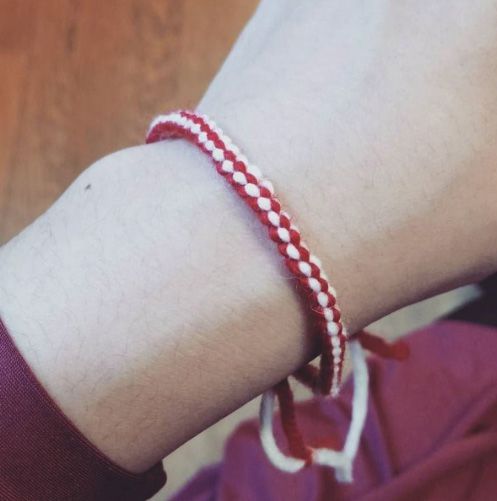
Bonus fact: “Mărţişor” is a Romanian holiday that is similar to “Baba Marta”. It’s also believed in Romania that wearing the red and white bands leads to a prosperous and healthy year. The threads are hung somewhere outside the house like a gate to protect against evil spirits. Today the threads are still bought by people for their friends and family to show admiration.
Happy Baba Marta!
