Quiz: Can you guess the language?
Are you a language expert? Try our quiz and see how many you can answer correctly…
If you were surprised by any of them, let us know! Don’t forget to share with your friends to see how many they can answer.
If you’re inspired to learn one of these languages, download our free uTalk app for iOS. We have over 120 languages to choose from!
Who needs football? I’d rather learn a language…
What’s your inspiration for learning a language? Today we’re hearing from Jack, a student and blogger at LangLearningBlog, on how he got addicted…
What inspired you to start learning French?
I never really was fond of languages, and I only studied French at school for a GCSE in a language – but bear with me! Soon I became almost addicted to language learning and I actually started enjoying learning completely alien and new vocabulary. Some thrive from obsessing over football fixtures and their league tables, others however (us!), are addicted to language learning. Let them obsess over futile fixtures. Meanwhile, we can be learning all the words a language holds!

What gives you motivation to continue learning?
Getting yourself motivated to learn new vocab or review flashcards is so difficult (especially when they’ve been stored at the back of a drawer for a few months!!).
My main motivation hack is that I keep my learning sessions short but regular. Not five minutes, but never over one hour, I find vocab literally pours into my brain doing regular learning sessions. Obviously there’s been days where I’ve done little or no vocab learning or reviewing, a.k.a ‘forgetting days’. Short bursts or an adrenaline-kicking 30 minutes are definitely my way forward to keeping motivated.
YouTube definitely helps, personally I think the short TED Talks speeches are great. They cover a huge range of topics, including language learning, and are never too lengthy. Beware though, or before you know it you’ll be watching pandas falling down slides and dogs dancing – one could say I have some experience getting distracted by YouTube.
What’s your biggest language learning challenge?
My learning routine has always been split into two halves: school and home independent study. School would give me the content, and my vocab learning at home would help me consolidate this and go further. Harder in practice though. One of the biggest challenges I had was the content that GCSE French covered. There was no ‘off the cuff’ speaking, nor conventional speaking topics (except food). The course seemed to shy away from practical topics that I’d actually need in France, like ordering bus tickets. So doing online reviewing programmes and not being able to translate some really simple stuff, it felt like learning the language was a waste.
What’s your favourite French expression?
On my visit to St-Etienne, France, I did work experience in a primary school. One night, some of the students on the work experience and teachers at the school went to a restaurant, and were all sat around this square table. Conversation slowed and we divided into two groups: English natives and French natives. It then turned to ;it’s raining cats and dogs’, then soon after all the students attempting to explain other idioms too. Trying to decode the French idioms to English was hard. I did manage to glean from the French idiom conversation ‘manger les pissenlits par la racine’. It translates literally as ‘eating the dandelions by the roots’, roughly meaning ‘pushing up daisies’. Obviously my favourite French expression to date – not because it’s unusual, but because it still reminds me of some of the French native’s facial expressions it got in return.
What do you find to be most rewarding about language learning?
Having the chance to visit the country is definitely the most rewarding thing about the entire years-long learning process. Before I knew it I was conversing with a bookshop assistant asking them to recommend books, and where I’d find them. I was explaining tasks to groups of primary school children and earwigging into conversations on the plane (apparently some French people really like TK Maxx).
After years of learning what felt like an artificial language, as I’d never heard it in action, all this learning had finally paid off, allowing me to not only have some great conversations, but also food – French crêpes and cheese cannot be described in words.
Jack
If you, like us, are now dreaming of crêpes (and cheese), and you’ve been inspired to learn some French, visit our website to see how we can help. Or download uTalk for iOS and start learning for free!

How do you know when you’re fluent in another language?
The other day, in a moment of idle curiosity, I took an online Spanish test. And it went rather well; when I finished, I was told that I was 87% fluent.
This is very funny, because – to my shame – I haven’t spoken Spanish properly for years. And although the test proved that everything I learnt at school and university is still there in my head, I know the next time I do try and have a conversation, I’ll struggle initially to remember the right words and how to construct sentences correctly. And there’ll definitely be a lot of ‘um’ and ‘er’.

Defining yourself as ‘fluent’ or ‘not’ seems like a simple enough task. Personally, I’d define fluency as the moment you’re able to have a conversation in another language without hesitation, just as you would in your own native language.
But is that setting too high a standard for myself? Surely what I’ve just described is one step on – what we would call native level?
So, I asked a few other EuroTalkers how they define fluency. A couple of responses were very much like mine:
“When you’re able to have a conversation (spoken or written) without making mistakes, without having to pause to think about words and grammar and without referring to a dictionary or other ‘cheat-sheets’. Be able to use the more complex features of a language with ease (e.g. conditionals, obscure tenses).”
“Speaking another language without having to think about it.”
While a couple were willing to be a bit more flexible:
“When you have enough of the language to get through a visit to the country, you can understand a local and they can understand you back when you speak their language.”
“I think minor mistakes are permitted as long as the other one understands you.”
And another one came at the question from an angle I’d never considered:
“You’re able to have any conversation about general knowledge, not specific fields like medicine, for example.”
But there was one thing all the answers seemed to have in common: the key to fluency is confidence, whether you know all the words or not. And that’s why I can’t think of myself as 87% fluent in Spanish; yes, I understand how the subjunctive works, and perhaps I’d even say that I can read the language fluently – but that doesn’t mean I can confidently have a conversation with someone about the weather.
What do you think ‘fluent’ means? Are you fluent in any other languages?
Liz
Junior Language Challenge – 2016 here we come…
The Junior Language Challenge 2015 may be over, but we’re already thinking about next year’s competition. In 2016, we’d love to double the number of children taking part from 1,100 to 2,200, and raise even more money for our brilliant charity, onebillion.
Every year, we’re blown away by the enthusiasm and commitment shown by children, parents and teachers. 2015 was no exception, as you can see from our brand new video, made at this year’s final.
Please help us make next year’s competition our biggest and best yet, by sharing the video with friends and colleagues across the UK. Thank you!
For more details about the Junior Language Challenge, visit eurotalk.com/jlc or email jlc@eurotalk.com.
How does a Greek person say ‘it’s all Greek to me’?
‘It’s all Greek to me’. This is what an English speaker might say when they don’t understand something at all. In this context the Greek language is used as a metaphor for ‘something incomprehensible’.
So that got us thinking here at EuroTalk… if an English speaker uses Greek, what does a Greek speaking person use? And in fact how does this expression translate in other languages?

Well as it turns out there is a (somewhat complicated sounding) term for this – ‘language of stereotypical incomprehensibility’. So Greek is the language of stereotypical incomprehensibility in English.
Other languages have similar expressions and they usually pick as a metaphor for ‘impossible to understand’ a foreign language with an unfamiliar alphabet or writing system.
To answer our original question: in Greek the language used as a metaphor for incomprehensibility is Chinese.
Chinese actually turns out to be the most popular choice as a synonym for ‘I do not understand’ and is used in many languages, including Albanian, Arabic, Bulgarian, Catalan, Dutch, Estonian, French, Greek, Hebrew, Hungarian, Latvian, Lithuanian, Polish, Portuguese, Romanian, Russian, Serbian, Spanish, Ukrainian.
Greek itself follows closely, and is used as a language of stereotypical incomprehensibility in: English, Afrikaans, Norwegian, Portuguese, Swedish, Spanish, Polish, Persian.
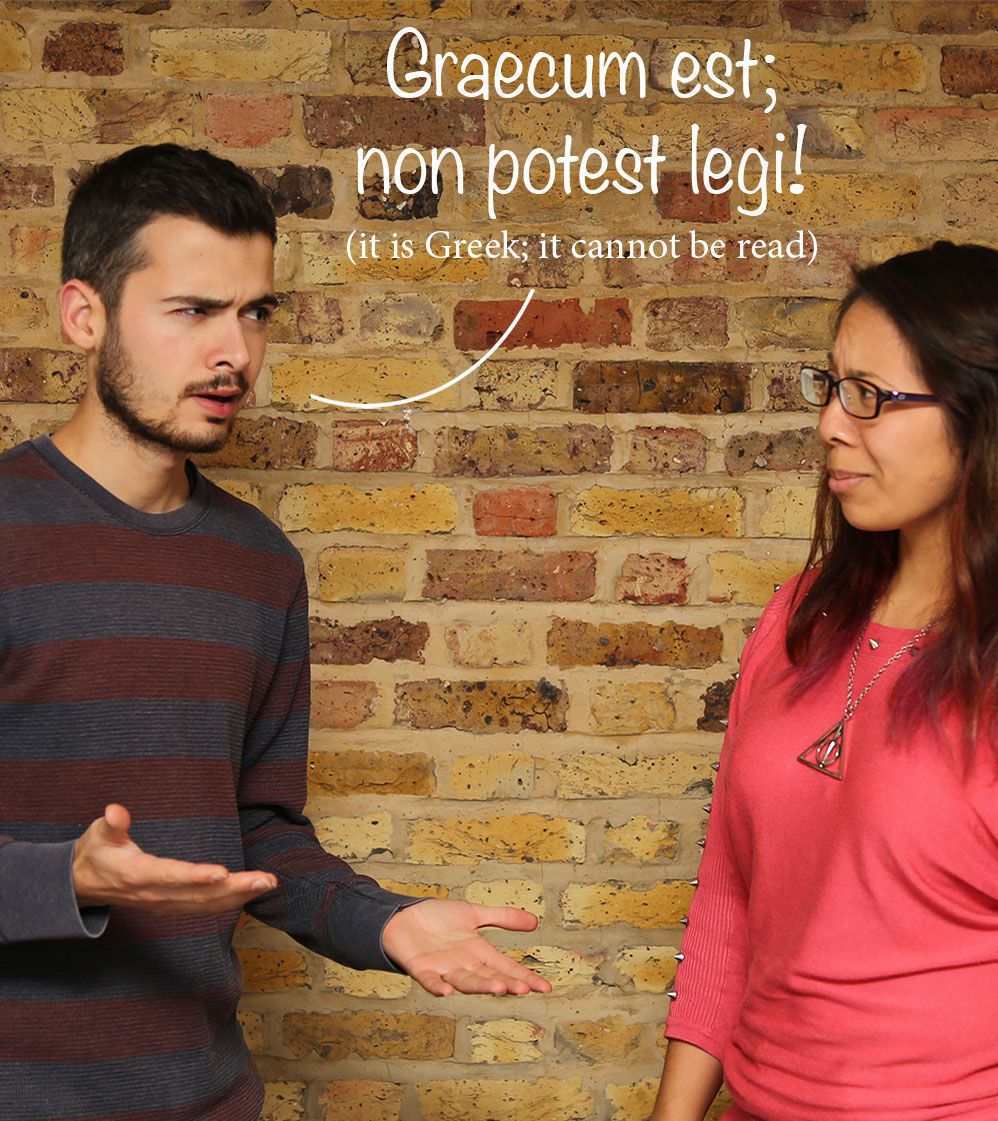
(Bonus fact: the origin of the phrase in some European languages can be traced to the Medieval Latin proverb, ‘Graecum est; non potest legi’, which translates to ‘It is Greek; it cannot be read.’)
Sometimes the language of incomprehensibility is not a specific human language at all. For example a Chinese (Mandarin) speaker would use something that translates roughly to ‘Ghost’s script’, ‘Heavenly Script’ or ‘Sounds of the Birds’. And a Cantonese speaker might say, ‘These are chicken intestines.’

And how about a constructed international language, such as Esperanto? As a tongue-in-cheek reference, an Esperanto speaker would say ‘That’s a Volapük thing’, Volapük being another constructed language (with about 20 speakers).
How about you? What language do you use to mean ‘incomprehensible’? And is your language used by any other languages as a synonym for ‘impossible to understand’?
Bonus points question:
What does a person whose mother tongue is Greek, but who also speaks English, say in English when they want to say ‘It’s all Greek to me’?
Nikolay
