How do you say ‘I have lost my rabbit’ in German?
Blogger Erika Holt is a big fan of languages and learning. In today’s blog post, she tells us why, and explains how knowing a little Greek helped her out in a sticky situation…
What made you start learning languages?
I have always found myself interested in languages. I have a huge passion for reading and writing, I think that it stems from that, coupled with my hunger for learning new things. I am slightly obsessed with learning, I always have my nose in a book or am completing an online course in one thing or another. I just feel like there is so much to know.

Erika in Kenya on her honeymoon
What gives you motivation to continue learning?
I just find it really enjoyable. Years ago I would learn a language (as much as was possible), before visiting a country for a holiday, now it is more to give me the chance to explore more of the internet and books. I also thoroughly enjoy the way various languages are connected, how one has influenced another and so on.
What do you find to be most rewarding about language learning?
It is definitely the moment when you absent mindedly come across the language and read/speak it without thinking, then realise what you have done. It gives you access to so much more of the world and enables you to meet new people.
What were some of the challenges you faced and how did you overcome them?
My challenges stem from how my illnesses can affect my concentration, understanding and memory. I find that having a mobile app really helps, it enables me to learn whenever I want to, rather than having to sit at a computer. Apps also allow for a repetitive learning process, this lets me really cram that knowledge into my brain, over and over, this helps me to retain it better.
The apps are also good for days when I am bedridden; it can get so boring being stuck in bed, but having the chance to feel like I am still being productive makes a huge difference to me.
What is your favourite word/expression in your favourite language?
It is ‘Douitashimashite’ and it simply means ‘you’re welcome’ in Japanese. I love the word, it is beautiful and rolls off of the tongue once you have learnt it. The Japanese people are very polite, something I love, having been brought up in such a way that manners are extremely important.
I have to admit I also, for some reason, have a bizarre one lodged in my brain – ‘Was ist loss? Meine kaninchen ist weggalaufen.’ This translates to ‘What is wrong? I have lost my rabbit.’ Yep, this is one sentence I can not forget and I love saying it, I just need to talk to more German people!

Any funny situations when you used Greek with a native speaker?
There was this one time when I visited Greece, the island of Kefalonia, which is a beautiful place. I had learnt as much Greek as I humanly could before going on holiday, I was able to have a basic conversation and order food, drinks and so on. It was a lovely experience and the Greeks really appreciated the effort I had made.
One morning I was walking along the stunning beach, which was practically deserted. All of a sudden, as the sun was warming and the sea lapping at the shore, I could hear this woman’s voice. At first I thought she was calling my name, as I moved closer I didn’t recognise her or the gentleman with her. I realised she was shouting ‘Ella, ella’ which I believe means ‘come here’. I went over and neither of the elderly people spoke a word of English – why would they, being Greeks, living in Greece? So I had to use the minimal vocabulary and some questionable sign language to establish what was wrong.
Now I should set the scene a little: the gentleman was as thin as a bean stalk, wearing trousers and a shirt with braces, he even had a hat on. The lady was his polar opposite, rather large and wearing just a swimming costume, she had this wild black curly hair that made her seem very odd to me and was obviously shouting at me in Greek. It was a strange situation, what was worse was that both her and the old man were standing in the sea up to their knees.
The lady was getting more and more agitated that I didn’t understand her, it was early morning so I couldn’t go for help either. Eventually, I worked out that both her and her husband were stuck, their feet had sunk into the sand and they couldn’t move. I gathered that it was in fact the lady who had found herself in this situation and her lovely husband, who had been watching her swim from the beach, had ventured in to help and ended up being stuck himself, bless him.
So there I am, 5’3″, a little thing at the time, and I am trying to pull out this couple from the sea. Of course I ended up in the drink myself, but managed to free the lovely pair after some rather awkward pushing and pulling. I was proud of my good deed, but to my surprise the old couple turned and waddled off down the beach without a word, the old man being berated by his wife, leaving me drenched.
Read more from Erika on her blog, Eclectic Enchantments. You can also follow her on Twitter: @LacunaRaven
Do you have a language story to share? We’d love to hear from you! Email ioana@eurotalk.com for more details.
Can you whistle a phrase?
A few days ago, Gloria stopped by my desk with a burning question: had I ever heard of the whistling languages?
Proudly, I was able to answer that I had, but quickly became deflated when we realised that neither of us had the slightest idea of how they work. Was there a whistling alphabet with different tones for vowels and consonants? Do you just learn whole phrases by heart for limited daily use? Clearly there was a very large hole in our knowledge, and we immediately set about trying to fill it in.

For those of you who don’t know what we’re talking about, whistling languages are those which have developed (mostly) in areas of extreme terrain, where communication by speech would be impossible but where whistles can carry over large distances (up to a couple of miles). Perhaps most well known is the whistling language Silbo Gomero (of La Gomera) which, once endangered, is now being successfully preserved through mandatory classes at school. The way the language actually works is that the whistled phrase resembles, in intonation and pitch, the phrase in the original language – Spanish, in this case. This means that users can improvise conversations in the same way as with a spoken language, even using modern vocabulary which may not previously have existed.
Gloria has actually been to La Gomera and seen first-hand how they achieve the incredible variations in the whistling language: not just with pursed lips, but with fingers to amplify the sound and change the tone. This is all very impressive to me, but it turns out that Gloria is a bit of an expert at whistling, and graciously offered to demonstrate a few simple techniques. Although it’s not the same as having a whole, developed whistling language at your disposal, she does have a few ‘set phrases’ which she not only uses in specific situations but which are understood by people and – in one case – birds too! Watch to the end to hear her top tip on how to make your whistles extra loud…
If you think you can rival Gloria for expertise in whistling, or have a different whistle you actually use in everyday life, we’d love to hear about it!
Nat
English Idioms: Halloween special [video]
Happy Halloween!
As is EuroTalk tradition, we celebrated the spookiest day of the year (a day early) with fancy dress, pumpkin carving and other Halloween-themed fun.
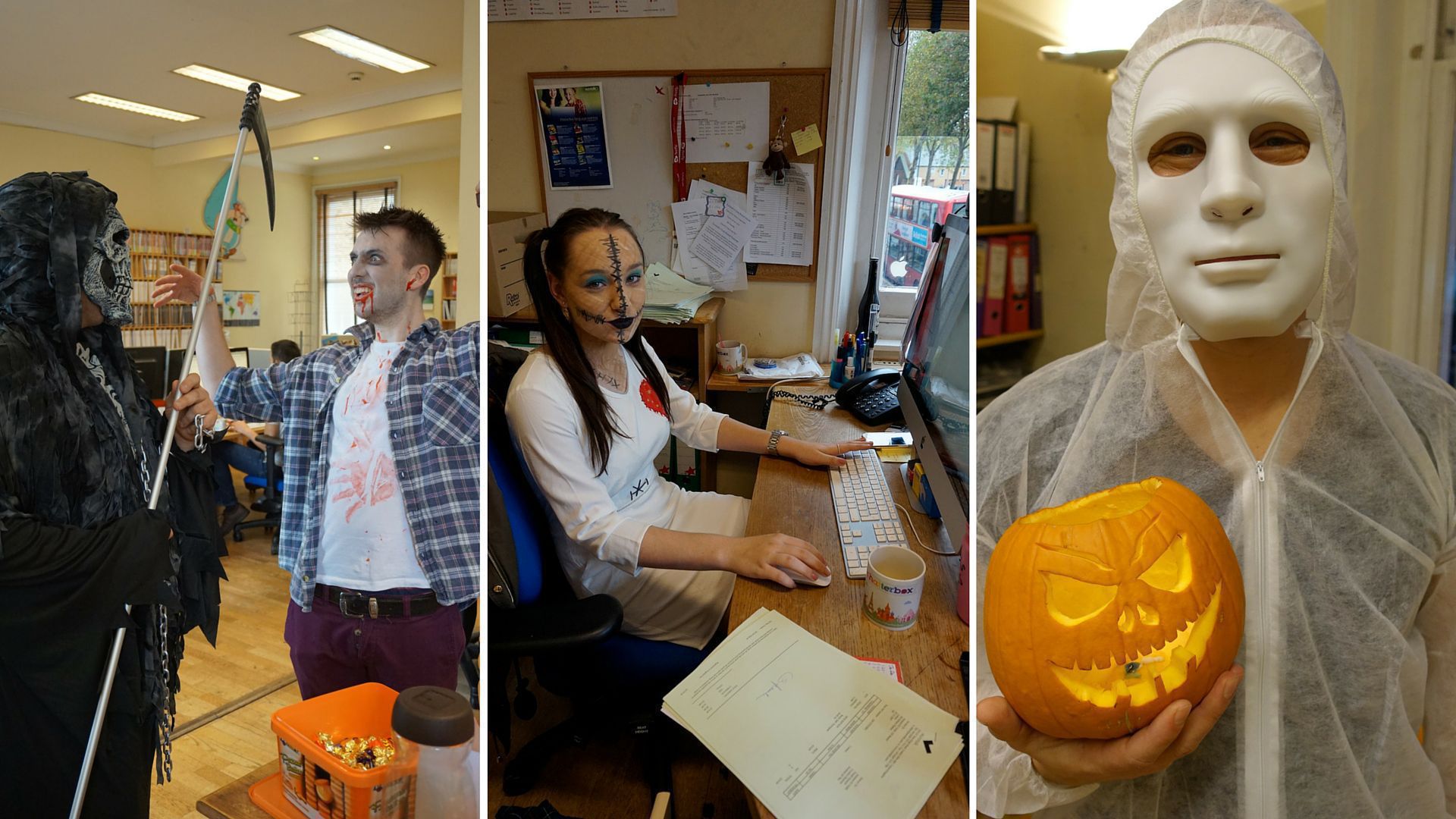
We also took the opportunity to put together this little video of Halloween-themed English idioms, starring members of the (endlessly talented, we’re sure you’ll agree) EuroTalk team.
We’re expecting our Oscar nomination any day now.
We really hope you love this video as much as we enjoyed making it. If so, please share it with friends, and let’s keep the madness going 😉
And we’re always open to suggestions, so if you have idioms – English or other languages – that you’d like to see immortalised in video, we’d love to hear them!
Taking the Stress Test: how emphasis can change meaning
One of the hardest things to grasp when learning the English language is emphasis. Emphasising a different word in the same sentence, each time can completely change the meaning of it. Some people make the emphasis on a certain word very clear. This can give you the general feeling of the sentence.
Other times it can be harder to pick up the meaning of a sentence and this can lead to you misinterpreting what the speaker means. Emphasis is normally used when someone wants to convey how he or she feels about something; this could be something they feel emotional about.
For example my mum could say to me ‘you’re not doing that tomorrow’.
This could be her checking with me ‘you’re not doing that tomorrow?’ implying that I am, or might be doing it on a different day. However, it is more likely that she is saying to me ‘you are not doing that tomorrow!’ – using this emphasis would make it clear to me that there is no chance I will be doing whatever I wanted to do tomorrow.
Emphasis is used by:
- Stretching out the vowel sound.
- Pausing after the word that is being emphasised is spoken.
- Speaking slower when saying the word they want to emphasise.
- The first syllable is pronounced louder than the other syllables.
Try emphasising a different word in this sentence each time you say it.

‘She isn’t flying to Hawaii tomorrow’
- By emphasising the ‘she’ it implies that it is someone else that is flying to Hawaii tomorrow.
- The ‘isn’t’ shows that she’s not doing this anymore.
- Emphasising the ‘flying’ means that she’s not flying, she may be getting there another way instead.
- ‘To’ this could mean she is flying from or by Hawaii not to.
- Emphasis on Hawaii shows that it could be a different location, not Hawaii.
- Finally, ‘tomorrow’ could mean that it’s actually a different day, not tomorrow.
Isn’t it strange how one sentence can be used in so many different ways?
Alex
Junior Language Challenge: Aalaya’s story
Last week, we heard from Jackie Gliniecka, a teacher at The Hawthorns School in Surrey, about her experience of the Junior Language Challenge over the last ten years.
But how does it feel to take part in the competition? Today we’re sharing runner-up Aalaya Sanjeeva’s story, which begins three years ago…
Aalaya
I started JLC when I was in Year 3. In the first year, when I got through to my first JLC finals, I did not make it to the final 12 after the heats. However, just getting into the finals was a fantastic experience and I just had to do it again the following year. In the second year, I worked really hard and made to the final 12 but not the top 3. This year, my friend Nithya and I worked our way through to the finals and we both did really well to get into the top 18. It felt so great and seriously nerve wracking while we were playing, when I came second I could not believe it (I still can’t believe it).
I would recommend entering JLC as the whole experience is a lot of FUN and besides, learning languages is an important skill, it helps you communicate better when you go to foreign countries and also since you know where the money is going and what it is helping with (onebillion), it inspires you and makes you work even harder for it! Over the years, I have seen the videos of a school classroom built in Malawi and happy children learning to read and learn maths in their native language and progressing quite well. It makes you happy to see their smiles when they get the stars on the iPad.
I also remember Martha Payne, a girl not much older than us, who handed out the prizes during JLC 2013 – her story, ‘Martha, Meals and Malawi‘ was amazing and really inspiring and touching!
I had great fun learning all the 9 languages over the last 3 years 🙂 Thank you, team JLC for the wonderful opportunity!
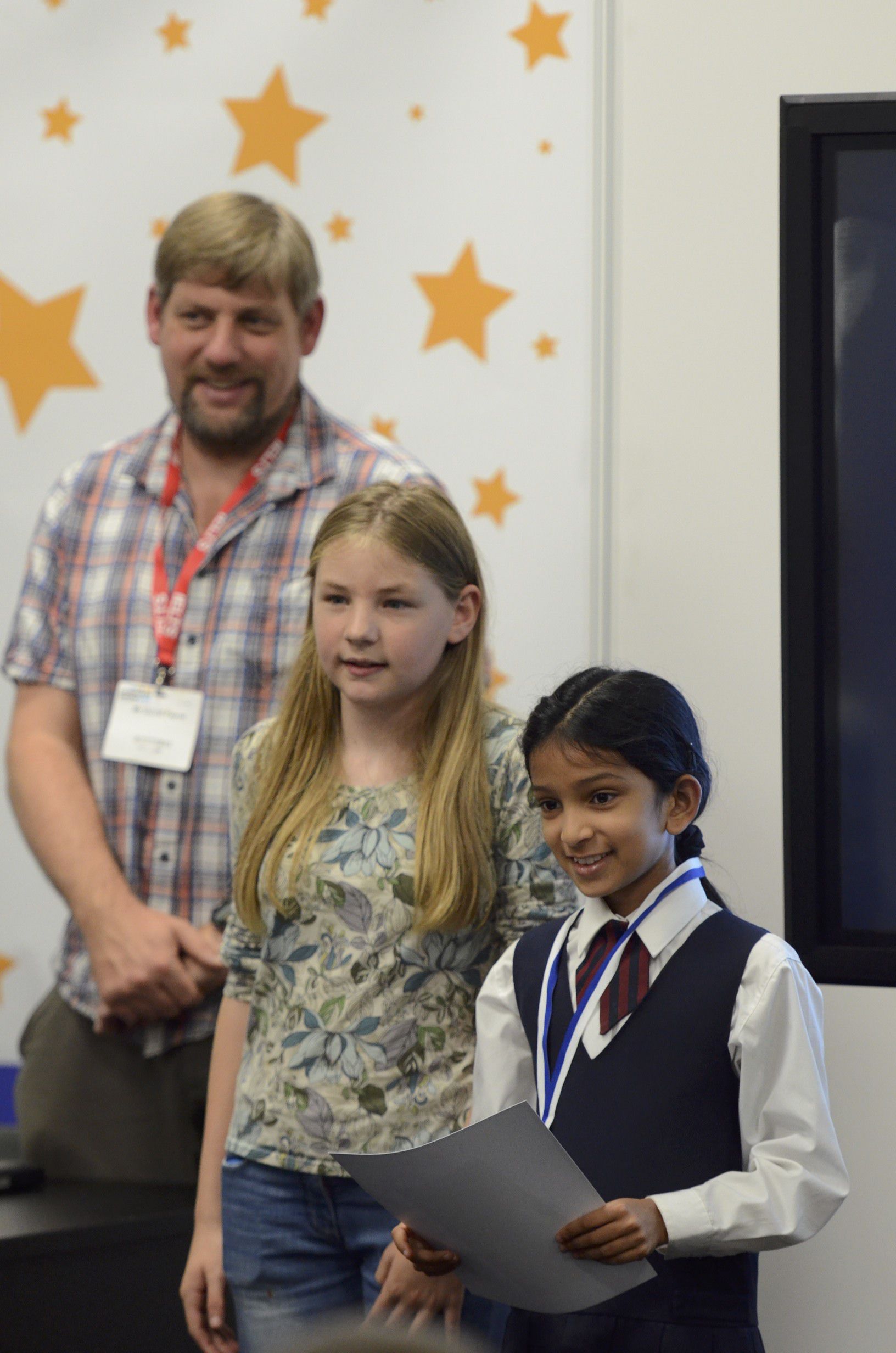
Aalaya receiving her medal and certificate from Martha Payne at the JLC Final 2013
Aalaya’s parents, Sanjeeva and Priya
We have had an amazing experience learning so many languages over the last 3 years, it has instilled in Aalaya a love of languages that will stay with her for life and the steadfastness of effort that was required was also something wonderful to see in all the kids who have done multiple rounds. Plus she has had tons of fun, going to the semi-finals and finals – looking forward to the special journey to London Olympia with her teachers Mrs Gliniecka & Mrs Guest and schoolmate Nithya, the exposure to the huge language show opening up the wonderful world of linguistics and last but not least, those marvellous goody bags – all part of a wonderful package for a young child 🙂
Your team (Liz, Franco and others) and Richard Howeson are amazing and inspirational people – the happiness and camaraderie and the genuine passion in what you do is so evident every year! Richard, especially, with his vision for onebillion, has been so instrumental to all this and much more. The progress we saw unfolding with EuroTalk and onebillion was heart-warming, it gives a lot of hope for the future. We hope and pray that onebillion will achieve the goal for which it was founded and will try supporting it by encouraging more children to join the competition every year!
Some learning stays for life! Aalaya has been very inspired by the wonderful initiatives she has witnessed and this in turn with similar other experiences will help her grow as a responsible person.
THANK YOU again and keep up the good work!
Two ever grateful parents! 🙂
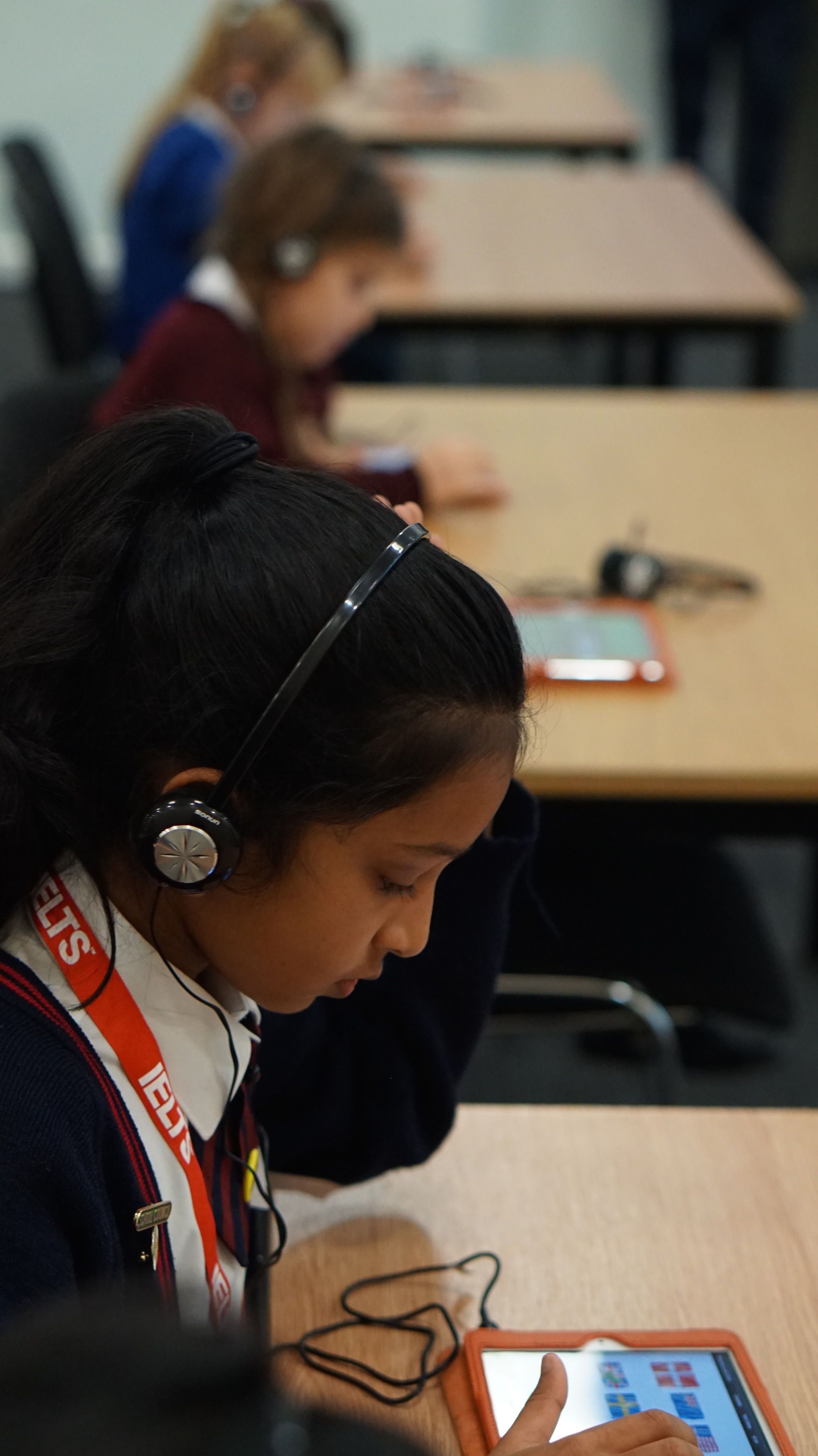
Aalaya at this year’s JLC final, where she came second
If you’d like to know more about the Junior Language Challenge, or you’re thinking of entering next year, please do feel free to contact us at jlc@eurotalk.com or visit eurotalk.com/jlc, where you can sign up to join the mailing list and be first to know all the details of the 2016 competition.
