Tell us about your Tartan…
We were disappointed recently to find that – somehow – we had missed National Tartan Day. I know! We’ll do better next year.
Although you might think National Tartan Day is a Scottish endeavour, it actually stems from North America and seems to have developed into rather a massive Celtic festival. Which leads us to wonder, what exactly is tartan and why is it so important?
When we think of tartan, we generally think of a woven patterned cloth which belongs to a particular Scottish clan. Most clans will tend to have both a dress and hunting tartan, the hunting tartan being a sombre version made up of dark colours whilst the dress usually swaps a colour from the pattern out for white, making it much brighter. There is a lot of etiquette around tartan, and I for one would not try to wear a tartan that I had no connection with, sticking instead to the tartans from my family’s history.
Or, I might wear a Cornish tartan, because in recent times tartan has become increasingly used by regions, ethnicities and businesses. Cornwall’s tartan was created in the 1960s and has really caught on, being widely available on tourist knick-knacks and formal clothing. At a wedding I recently attended, the groom and best men were all wearing Cornish tartan waistcoats, and the Cornish tartan kilt is not an unusual site at a festival. What is perhaps especially nice about this regional tartan is that anyone Cornish is entitled to use it- there’s no difficulty in etiquette- and even if you’re not Cornish but want to celebrate Cornwall, you’re more than welcome to help yourself to some Cornish tartan, as long as you can stand the slightly weird and bright mustard yellow of it…

If you want to wear tartan but don’t really feel a particular affiliation with a particular clan, then a good option for British and Commonwealth citizens is the Hunting Stewart tartan which, being Queen Elizabeth II’s personal tartan, can be used by all of her subjects. The other good option is Black Watch, also known as Government Tartan, which is traditionally available to those who don’t have a tartan of their own.

Do you have a particular tartan you wear, or thoughts on tartan etiquette? We’d love to hear from you!
Nat
A cab ride in Toronto, a cab ride in the world
Patricia is one of our most hard working uTalk challenge participants, learning Basque, Czech, Farsi and Kazakh since January (and let’s not forget Icelandic, Esperanto and Latvian last year)! We can’t wait to hear which language she’ll choose next…
There are many reasons why I love learning languages, including popular ones such as improving my résumé or getting by on a trip (and yes, I’ve got another trip to Iceland lined up, það er spennandi!). However, today I’d like to share with you one reason that is perhaps a little less obvious.
Due to an unexpected flight delay on my way from Pittsburgh, I recently overnighted in Toronto. The airline provided us (wonderful) accommodation in downtown Toronto and I shared a cab ride with two other stranded passengers. The cab driver had a talk radio station on, but it was not in a language I immediately recognized. Curious, I asked the driver which language that was. He told me it was Amharic, one of the languages of Ethiopia. I excitedly told him it was a language that was on my uTalk Challenge list and that I would learn it soon. Promise. He laughed and told me a little about Ethiopia and the Ethiopian community in Toronto. He taught me how to say “Hello” in Amharic and said I was brave to take on a new language every month. He then asked which language I was learning at the moment. I told him I was learning Persian (Farsi) and loving it.
The other two passengers in the cab then turned to me and said “well maybe we can help you then”. I lit up and proudly said “shabetun bekheyr”, “parvaz”, and “ba t’akhir” – “good evening”, “flight”, and “delayed”. They smiled and asked me what else I knew and if I had any questions about the language. And from there on, we talked about the old Persian script, Noruz, the influence of French, various historical events, Persian poets, and many other things. When I had left my house that day, I hadn’t expected to learn so much from people who, up to that taxi ride, were perfect strangers.
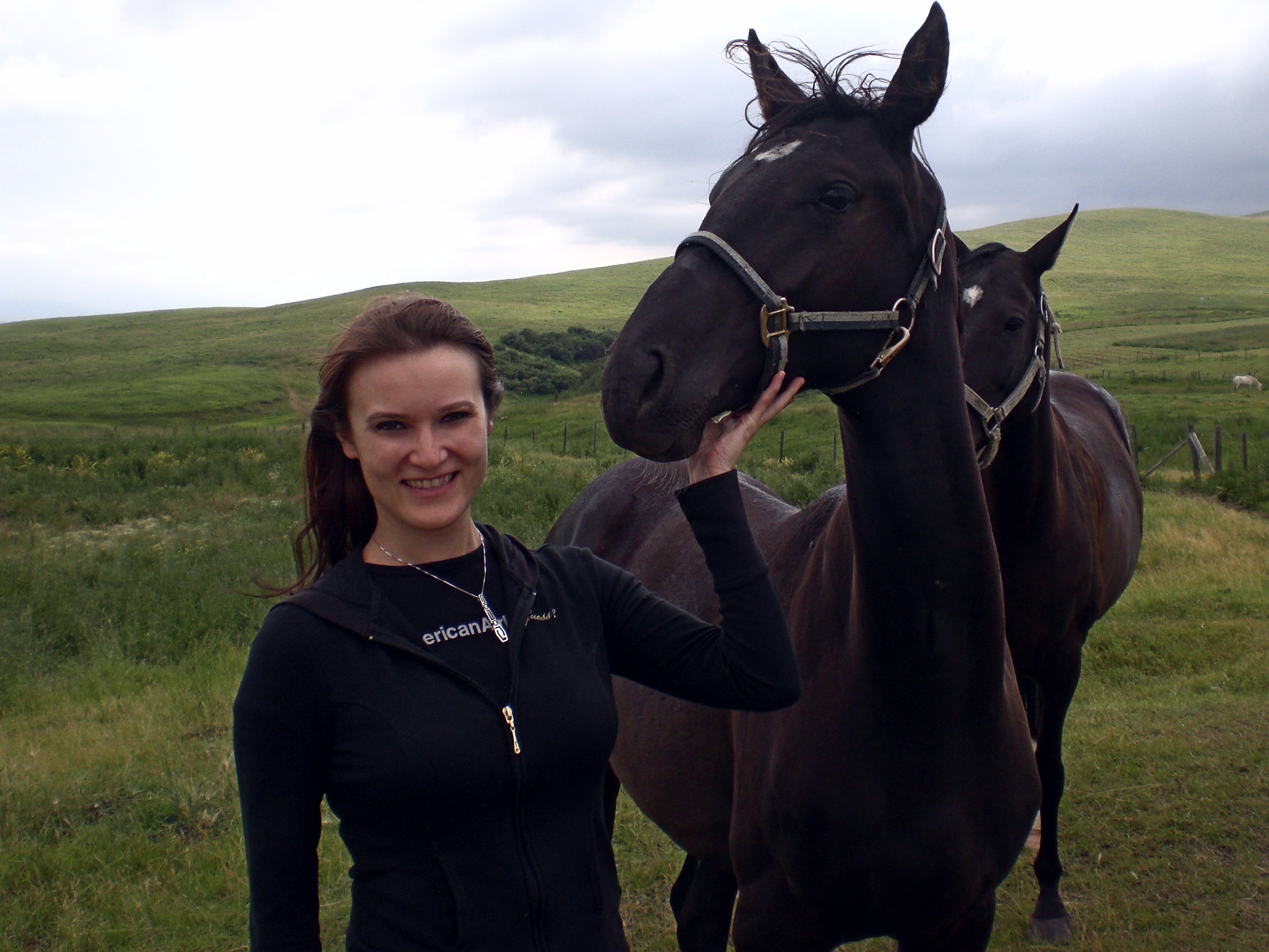
Patricia with two beautiful Akhal-Tekes horses from Cynthia Swensen’s Bold Vantage Akhal-Tekes farm in Canada. She loves horses and told us that these and other related breeds have historically been bred in Iran and Turkmenistan.
And that’s exactly the point: learning languages, even at a rudimentary level, opens you up to the world because it fuels curiosity. I didn’t converse in fluent Persian with my fellow passengers – I just let them know that I was interested in it and the culture and history that surround it (but it was very nice to hear that my pronunciation’s lovely!).
On that night, immersed in the vast multiculturalism of Toronto, I suddenly felt extremely connected to the world. And that’s the feeling I keep seeking over and over again in my language-learning journey. Perhaps it’s one of those “chicken or egg?” things, where it’s unclear whether learning languages opens up your mind or if it’s the curiosity that encourages you to learn languages… but whichever one came first for me, I’m certainly happy they keep feeding off each other.
So go ahead, tackle a new language, just start with a few words – you never know where it’ll take you.
Ready to start? Check out uTalk for iOS to start learning a language for free – or visit our website.
The Jungle Book’s taught you some Hindi without you realising…
The majority of us have seen The Jungle Book or at least can hum along to ‘The Bare Necessities’. And we are super excited about the release of the new Jungle Book adaptation, so we thought we would find out how Rudyard Kipling came up with all of the animals’ names.
As the film is set in India, many of the names are based on the Hindi translation of the animal themselves. For example ‘Baloo’ is based on the Hindi word Bhãlū which means bear. Bears represented the idea of protection, courage and physical strength. The bear showed authority and was seen as a good omen and arguably Baloo is Mowgli’s main carer. Similarly, Bagheera is almost the same word as Baghirā which means black Indian leopard. This is the same with Hathi, which is the exact word for elephant in Hindi.
Kipling also used influences from Persian and Arabic, with the tiger’s name ‘Shere Khan’. The word for tiger in Persian is just ‘Shere’ which is followed by the Arabic word for lord ‘Khan’. Kipling surrounded Mowgli with animals that all represented strong and powerful companions. All of the animals that looked after Mowgli were given characteristics, which made them ideal for looking after the young boy.
Despite this, the main characte, Mowgli’s name hasn’t come from Hindi or any other Indian language. At times he is named ‘the frog’ due to his lack of ‘fur’ and inability to sit still, or ‘man cub’ by the wolves that raise him, but his name doesn’t actually translate into anything; Rudyard Kipling made it up. Kipling also stated that Mowgli is meant to be pronounced, mow-gli, with the ‘mow’ rhyming with ‘cow’.
The influence of Hindi and other Indian languages in The Jungle Book comes from Kipling’s upbringing in India. He was born there before moving to England to be educated when he was 5, and once he’d completed his education he returned to India. The book is based on the Indian jungle ‘Seonee’ (now known as seoni) however, he had never actually visited this place. Kipling actually used stories from his friends to set the scene of the jungle. Maybe his friends told him about the singing bear in the jungle…

Happy St George’s Day! 6 reasons to love England
Ioana has been living in London for 2 and a half years. She believes moving to London was the best decision she ever took, and here she shares some of the reason why England is amazing. Happy St George’s Day!
I vividly remember one of the first times I went by myself to the supermarket after I arrived to London. The cashier asked me how my day was going, smiled and made small talk. Now that may seem something natural if you’ve lived here for a long time but believe me, that made such an impact on me. If it’s one thing that stands out from the Brits’ behaviour that’s politeness and it makes such a positive difference to respect each other and live in a comfortable environment.

Many people ask me “So how’s the food there? I heard it’s bad,” thinking about the heavy English breakfast with beans and sausages. Now I’ve never had an English breakfast but what I have had is porridge. Porridge is amazing. If I would have to choose one thing to eat for the rest of my life then that’d be it.
Tea with milk. In some countries when people say “tea” they think of infusions, camomile tea, raspberry tea and so on. So imagine thinking about having that tea with milk. Disgusting. Which was my thought exactly until I found that the Brits actually drink black tea, the English Breakfast. It goes really really well with milk, especially on gloomy days, staying warm inside and curling up with a cuppa.
Hard working and devoted people. Brits work hard and put passion in what they do. They rarely treat tasks superficially and they have a natural sense of going the extra mile when it comes to delivering performance. No wonder London is one of the biggest and most successful cities in the world. These people work hard and play hard.
British accent. It just makes everything sound so sophisticated. It’s not easy to master, I’m still working my way through it but it’s totally worth it.
Balanced weather. Now hear me out. I’m not saying British weather is the best. But having a balanced temperature throughout the year means very rare or no snow in the winter and bearable temperatures in the summer. Which is how it should be in a city where we go to work and don’t have time to build snowmen or get a sun tan. That’s what holidays are for!
If you haven’t been to England yet, it’s definitely something you should consider, either for crazy, busy, exciting London or for the more quiet little picturesque villages in the countryside.
Ioana is responsible for Customer Care at EuroTalk and handles all communication with potential or existing customers. She’ll also help you with Tech Support for either the uTalk app or our computer based programs.
Stars and Specials: what’s new in uTalk
Our small office has been very busy recently preparing a big new update to uTalk, and we’re very happy to finally share it with you! Some of you may have already tried it – if you have we’d love to hear what you think.
So what’s new?
Stars and Specials
Stars are the biggest change within the new features, and it’s safe to say we’re all pretty excited about them! With the Stars, the more you play the more you get, so they’re basically in-game coins. By earning stars and achievements you can then buy additional topics or what we call uTalk Specials. These are extra topics that you may find helpful in various situations such as Camping, Driving, Sailing and many others.
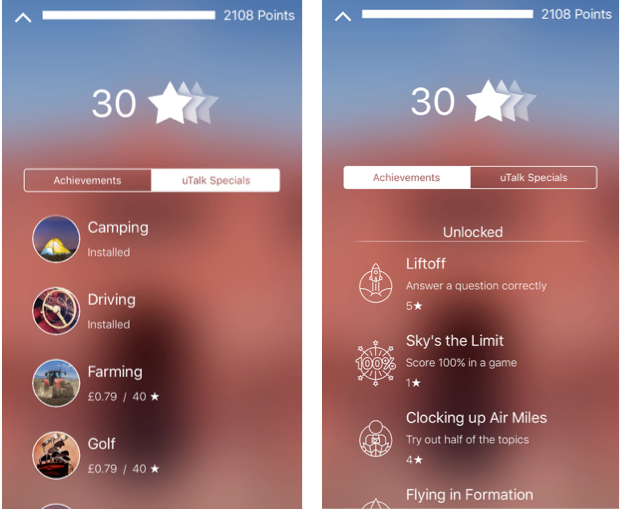
Dashboard
We’ve introduced the Score Dashboard where you can see your points, your stars, uTalk Specials and Achievements. These are designed to keep you motivated; every time you get past a small milestone (like getting 30 correct answers in a row or try out half of the topics), we’ll reward you with stars that can be used to buy the uTalk Specials.
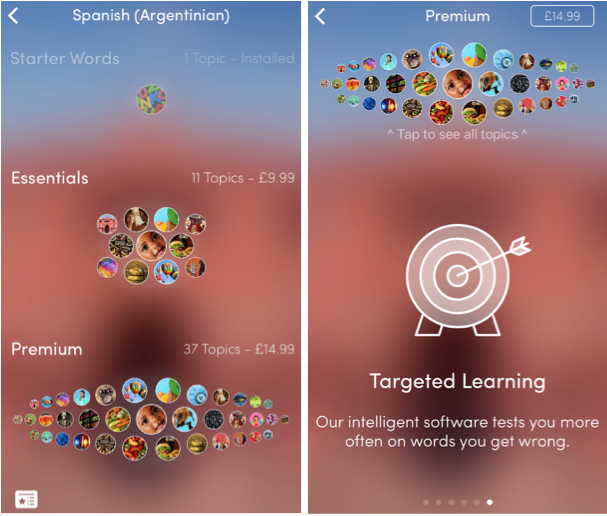
New-look store
The store inside the app where you can purchase extra topics has a brand new look too, which we think is nice to play with. We’ve added beautiful imagery and interactive descriptions of how the app features will help you learn, so you always know exactly what you’re getting.
Instant Search
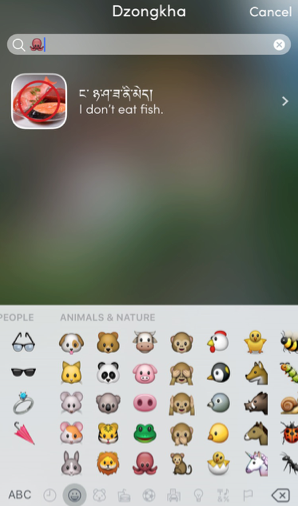
Something that’s not new but always helpful to have is the search bar at the top of the screen that you can use to search for words when you’re in a rush. Plus, you can search with emojis too!
The uTalk app is free to download for iPhone and iPad, and you can try any of the languages for free with our Starter Pack. We’d love to hear from you so please get in touch at info@eurotalk.com or even better, if you love the update, leave us a review on the App Store and we’ll be your friends for life 🙂
