Why learn Chinese Chengyu?
Today’s guest post is by Joe Paterson, a student at Keats School in China. Joe explains Chinese chengyu, which are absolutely fascinating and a perfect example of why we love languages so much – they’re all so unique and interesting. Do any Chinese speakers have more examples – or does the language you’re learning have an equivalent?
 Each language has its own idiomatic richness. English is full of proverbs, sayings and odd phrases like ‘Bob’s yer uncle’. Chinese is no exception. When you learn Chinese in China, you will definitely come across all kinds of interesting and creative ways of saying and expressing things. 土包子 (tubaozi/earth steamed-bun) means a country bumpkin or someone with backward or poor taste, and to wear 绿帽子 (lv maozi/ green cap) means to be cuckolded. But perhaps the most uniquely Chinese idioms are 成语 (chengyu).
Chengyu are four character phrases that can be thrown into daily conversation but will throw up a wealth of meaning and significance to the interlocutor. Some of these phrases seem quite bizarre without a context, but many have a background story which explains the meaning and also conjures up images that reinforce the word’s meaning.
The first chengyu we will look at is 东施效颦 (Dongshixiaopin/ Dong Shi effect frown). The literal translation is altogether puzzling but a native speaker would instantly know the meaning to be to imitate someone but have the opposite to the desired effect. It is only when we know the background story to the saying that we can fully comprehend it. The story goes that there was a beautiful girl named Xi Shi in the ancient Yue state who was admired by everyone in the village. However Dong Shi, another girl, was ugly and could never command attention. One day when Xi Shi fell ill she walked out of the door holding her hand to her breast, her face contorted in pain. All the villagers were concerned at her trouble and pain. Seeing this, Dong Shi attempted to imitate her mannerism. But when the villagers saw such a grotesque sight they were repulsed and ran away.
Nowadays people might use 东施效颦 to describe someone blindly imitating a pop star’s outfit, only to be ridiculed themselves for looking stupid. Or, someone plagiarising another’s business idea only to find themselves go bankrupt.
The second chengyu is 刻舟求剑 (ke zhou qiu jian/mark boat search sword) which means to pursue a goal despite changing circumstances that should be considered, or, in short, being stubborn in a foolish pursuit.
The phrase comes from a story where a man drops his beloved sword into a river. He marks the side of the boat to show where the sword fell in. Once at the shore he dives back in to find the sword but to no avail. Of course between marking the boat and getting to the shore the boat has moved downstream. An example of when his phrase could be used might be if someone insists in investing in a certain product even if research shows that the product might not sell.
Other phrases are not strictly chengyu but are made up in the same structure and used in daily speech, even though most people may not know the exact origin of the term.
乱七八糟 (luan qi ba zao/confusion seven eight pickle) is a word used to describe anything messy and unorganised, from a bedroom to the way in which someone does something. The phrase actually originates from a late Qing dynasty novel by Zeng Pu, in which he describes the way craftsmen used to keep their workshops in a 乱七八糟 state.
Many common chengyu may not have such an interesting background but serve to colour the language with images that are created by the visual characters themselves or their meaning. 自讨苦吃 (zi tao ku chi/ self ask for bitter eat) provides an image for the idea to ‘ask for trouble’ and 利欲熏心 (li yu xunxin/ profit desire smoke heart) would be the equivalent of the English phrase ‘blinded by greed’, but creates an interesting image of the desire for profit creating a vapour masking the heart.
The ability to use chengyu well is very much admired in China and so it is well worth trying to improve one’s own use and trying to learn more. After a while some chengyu become so natural to explain a certain scenario or situation that sometimes they even surpass one’s own mother tongue equivalent word or phrase. Taking a Chinese language course from a professional language school could help to establish one’s linguistic and cultural foundation to be able to understand and use chengyus in a versatile way.
Joe Paterson (Keats School)
Quote of the week: 18 Oct 2014
“You’re braver than you believe, and stronger than you seem, and smarter than you think.” Christopher Robin

Embed This Image On Your Site (copy code below):
Quote of the week: 11 Oct 2014
“The best way to not feel hopeless is to get up and do something. Don’t wait for good things to happen to you. If you go out and make some good thing happen you will fill the world with hope, you will fill yourself with hope.” Barack Obama

Embed This Image On Your Site (copy code below):
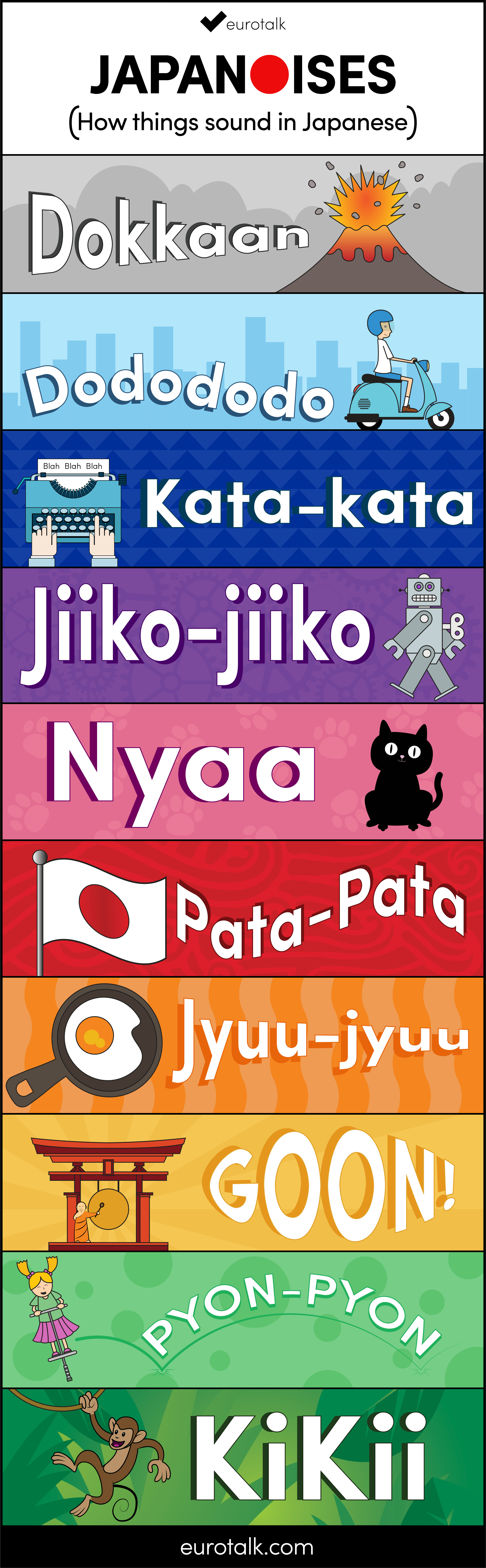
Japanoises (How things sound in Japanese)
Have you ever wondered how to make the sound of a typewriter in Japanese? Or how to describe the noise a cat makes?
Well, wonder no more. We present to you – Japanoises! (Yes, we were so excited that we made up a word.)
Which one’s your favourite?
Other Japanese sounds that almost made it into our top ten – ‘Doki-doki’, which is the sound of an anxious heartbeat, and ‘Chokon’, which is, literally, the sound of silence.
How do you describe these sounds in your language?
Like this? Please share it with friends! Let’s get #Japanoises trending… 😉
Embed This Image On Your Site (copy code below):
Language of the Week: Japanese
As it was the Japanese Grand Prix on Sunday, we have chosen Japanese as our Language of the Week.
First and foremost, our thoughts and good wishes go to Jules Bianchi for his full recovery following his crash on Sunday at Suzuka.
Though in many respects I’m a complete petrol head, I have never found Grand Prix very interesting to watch, lap after lap, rarely exciting in my book. However, when I started to research the history of the Japanese Grand Prix, I found some interesting facts:
Surprisingly it is the only circuit that crosses over itself in a figure of eight and therefore runs both clockwise and anti-clockwise.
The fastest lap ever recorded at the Suzuka circuit is 1:30.54 minutes and was set by Kimi Räikkönen in 2005. To put this into perspective, since the track is 3.387 miles long, if a Cheetah could run at its fastest for further than 1500ft, it would take it approximately 2.7mins!
When looking to learn Japanese it can appear very daunting because of the characters. However, it is one of those languages which is much easier to speak than write. Unlike the majority of languages, nouns do not have genders and there is also no differentiation between singular and plural. Personally, we love both these facts. There are also no pronunciation or tones.
Here are a few fun facts about Japan:
 Japan’s trains are among the most punctual in the world, their average delay is just 18 seconds. (What we’d give for that on a rainy Monday in London!)
- Japanese farmers are growing square watermelons, because they are easier to stack and store. (Now that is thinking outside the box! Or is that inside?)
- In Japan there is a cat café where you can and go drink coffee whilst hanging out with cats for hours (Is that a new kind of speed dating opportunity?)
- This one has to be one of our favourites – sleeping on the job is acceptable as it’s a sign of exhaustion from working hard. (Sweet dreams!)
- In Japan there is no Ronald McDonald!! But panic not Big Mac fans, he’s called Donald McDonald due to the lack of a clear “R” sound in Japanese.
- There is an island in Japan called Ōkunoshima or Rabbit Island, since numerous feral rabbits run wild, though apparently they are quite tame!
The challenge for you all this week is another tongue twister:
Niwa no niwa ni wa, niwa no niwatori wa niwaka ni wani wo tabeta
Which means: In (Mr) Niwa’s garden, two chickens suddenly ate a crocodile.
So let’s see your best efforts! Send us your videos on Twitter to @EuroTalk using #itsJapaneasy or send them to us on Facebook – our favourite will win a free uTalk Premium in a language of your choice. Get twisting!
Are you learning Japanese? Or do you have any favourite facts about the language or the country? Let us know in the comments!
Amy
