What’s your excuse for not learning another language?
Even as a pretty serious language geek, who actually learns other languages for fun, I still find myself making excuses sometimes. I spotted this chart the other day (I’m not sure where it originally came from, but I found it when translation agency Finverbus shared it on their Google+ page) and recognised a lot of the excuses as ones that I’ve made at one time or another. It also backs up what we learned in our recent survey. How many of these excuses have you used in the past?

Most of us learn at least one foreign language at school. But sadly many people drop it after that and possibly never take it up again. But why? According to research, there are many reasons (or excuses) that people have for dropping a language or not taking one up. Most commonly, many people say they don’t have enough time (24%) or that they don’t have enough money (11%). Well, if it’s the first reason, check out our top tips on how to fit language learning in to your busy week. Or if you’re struggling for cash, check out our guide to learning on a budget.
The other main reason cited by many is lack of motivation (16%). I have to say I recognise this! When you start learning a new language it’s really exciting. ‘I can say “dog” in French!’, ‘I can say “hello” in Italian!’ But then when you get to memorising long lists of verbs, tenses and grammar, enthusiasm often starts to wane. You have to put quite a bit of time and effort into learning a language properly, and often, life gets in the way, and the latest episode of Game of Thrones seems more interesting than another round of German adjective endings. If this is the case, I feel your pain! But there are ways to boost your motivation and get back into learning if you’ve lost momentum lately.
Try breaking up your language learning into a small chunk each day: ten minutes of using a language app or program like uTalk or Talk Now; reading a newspaper article or language book on the train or listening to a short podcast. Make learning fun by listening to music or podcasts, watching videos or films, reading books or magazines or using fun language games. Don’t put too much pressure on yourself to master perfect grammar – just enjoy it. Find people to chat to and impress yourself with how much you can say already.
Try thinking about what your motivation for taking up a language could be: a holiday to a fantastic new country, moving abroad for work, finding new friends, talking to someone you know in their language, understanding the culture of a certain country (be it Japanese anime, French cinema or German heavy metal) or enhancing your CV. Somehow half an hour of practising verbs and vocabulary seems much more appealing when you picture yourself using your newly-learned ‘un caffè grazie’ to order a coffee in Rome, or asking ‘dónde está la playa?’ in the south of Spain.
Finally, another common reason that I can definitely identify with is feeling embarrassed when speaking another language (11%). I was pretty embarrassed this week when speaking Spanish to my Argentinian colleague and accidentally using the Italian word for butter (‘burro’) instead of the Spanish word ‘mantequilla’ (burro in Spanish means donkey, not butter!). But in most cases, even if you make a silly mistake like this, you can just laugh it off and carry on. It might take a little time to gain confidence when speaking, but the best way to do this is simply to try it, make mistakes, realise it doesn’t matter and carry on. If you’re quite shy, try finding another learner to practise with, doing a language exchange with someone who is learning your language (so you’re in the same boat) and practising with friends before you actually go to the country.
Saying that, the BBC language page has some funny examples of when languages go wrong!
So, whatever your reasons for slacking off in your language learning, I hope we’ve given you a few ideas on how to get back into it, or get started on a new one if you’ve been putting it off.
Alex
10 reasons to visit… Bruges
Have you ever visited a city that managed to change your mind?
I visited Bruges earlier this year. Unfortunately, I’d accidentally timed my visit to coincide with the enthusiastically named ‘Amateur Arts Festival’, and consequently spent Saturday night with tissues rammed in my ears and arms clenching pillows to my head, as my hotel room shook with the relentless noise of amateur bass. I thought then that the chances of coming up with ten reasons to visit Bruges were pretty slim. Yet on Sunday morning, with the loudspeakers in the square finally silenced and the sun out, I became enchanted with this town that everyone always refers to as a peaceful haven of canals. These are the things which managed to turn my opinion around in the space of just one morning.
1. Trains
I get a bit excited about foreign trains, I know, but going to Bruges presented me with a new wonder: the double decker train. True, this is not localised to Bruges alone but most of the IC trains from Bruxelles seemed to be two storeys high, giving a fantastic view of the very flat countryside (and occasional windmill!) from the top deck. The trains are smooth and cool, and the conductors wear an amusing flat cap as part of their uniform. If you’re just planning a short visit to Bruges, you can get the Eurostar to Brussels and travel on from there (it’s about an hour on the fast train, two hours on the slow train).
2. Canals and boat trips
I wouldn’t say the town is riddled with canals in the same way Venice or Amsterdam are, but they linger in the backstreets and circle the centre so that you stumble across them when you wander off the main street. Surprisingly, there didn’t seem to be any locals drifting around on pleasure boats, although there were a few promising houses whose main doors seemed to lead out directly onto the canal. Activity on the waterways instead seemed to be wholly dominated by the tour boats, taking cargoes of visitors on half hour drives up and down the canal, streaming off fluent speeches in three languages as they went. If you’re only there for a short time, I’d advise a boat trip to get your bearings on the town, and to see some impressive buildings from otherwise undiscovered angles.
3. Chocolate
Belgium is world-famous for chocolate and there are lots of chances to sample it in Bruges. Having been there just after Easter, lots of independent chocolate shops were still displaying elaborate chocolate rabbits and chicken-shaped Easter eggs, as well as the usual array of picturesque truffles and pralines. It being the weekend, there didn’t seem to be anyone around making the chocolates, which was a pity, but I imagine that in the week you’d get a good look at the chocolatiers at work. I was particularly impressed with a small boutique called Stef’s, which sold chocolate tools dusted with cocoa to make them look rusty – I was entirely taken in until I decided it was highly unlikely that a food shop would fill its window with rusty tools.

4. Walking
Bruges, although it also has lots of famous sights, is perfect for the lazier tourist who just wants to meander and drink in the tranquil beauty. Cobbled streets with broad flat pavements and gentle bridges over canals provide a little haven to lose yourself in, and since the whole town is very small you soon enough stumble upon some familiar street or building to set you back on route. Horse drawn carriages trot past every so often, carrying bands of eager-eyed tourists, A particularly pretty walk turned out to be the wide promenade from the station into town (a very short stroll and definitely not worth getting the bus unless you have heavy luggage), which passes a beautiful pink-flowered war memorial and glides into the centre of town and some pretty little cafés.
5. Houses and architecture
The typical Flemish façade presides here, and people seem to take enormous pride in their property, keeping every gate neatly painted and every tile in place. With a maximum height of 30m for any building in the city, the scenery is all low-lying and the views from any high points are panoramic. Some interesting and very modern architecture brings a new sense of style to the traditional steep-roofed old houses.

6. Brewery
At one point home to over 50 breweries, Bruges now has only one active one, De Halve Maan brewery, which runs daily tours around its compact factory in the heart of the city. The tour, in Dutch, French and English, is definitely worth going on as it is stuffed full of information and lots of insights into why beer is healthy (an argument I always like to hear). They’ll also tell you that back in the ’50s the breweries would do home deliveries – you just had to ring a bell for the cart to stop and dispense beer to you directly. I imagine it’s no longer feasible to re-introduce this practice, but we can always dream… Having climbed right to the top of the factory and experienced the lovely view, you are released at ground level to claim your free beer in the spacious bar-restaurant, where one beer can easily turn into a happy afternoon sampling all the brewery’s many offerings.
7. Bike pumps
I’ve seen these around a little more recently – the free foot-operated bicycle pump – and I’m always impressed with a town that spends its money on something as practical and helpful as this.
8. Coffee…
and cake. This doesn’t need much explanation really: in Bruges, you can sit at a table on a cobbled pavement outside a bakery with exquisitely executed cakes and sip a small cup of intense black coffee. Although waffles seem to be the thing to have in Belgium, my favourite snack is the florentine – not a native Belgian sweet but nonetheless available in every cake shop.
9. Beers and beer glasses
Almost as attractive as the idea of sitting in a bar all day trying all the different beers is the idea of trying out all the different glasses. That may sound geeky but there are some really fun ones, including the absurd Kwak beer glass whose bulbous end makes it impossible to put down without the proper stand, and the La Corne drinking horn (which you can clink with a fellow Viking over a drinking toast and which, again, cannot be propped up except with the stand it comes served in). Good bartenders, the Belgians will tell you, will never serve a beer in the wrong glass, and each beer has its own glass, most of which are shaped like a chalice or a tulip.

10. Shopping
If this is what you’re after, you won’t be disappointed in Bruges. With a long, meandering high street full of clothes and chocolate shops, as well as a large market and side streets offering endless souvenirs, you could spend a day just in the shops. And if you’re looking for a bigger centre, Brussels is only an hour or so away by train, and Ghent is neatly stuffed in between the two, to make a weekend of it.
Have you been to Bruges? What were your highlights?
Nat
Quote of the week: 30 Aug 2014
“It’s never too late to start over. If you weren’t happy with yesterday, try something different today. Don’t stay stuck. Do better.”

For more like this, find us on Pinterest.
Embed This Image On Your Site (copy code below):
An introduction to Finnish
Here at EuroTalk, we love languages (obviously). And we particularly enjoy discovering fun facts about languages; they’re all so different and each has its own unique character. So we’ve decided to share some of them with you, in our new Language of the Week series. Each week, we’ll choose a new language, and we’re always open to suggestions!
Please do get involved – we love to hear from you, so send us your own favourite facts and have a go at our weekly challenge for a chance to win some fun EuroTalk prizes 🙂 You can join the conversation here on the blog, or on Facebook or Twitter, where we’ll be sharing more of our discoveries over the coming few days.
 So this week, we’re starting with Finnish, in celebration of the annual Air Guitar World Championships, which start in Oulu on Wednesday, and may be our new favourite event of all time.
Here are a few of the best things we’ve discovered about Finnish this week:
– Finnish is thought to be one of the hardest languages for a native English speaker to learn, because of its complicated grammar, which is nothing like English or any of the other languages we’re used to learning. Finnish words can also look pretty daunting to a new learner, as they’re very long and seem to contain a lot of vowels!
– There is no word for ‘please’ in Finnish – not because Finns are rude, but because they just assume politeness. There is a word which means ‘thank you’, kiitos, which is sometimes used in place of ‘please’, and the other way to indicate politeness is to use the conditional – ‘Would you…’
– Also interesting is that a grandson can be either pojanpoika if it’s the son of a son, or tyttärenpoika if it’s the son of a daughter. The same with granddaughter – pojantytär is the daughter of a son and tyttärentytär is the daughter of a daughter. But don’t panic; you can use just lapsenlapsi, which means ‘child of a child’, for a generic term.
– The word sauna is the most widely used Finnish word in English. There are 3.3 million saunas in Finland, which means there is 1 for every 1.63 people. Visiting the sauna is as normal for Finns as going to the pub is to Brits. It’s also a tradition to jump into the lake outside after a hot sauna. This sounds a little crazy and very cold!
– The Finnish language holds the world’s longest palindrome, and just in case you don’t know what that means, it is a word that can be read the same both ways. And here it is: saippuakivikauppias, which is a dealer in lye (caustic soda). Probably not something you’d say every day, but always useful to know.
– The longest Finnish word is 61 letters long (which is outrageous compared to English’s mere 45-letter longest word) and it is:
entokonesuihkuturbiinimoottoriapumekaanikkoaliupseerioppilas
Which means: ‘airplane jet turbine engine auxiliary mechanic non-commissioned officer student’.
– A Finnish tongue twister is:
Appilan pappilan apupapin papupata pankolla kiehuu ja kuohuu. Pappilan paksuposki piski pisti paksun papukeiton poskeensa.
There is no absolute translation but it’s about a vicarage’s assistant priest and his hot pot of beans, which are boiling on the stove and the vicarage’s fat mongrel who ate up the thick bean soup.
Language Challenge of the Week
So now it’s your turn. Have a go at pronouncing one of the words above, or, for ultimate respect, the tongue twister… Send us your videos on Twitter to @EuroTalk with hashtag #loveFinnish or post a link to your video in the comments below. If we’re really impressed, we’ll send you a code for uTalk Finnish 😉
Oh, and in case you wondered what’s so great about the Air Guitar World Championships…
I Can Read Chinese, So Can You
Today’s guest blogger, Peter Gokey, is learning Chinese in China at Keats School. In this article, he shares his own learning experience in Chinese, with a particular focus on learning to read the language. If you’re a student or speaker of Mandarin and have any suggestions to add, please do so in the comments below.
There are two aspects of Chinese that people from western countries find intimidating. The first aspect is the system of tones where the pitch of your voice can be the only difference between two or more words. The second is the writing system, called Hanzi. In order to speak, learners of Chinese must tackle the tones; however, since the barrier to reading and writing seems so high, many language learners delay studying Hanzi or never study it. This is often a reaction to one teaching method that emphasizes reading and writing at the cost of speaking. I think that either extreme is a mistake. Reading reinforces oral vocabulary and grammatical structures. Keats School finds a good balance by focusing on speaking and listening but also encouraging students to recognize the Hanzi for their new vocabulary words.
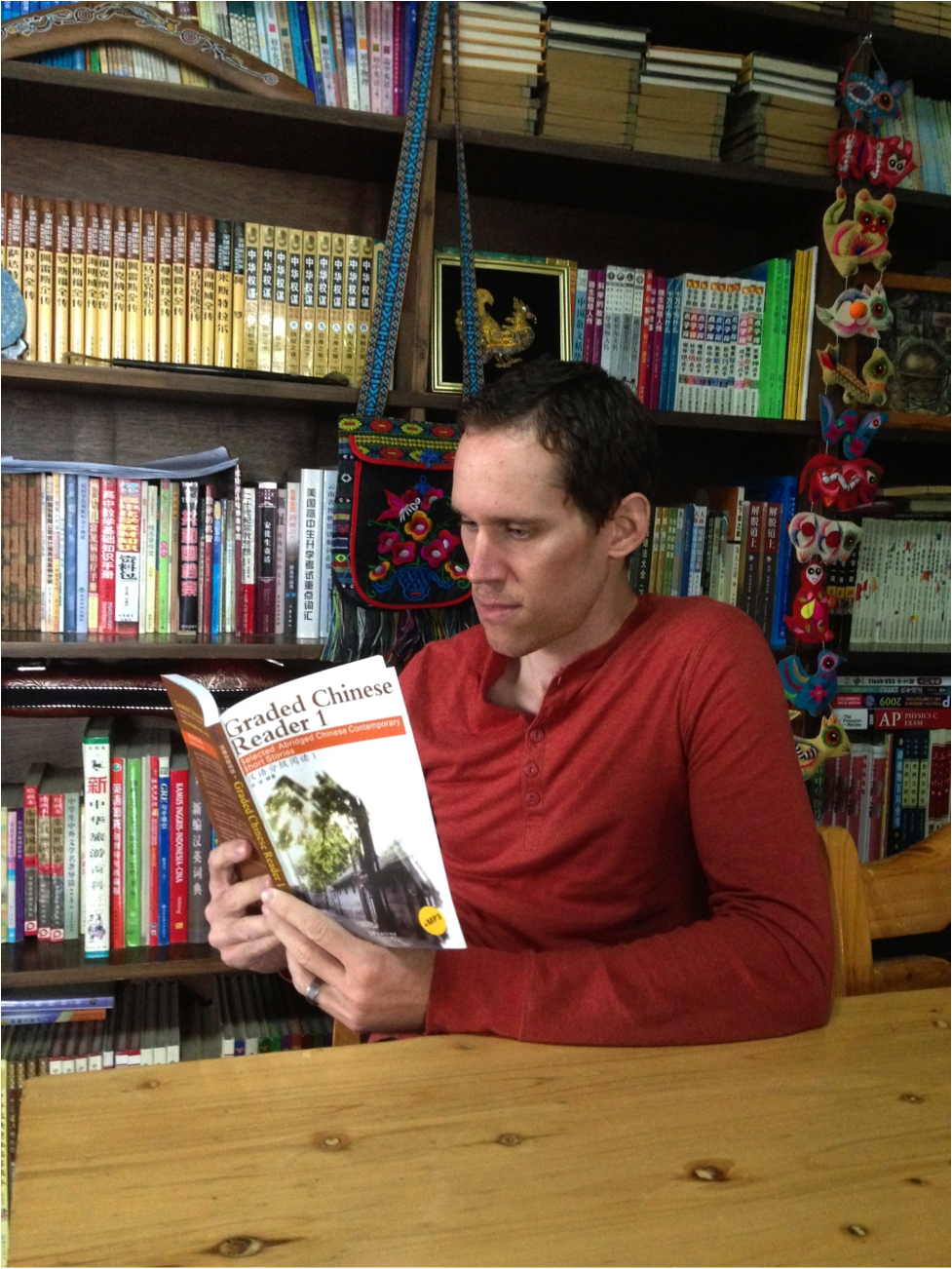
Finding materials suitable for a beginner-level Chinese language learner, can be a difficult and discouraging task. Early on, my wife and I purchased a book of very short stories designed for Chinese children who are learning to read Hanzi. One year later this book is still beyond our level, but Hanzi is only the secondary reason this book is too difficult. The primary reason is that Chinese children learning Hanzi and those foreigners who learn Chinese in China have different needs. By the time Chinese children begin learning to read Hanzi they are already fluent in spoken Chinese. So a book aimed at children can use thousands of words as long as the pinyin (the phonetic system for writing Chinese using the Roman alphabet) is included above each character. Second language learners, on the other hand, are not yet fluent. They are learning both how Chinese words are pronounced and how they are written at the same time. Therefore, second language learners like us need materials specifically designed for second language learners.
And the good news is that there are such materials. After learning to recognize about 300 Hanzi, I began reading the beginner-level books in a series called Chinese Breeze (15元 each). Each book is a short but interesting fictional story. In this series there is a love story, a murder mystery, and even a couple of traditional Chinese tales. So far this series consists of 16 books in three reading levels (300, 500, and 750 word levels). When complete, the Chinese Breeze series will include 80 titles divided between eight reading levels.

There are a few features about these books that I really like. First, pinyin only appears in footnotes defining select new words. I find it very distracting to practice reading Hanzi with the Pinyin right above it. Second, at the back of the book there are comprehension questions for each chapter and an activity that tests your understanding of the whole story. Finally, each book includes a CD with MP3 recordings of the entire story read by a native speaker at two different speeds.

Having read all the books at the 750 word level, I am now trying books from two other series. The first is a collection of short stories titled Graded Chinese Reader (three books in this series) and the second is a collection of very short essays called Read It Now (there are many books in this series at several reading levels). Both of these books also include CDs.
All of these books are available at Mandarin Books 漫林书苑 on Wenhua Xiang 文化巷 in Kunming.
Thanks Peter! If you’re learning Mandarin, we hope these suggestions are helpful for getting started on reading. Alongside these, you can use EuroTalk’s programs to begin speaking and listening. Good luck!
