Quote of the week: 16 Aug 2014
“Learning another language is like becoming another person.” Haruki Murakami

For more like this, find us on Pinterest.
Embed This Image On Your Site (copy code below):
Quote of the week: 9 Aug 2014
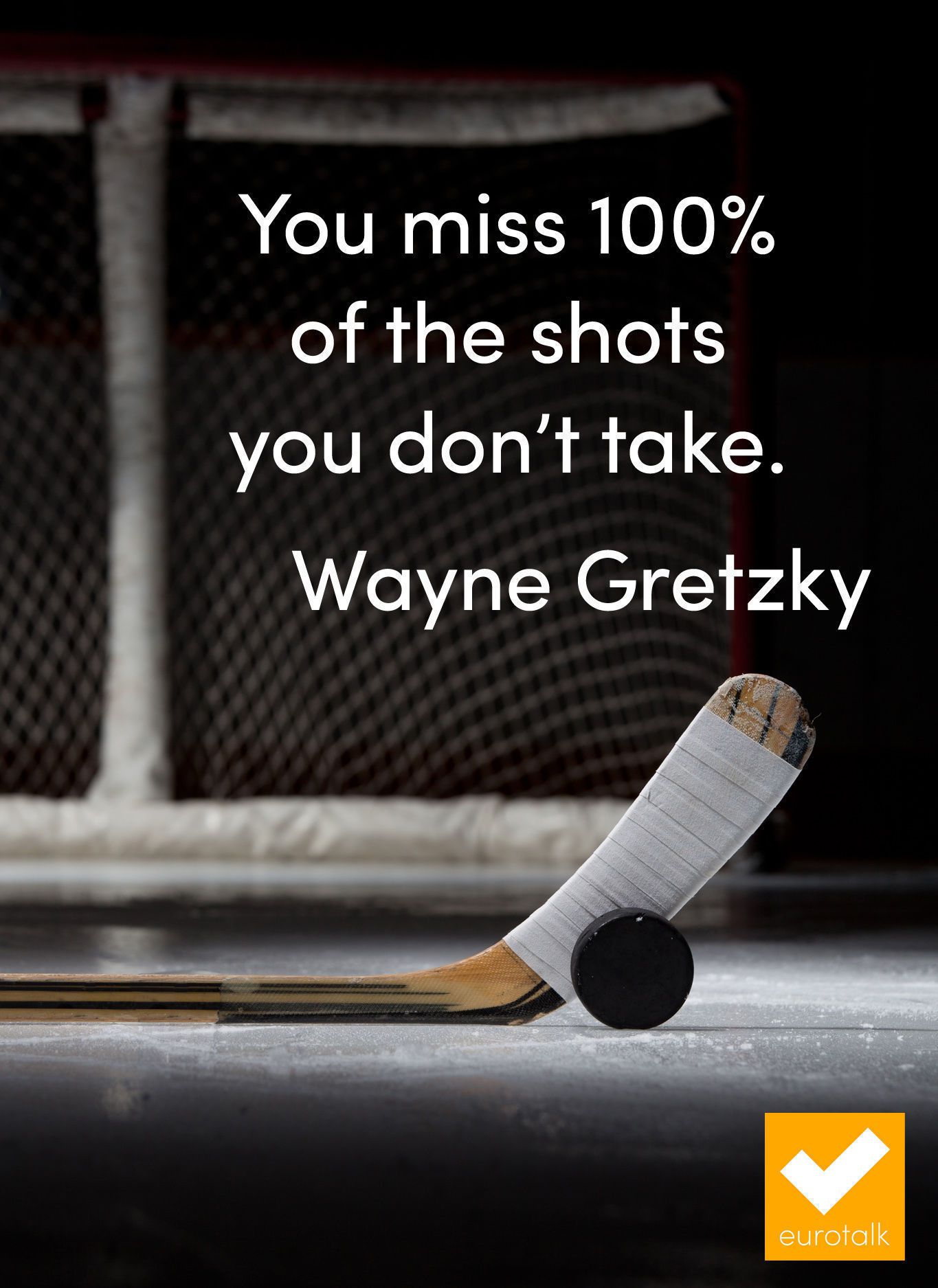
“You miss 100% of the shots you don’t take.” Wayne Gretzky
For more like this, find us on Pinterest.
Embed This Image On Your Site (copy code below):
Which language are you learning? The results!
We had a great response to our recent language learning survey; thank you to everyone who took the time to complete it. First things first: we’re delighted to announce that the winner of the iPad mini prize draw is Konstantia Sakellariou. Congratulations, Konstantia – your iPad is on its way!
We wanted also to share a few of our findings with you. Some of the results from the survey were as we expected, others were quite surprising. Here are just a few of the things you had to tell us. Thanks again for all your thoughtful responses, we’ll put them to good use.
Which language(s) are you learning (or would like to learn)?
The first question was pretty straightforward. A couple of people ticked every language on offer (over 100) – now that’s what we call ambition! – but most chose between 1 and 5. Here are the top ten most popular languages: 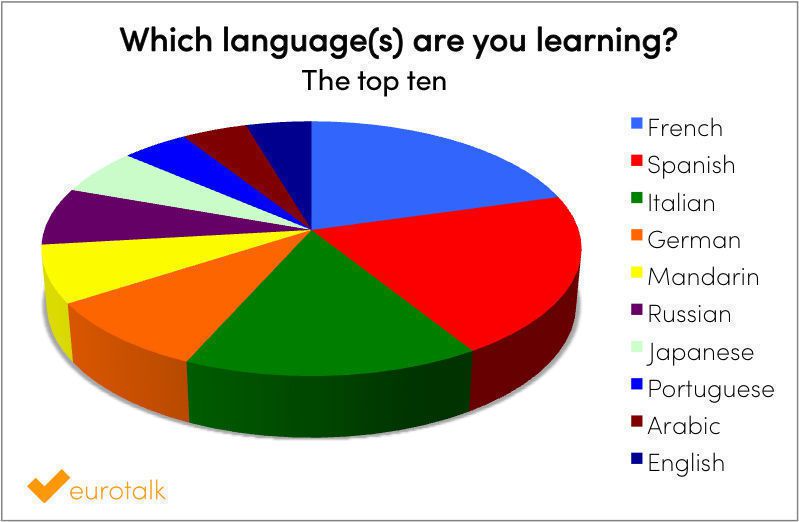 Other popular choices included Greek, Swedish, Dutch, Brazilian Portuguese, Norwegian, Irish, Polish and Icelandic. We also got some requests for languages we don’t yet offer, like Guernésiais and Twi – we’ll do our best to add those languages to our list, so watch this space!
Why are you learning a language?
Next, we wanted to know why you’re learning a language. Nearly half of the respondents chose travel as a reason, and almost as many said they were learning a language just for fun. 36% of respondents said it was for family reasons or for a relationship, and 27% for work. The results were quite evenly split though, showing that there’s no one overwhelming reason – everyone has their own motivation. 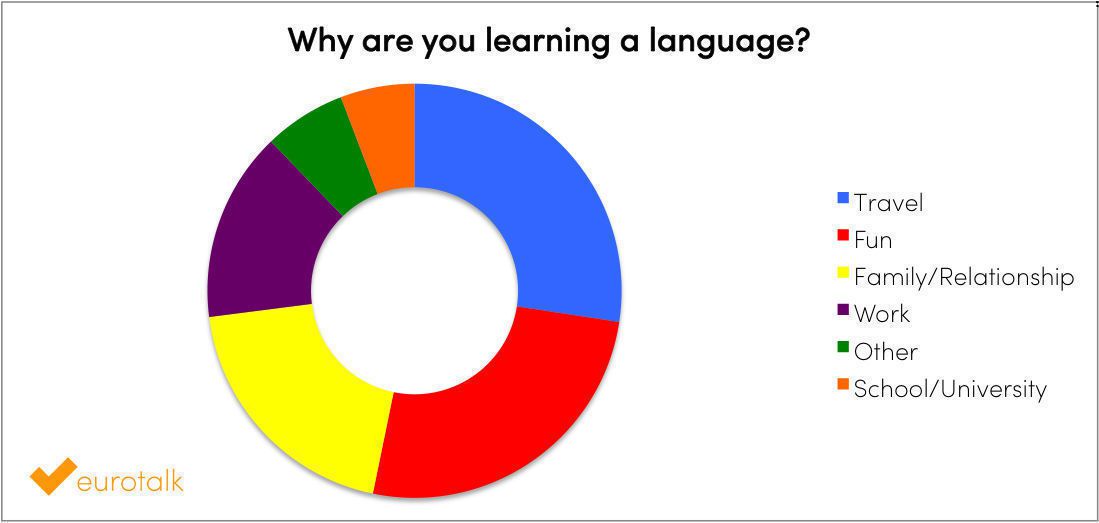 Among the other reasons, we had a range of answers, including an interest in the culture of the language, personal challenge and wanting to follow literature, film and music in other languages. Many people are living in another country, which was their main motivation for learning the local language. And one person said that their heart asked for the knowledge, which we loved 🙂
What prevents you from learning a language?
We were also interested to know what stops people from learning a language, so we asked you to rate the following reasons out of 5. The most common barrier to learning is a lack of time, followed by not having found the right method, and then the cost involved. 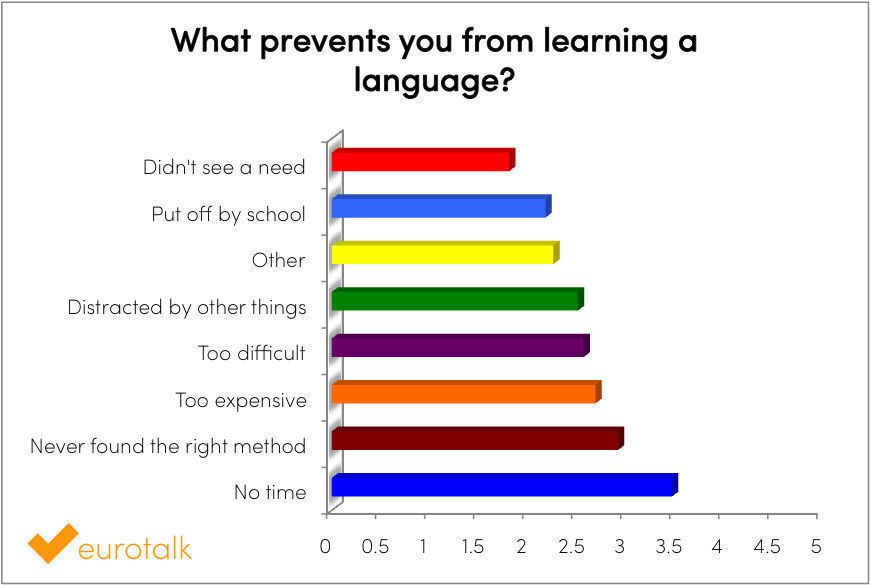 Incidentally, if you’re facing any of these barriers, you may like to check out our recent posts, on finding time to learn a language and learning on a budget. And if you’re looking for resources, did you know you can try out the EuroTalk learning method for free? Either visit our website, or download our free app, uTalk for iOS, to give it a go. We believe learning a language should be fun, because our research shows we learn much better if we’re enjoying ourselves, and this in turn makes it a lot easier to overcome the obstacles that get in the way. See what you think! Other answers included not having an opportunity to use the language, a lack of motivation and difficulty finding resources for the particular language they wanted to learn (we may be able to help there – we’ve got 136 languages and counting…).
How have you used your language when travelling?
Finally, we asked how knowing another language has been useful when you’re travelling. There was no clear winner here, which just goes to show knowing a language is always useful! But the top response was that it gives you the ability to talk to locals in their own language; many people added that they felt more welcome as a result and that it gave them independence so they could make the most of their trip. There were lots of practical reasons too, with getting around and eating out narrowly beating shopping in the poll.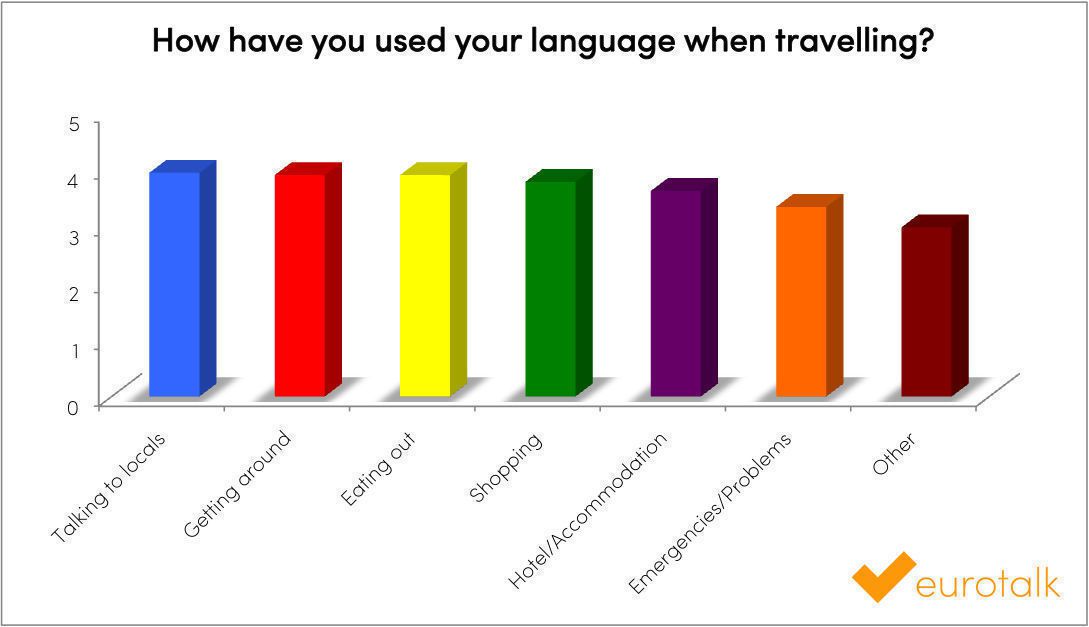 If you missed out on the survey this time, don’t worry – we’re planning another one soon, so keep an eye on the blog (you can subscribe by email above to get the latest updates), or follow us on Facebook or Twitter. And if you didn’t answer this survey but would still like to have your say on any of the questions, you’re very welcome to email us or add your thoughts in the comments below.
Liz
Data above based on 877 survey responses.
Translation mistakes – not just for laughs
Today we have a guest post from language company, thebigword, on famous translation mistakes, some of which had serious consequences. Mistakes are common, and to be expected, when you’re learning a language – but when it really matters, it’s important to get it right!
Over the years there have been many translation ‘slip ups’ and faux pas, and whilst the mistakes may seem funny some can have a far more serious impact. Reputable language solution agencies such as thebigword, specialise in international translation and you can bet your bottom dollar that they wouldn’t be caught making slip ups like the following.
There have been many incidences over the years where mis-translation can go from highly amusing to potentially life damaging. For example, Mead Johnson Nutritionals in 2003 had a case raised against them when 4.6 million cans of baby food had to be recalled. The translation error, which was caused by effectively being lazy, meant that the prescribed recipe translated into Spanish could have caused massive health issues, according to the U.S. Food and Drug Administration.
 Businesses and the world financial markets have also paid the price at the hands of poor translation, most notably when the price of the U.S. dollar was sent spiralling after an incorrect translation of an article by Guan Xiangdong for the China News Service. Guan’s original piece was meant to be a speculative overview of a series of financial reports, but instead it was translated in a more aggressive tone, which ultimately made readers in the U.S. think it was an authoritative warning and they should move their money and sell shares.
The Chicago Tribune published a highly shareable article not that long ago when it collated a series of images captured by tourists on their worldly travels. Examples from China included, ‘man toilet’ and ‘The government decides to cracking down fakes intensively for another three years’. However, our favourite has to be, ‘Because there is the situation when a step is bad, please be careful’. We’re pretty positive that was meant to say ‘mind your step’.
Of course, no faux pas goes unnoticed in the world of marketing, where language on billboards or even newspaper advertising isn’t missed by the most ardent observer.
The popular Dairy Association campaign, ‘Got Milk?’, raised an eyebrow or two when in Mexico it was translated to ‘Are you lactating?’ And in France, Colgate produced a new range of toothpaste called Cue; little did anyone realise that it had the same name as a well-known adult magazine. Now that is what we call a faux pas!
Do you have any favourite translation errors? Please share them in the comments below.
Quote of the week: 2 Aug 2014
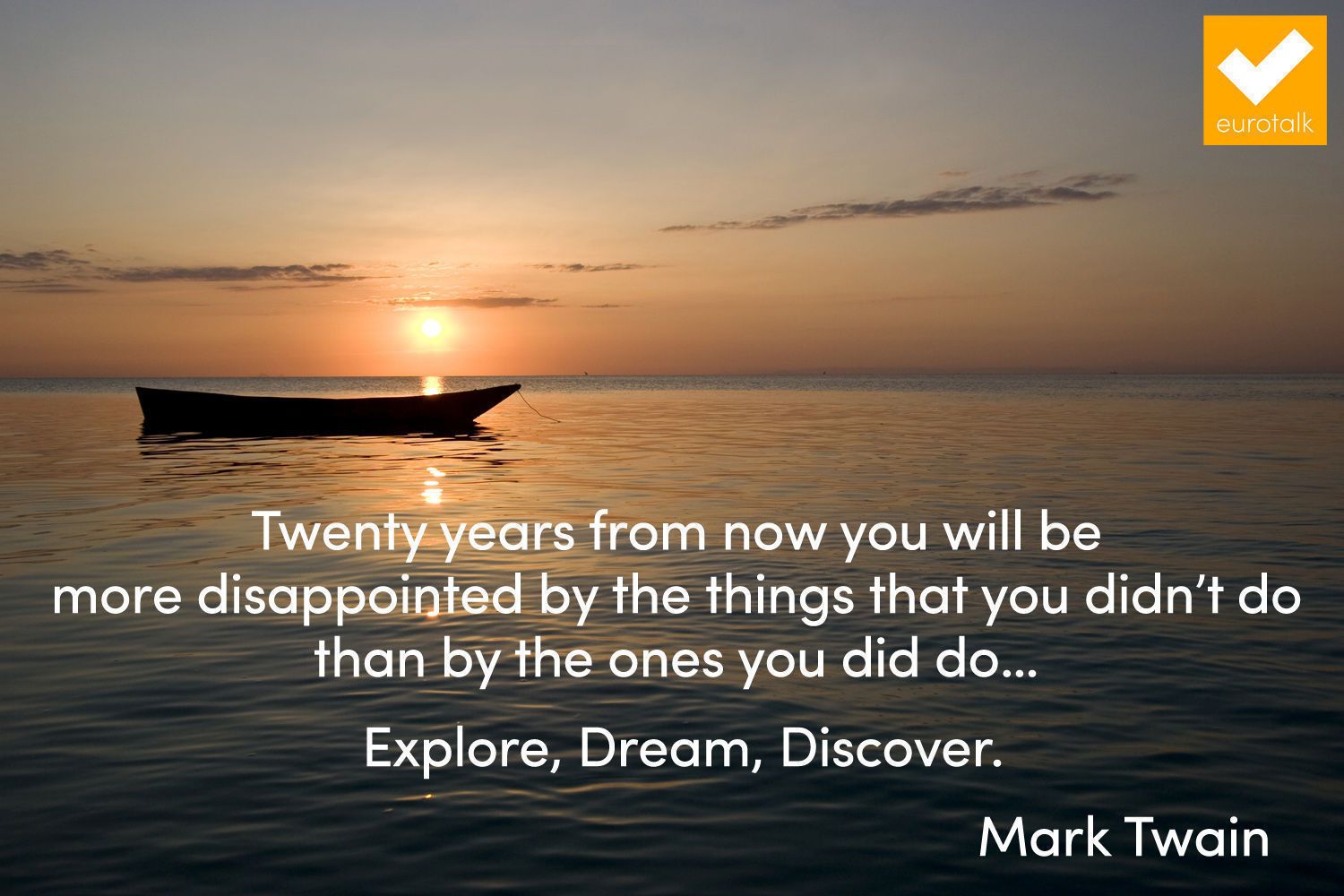
“Twenty years from now you will be more disappointed by the things you didn’t do than by the ones you did do… Explore, Dream, Discover.” Mark Twain
For more like this, find us on Pinterest.
Embed This Image On Your Site (copy code below):
