Quote of the week: 7 Jun 2014
“Everybody is a genius. But if you judge a fish by its ability to climb a tree, it will live its whole life believing that it is stupid.” Albert Einstein
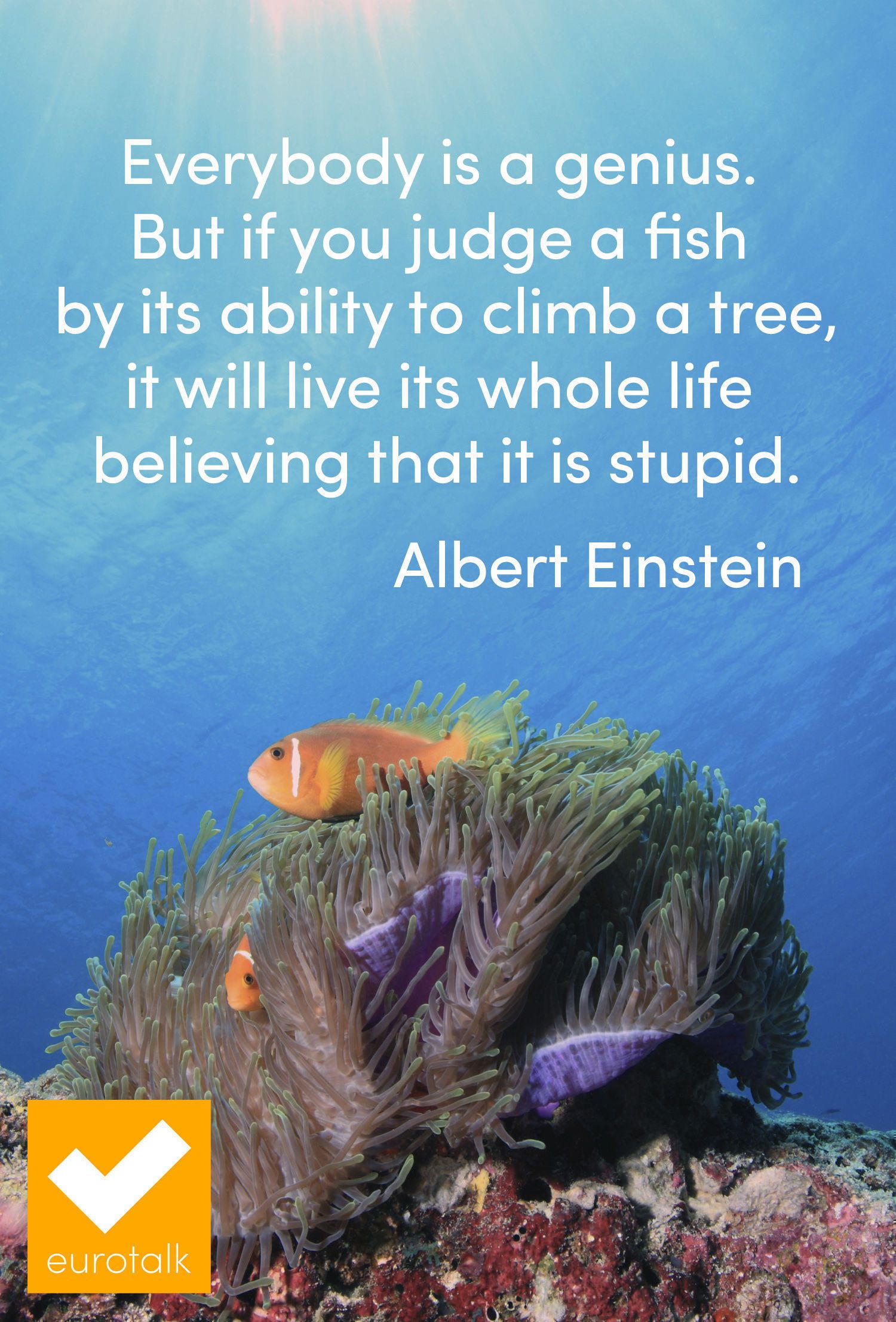
For more like this, find us on Pinterest.
Embed This Image On Your Site (copy code below):
10 sport stars who speak other languages
 It can often feel like life is all about sport, whether we like it or not. But have you ever wondered how good sports stars are at languages?
It turns out, pretty good. Like anyone who has to travel a lot for their work, athletes often find knowing only their native language isn’t enough. Here are 10 great examples of sports stars who speak more than one language.
Gary Lineker
Besides English, the former footballer learnt Spanish while he was playing for Barcelona, and picked up some Japanese when he later moved to Nagoya Grampus Eight. He’s now a passionate ambassador for languages in schools, saying in an interview with TES last year, ‘the learning of languages, for me, will always be helpful for the vast majority at some stage in their life’.
Roger Federer
Not content with winning a frankly quite ridiculous 17 Grand Slam titles, the Swiss tennis player also speaks four languages fluently – his native Swiss German along with French, English and German. He’s known for his ability to switch effortlessly between languages in interviews and press conferences and can quite comfortably answer journalists’ questions in their own language, a feat some of his fellow tennis players can’t keep up with. Wouldn’t be the first time.
Tom Daley
The British diver recently got an A in his Spanish A-level (congrats, Tom!), and makes good use of his language skills when in Mexico, where he spends a lot of his time. Here’s a video of him showing off his Spanish.
Jonny Wilkinson
Here in England, Jonny Wilkinson is known (at least by me) as that guy who’s pretty good at drop goals. But he’s also a bit of a superstar in France, where he’s been playing for Toulon since 2009. He’s now fluent in French and was awarded honorary citizenship of Toulon earlier this week – giving his acceptance speech in the local language, of course.
Fernando Alonso
The Spanish Formula One racing driver speaks an impressive four languages – Spanish, Italian, English and French. And in case that’s not enough, he’s apparently working on Russian too.
Arsene Wenger
The Arsenal manager is well known for his interest in languages, speaking French, English, German, Spanish, Italian and Japanese. Like Gary Lineker, Wenger’s also known as an ambassador for languages, and last year he was voted Britain’s first Public Language Champion by readers of The Guardian. In this video he explains why languages are so important.
Novak Djokovic
Never one to let Roger take all the glory, fellow tennis champion Novak Djokovic speaks five languages – Serbian, English, German, Italian and French. He studied English and German at primary school, and learned Italian when he worked with coach Riccardo Piati. In an interview with Tennis Talk in 2013, he said, ‘We have a saying in our country: The more languages you know, the more is your worth as a person. I like to understand what people are saying wherever I am, at least to pick up a few phrases of those languages.’
Paula Radcliffe
Long-distance runner Paula Radcliffe has a first-class degree from Loughborough University in European Studies, and speaks French and German fluently. She now lives in Monaco with her husband and two children, who are both bilingual, attending a French school but also fluent in English.
Cesc Fabregas
Another Barcelona footballer, Fabregas speaks four languages – Spanish, Catalan, English and French, and his Twitter feed is multilingual. When asked about his language skills in 2005, he replied, ‘These days you have to keep studying, not least because my mum tells me so.’ Words to live by.
Daniela Hantuchova
And finally, another tennis player, because tennis is my favourite. Daniela Hantuchova, from Slovakia, is by all accounts a very talented lady. Besides her tennis career, she’s also a trained classical pianist, and speaks – wait for it – six languages: Slovak, Czech, English and German fluently, and some Croatian and Italian.
Does anyone else feel like a bit of an underachiever now, or is it just me?
If you know any other examples of sports stars who speak other languages, please tell us about them in the comments.
Quote of the week: 31 May 2014
“Language is to the mind more than light is to the eye.” William Gibson

For more like this, find us on Pinterest.
Embed This Image On Your Site (copy code below):
Will online translators make language learning redundant?
Microsoft have just unveiled the latest version of their Skype Translator, which will enable us to chat with people all over the world even if we don’t speak their language. This story ran in the Daily Mail here in the UK yesterday, under the rather depressing headline, ‘Don’t bother learning a foreign language! Skype will soon translate spoken foreign words in real time’.
I can definitely see that this innovation has its uses, particularly if you need to speak to a client or colleague in another country, and don’t have time to learn their language. And I’m in no way trying to undermine all the years of research that have gone into its development – it looks incredibly clever and impressive. But I think it’s unrealistic to believe that it’s going to make language learning redundant.
For one thing, I haven’t had a lot of faith in translation software since the time I needed to write an email to a colleague in Dutch. Since the only Dutch I know is ‘waar is de winkel?’ (‘where is the shop?’) and ‘de tweemansbob’ (‘two-man bobsleigh’), naturally I turned to Google Translate, copied and pasted the offered translation and sent the email, feeling pretty proud of myself. Until my colleague replied, telling me – in English – to never use Google Translate for Dutch again, because what I’d sent him made no sense at all. Hard to tell by email, of course, but I always picture him wiping away tears of laughter as he wrote his reply.
This was a few years ago, and I realise things have come on a bit since then. But these days if I have to use an online translation tool, I’ll always copy the text back in and check it makes sense in English before I hit send. And even then I’m never completely convinced I haven’t made some horrible mistake. As with any translator, if you don’t know the language at all, you have to put complete faith in the intermediary to correctly translate what you’ve said. With people, you can generally tell if they know what they’re talking about. With computers, it’s not so easy – especially given that this particular innovation also relies on speech recognition technology to even decide what needs translating in the first place.
I’m no expert but I’d assume most people with a need for the Skype Translator will be those needing it for business calls, and in that case you definitely need to know your translator is 100% reliable, or who knows what you could end up agreeing to? Presumably those who call friends or family through Skype will already know at least a little of the other person’s language – unless they’re calling their in-laws, in which case it’s possibly even more important to avoid embarrassing translation mistakes.
Secondly, even if I were completely confident that the translator was accurate, I’m not sure I’d want to use it. The brilliant thing about video call software like Skype is that it allows you to talk face-to-face with someone on the other side of the world, where before they would have been a disembodied voice on the phone or, even more impersonal, a written letter or email. Microsoft describes the translator as ‘human to human interaction’ but it’s not really – it’s ‘human to computer to human’, and what you hear is not your friend or colleague but a computer-generated voice giving you the translation of what they’re saying.
Personally, I’d rather do a bit of preparation, then fumble my way through a conversation, probably in a mix of languages and littered with mistakes, than have to sit and wait for a program to decide what it thinks I said and pass it on. Not only that, but making the effort to learn at least a little of the other person’s language shows respect for them and their culture. It’s well known that speakers of other languages would much rather you try, and get it wrong, than sit back and let a computer do all the work.
Finally, as we all know, there are no end of benefits to learning a language, far beyond making it through one Skype call. We’ve covered all these benefits elsewhere, so I won’t go into them all again. And in fairness, I don’t think Microsoft are trying to replace language learning. But I can’t agree with the Daily Mail‘s headline – just because a machine exists that can help us out in a tight spot, it doesn’t mean we should never make the effort to learn a language again. Language learning is as important as it’s ever been, if only to avoid an embarrassing situation like this, when we’re forced to leave the computer behind…
(Apologies in advance to any Italian speakers!)
Liz
Quote of the week: 24 May 2014
“If it scares you, it might be a good thing to try.” Seth Godin

For more like this, find us on Pinterest.
Embed This Image On Your Site (copy code below):
