The true meaning of character names from fiction
The other day, I was watching one of my favourite films, The Lion King (yes, I know it’s a kids’ film but I love it) and I was reminded of a fun fact I read recently, that many of the characters’ names are taken from Swahili. Simba means ‘lion’, Rafiki means ‘friend’, ‘Nala’ means ‘gift’ and Pumbaa means ‘simpleton’. Poor Pumbaa.
So often when we watch a film or read a book, we take for granted that the characters are just called whatever they’re called, without considering why. So here are a few more examples – some of which may be surprising, but all of which I hope will be interesting.
Disney
The Lion King isn’t the only Disney film to give its characters significant names. In Beauty and the Beast, perhaps most obviously, the heroine’s name, Belle, means ‘beautiful’ in French. But many of the other characters resemble their names somehow, like Mrs Potts (the teapot), Cogsworth (the clock) and everyone’s favourite candelabra, Lumière, which means ‘light’.
In Sleeping Beauty, the name of the villain Maleficent comes from the Latin ‘maleficus’, meaning ‘wicked, prone to evil’. Seems appropriate. And on a similar theme, Cruella DeVille from 101 Dalmatians is pretty self-explanatory.
The Jungle Book
I think Rudyard Kipling would object to me listing this under Disney, although that might be where many people know The Jungle Book from. Shere Khan translates roughly as ‘Tiger King‘ (‘shir’ is ‘tiger’ – or ‘lion’ – in Persian, Punjabi and Hindi, while ‘khan’ is ‘king’ in many languages). ‘Bhalu’ (Baloo) means ‘bear’ in Hindi, and the ‘bagh’ in ‘Bagheera’ means ‘tiger’ – which is slightly confusing since Bagheera’s a panther.
Lord of the Rings
In J.R.R. Tolkien’s trilogy, the character Frodo Baggins gets his first name from the Old English word ‘fród‘, which means ‘wise by experience’.
Game of Thrones
The character names in George R.R. Martin’s books, and the accompanying TV series, for the most part seem to be modern names with a slight twist (Robb, Jaime, Eddard), but there is one character whose name has a deeper meaning – Bran Stark, whose first name is Irish for ‘raven‘. Fans of the series will know about the three-eyed raven, who plays a significant role in Bran’s story from the start.
Star Trek
I’m not much of a Star Trek fan myself, but I have it on good authority that Nyota Uhura’s name means ‘Star Freedom’ in Swahili.
Harry Potter
Many of the characters in J.K. Rowling’s best-selling series have names that mean something, most often in French or Latin. Voldemort (I’m not scared to say it!) means ‘flight from death’, which is very appropriate for a character whose main goal is immortality.
Meanwhile, the Malfoys’ surname means ‘bad faith’ in French, and perhaps the best known, because his name is a spoiler in itself – Remus Lupin, whose surname comes from ‘lupus’, which is Latin for ‘wolf’. His first name is also a reference to the story of Romulus and Remus, who were raised by wolves.
Star Wars
Speaking of spoilers – according to George Lucas, ‘Darth’ is a variation of ‘dark’ and ‘Vader’ is Dutch for ‘father’. So I guess the Dutch probably saw the big twist coming a mile off.
The Hunger Games
We’re told that Katniss Everdeen, the main character in Suzanne Collins’ books, was named for a plant, but there’s a bit more to it than that. The katniss plant is also known as ‘arrowhead’ and comes from the genus Sagittaria. Sagittarius – the archer. Katniss is pretty good with a bow and arrow. See how we got there?
So next time you’re enjoying your favourite movie or book, have a think about the character names, because they may have been the result of hours of debate!
Has anyone got any more examples?
Liz
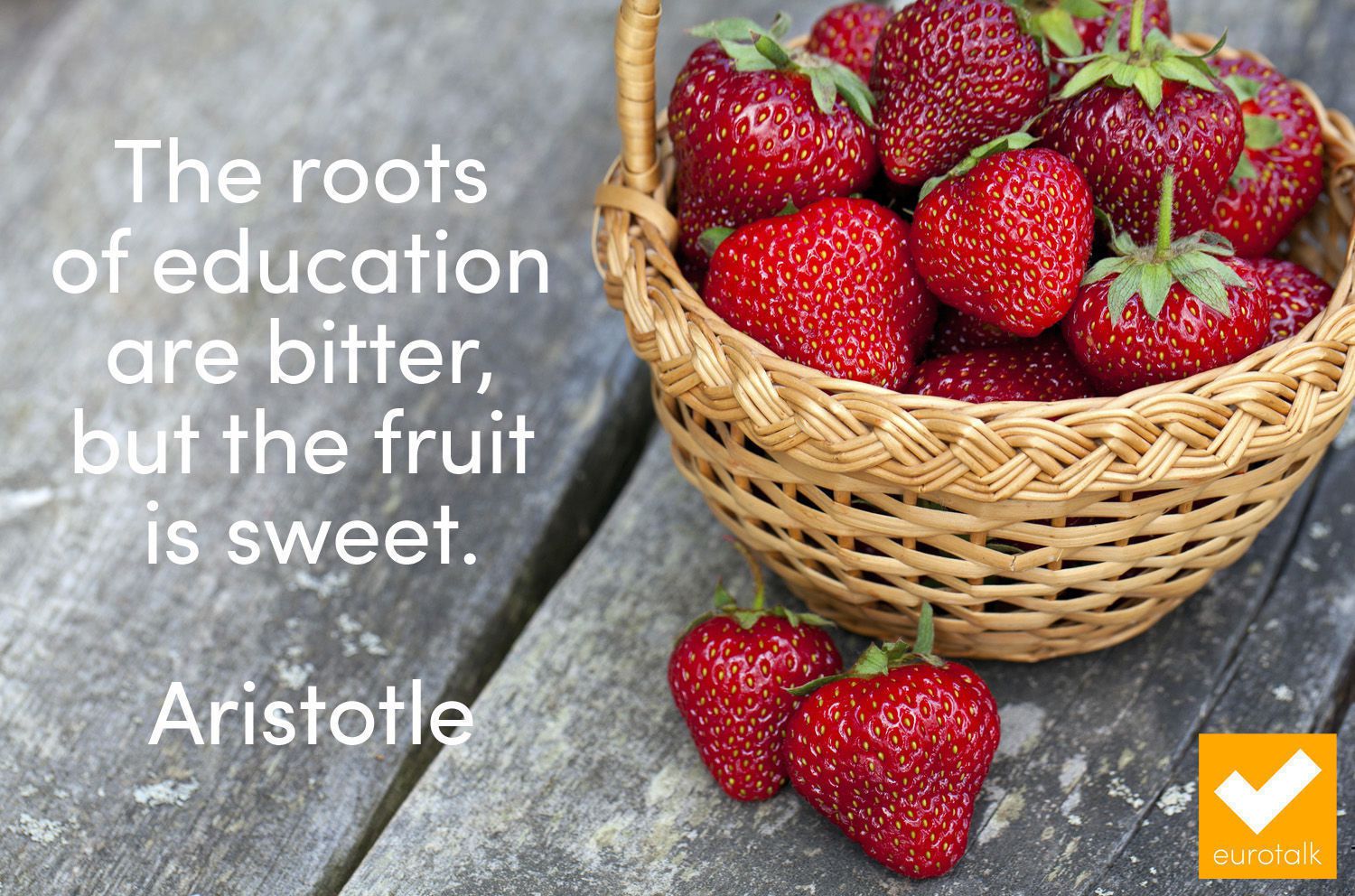
Quote of the week: 26 Apr 2014
“It is not true that people stop pursuing dreams because they grow old, they grow old because they stop pursuing dreams.” Gabriel García Márquez
In need of some more inspiration? Find us on Pinterest.
Embed This Image On Your Site (copy code below):
10 popular expressions we owe to Shakespeare
Today is the official anniversary of William Shakespeare’s birth. (23rd April is also the day he died, but let’s not dwell on that.) For those of us who speak English every day, we often forget, or don’t realise, how many of the words and phrases we use come from the works of Shakespeare.
Of course we don’t know for sure that he invented them all himself (although apparently about a tenth of the words he used in his work were new). But it’s interesting to see how many of us, even those who claim not to be fans of his work, are regularly quoting Shakespeare.
There are so many examples of these – here are just a few.
Green-eyed monster
What does it mean? Jealousy.
Which play? Othello (Act III, scene 3) – although Shakespeare had earlier used ‘green-eyed’ to describe jealousy in The Merchant of Venice (Act III, scene 2).
“IAGO: O, beware, my lord, of jealousy;
It is the green-eyed monster which doth mock
The meat it feeds on”
Cruel to be kind
What does it mean? Treating someone badly for their own good.
Which play? Hamlet (Act III, scene 4)
“HAMLET: I must be cruel only to be kind.
Thus bad begins and worse remains behind.”
It’s all Greek to me
What does it mean? Completely incomprehensible.
Which play? Julius Caesar (Act I, Scene 2)
“CASCA: those that understood him smiled at one another and shook their heads; but, for mine own part, it was Greek to me.”
Break the ice
What does it mean? To get a conversation going, often by breaking some initial tension.
Which play? The Taming of the Shrew (Act I, Scene 2)
“TRANIO: And if you break the ice and do this feat,
Achieve the elder, set the younger free”
In a pickle
What does it mean? In a tricky situation.
Which play? The Tempest (Act V, Scene 1)
“ALONSO: How camest thou in this pickle?”
Forever and a day
What does it mean? A really long time!
Which play? As You Like It (Act IV, Scene 1)
“ROSALIND: Now tell me how long you would have her after you have possessed her.
ORLANDO: Forever and a day.”
The world’s my oyster
What does it mean? To have a wealth of opportunities.
Which play? The Merry Wives of Windsor (Act II, Scene 2)
“PISTOL: Why then the world’s mine oyster, Which I with sword will open.”
One fell swoop
What does it mean? All at once.
Which play? Macbeth (Act IV, Scene 3)
“MACDUFF: What, all my pretty chickens and their dam
At one fell swoop?”
Good riddance
What does it mean? To be glad to see the back of someone.
Which play? Troilus and Cressida (Act 2, Scene 1)
“THERSITES: I will keep where there is
wit stirring and leave the faction of fools.
[Exit]
PATROCLUS: A good riddance.”
Eaten out of house and home
What does it mean? To take advantage of a host’s generosity.
Which play? Henry IV Part II
“MISTRESS QUICKLY: He hath eaten me out of house and home; he hath put all my substance into that fat belly of his”
How many of these have you used lately? And does anyone have any other favourite Shakespearean phrases?
Personally, we’re a bit disappointed that more of Shakespeare’s insults haven’t made it into modern English; you don’t hear ‘thou cream-faced loon’ often enough these days (although maybe that’s a good thing). There’s probably a whole other blog post to be had from Shakespeare’s insults – but in the meantime, here’s a random insult generator – have fun, but be careful who you say them to!
Quote of the week: 19 Apr 2014
For more like this, find us on Pinterest.
Embed This Image On Your Site (copy code below):