5 tips for beginners in Japanese
Adam, 15, recently spent two weeks at EuroTalk for work experience. He’s passionate about languages and is currently learning Japanese. Here are his top tips for other beginners.
In November 2012, I decided to start taking Japanese lessons once per fortnight. As a younger learner, I thought it might be interesting for you to see some challenges that I have already faced while learning. If this post was about a language like French, quite a lot of the tips would be generic and applicable to other European languages, such as Spanish or German. Therefore, I hope that most of my tips will remain unique, just like the Japanese language.
Here are 5 tips for starting Japanese, from the viewpoint of a beginner!
1) Consolidate your kana before tackling Kanji
When I started to learn, I was pretty frightened at the prospect of learning kanji. In fact, I only started to learn kanji about nine months after starting, because my teacher advised me to gain a basic knowledge of the sound system, grammar, vocabulary and kana alphabets before learning. She was absolutely right – I couldn’t have imagined being able to pick up any of the theory behind kanji without the basic grounding first. Often, the On’Yomi reading is written in katakana. Considering I had been learning for 9 months at the time, my katakana knowledge was pretty poor, which inhibited some of my kanji learning. Getting a basic knowledge of Japanese is definitely a must before learning kanji!
2) Choose your learning materials wisely
There are a variety of Japanese learning materials out there, ranging from internet courses to books. It is important to choose learning resources that can cover every aspect of the language, without leaving any gaps in your required knowledge. This is why I would recommend the ‘Japanese for Busy People vol. 1’ book. It covers grammar, various verb forms, vocabulary, information on the culture, particles, conjuctions, sentence structure and counters. Another important feature is that it features no kanji, allowing you to consolidate your knowledge of kana and general understanding of the language. One negative aspect could be the fact that the book is quite business-orientated. In terms of grammar, this is fine, and means that politeness is emphasised throughout. However, some of the vocabulary might not be useful to some learners. For me, it’s quite funny to be able to tell a taxi driver how to get to the main branch office! Otherwise, you could use online vocabulary resources and of course don’t forget the uTalk app!

3) Don’t overload yourself with kanji readings!
When I learn languages, I want to know everything when I first come across it, even if it is really complex. For example, when I started to learn German, I was really eager to learn the perfect tense within the first few lessons. It was exactly the same as in French – just use ‘haben’ and add the past participle, right? Of course I failed, because I put the past participle straight after the auxiliary verb, rather than at the end of the sentence. In Japanese, I wanted to learn all the readings of a kanji as soon as I had learnt it. Eventually, I would have probably ended up using it incorrectly because I had just memorised the words associated with that kanji, without ever encountering them in a sentence!
Instead, you might want to try and learn a new kanji of a word that you have encountered frequently, rather than learning multiple new words from a kanji. In my Japanese book, I have a section for all the vocabulary that I need to learn for homework. I started to look up the kanji for each of those words. If I came across a kanji that I already knew, I would right the corresponding word down, with its kanji written next to it. Furthermore, if an unknown kanji came up a lot, I would write it down with the familiar readings next to it. This method ensures that I learn the readings of words that I am already familiar with.
4) Be organised
When learning Japanese in particular, I like to keep a routine to ensure that I learn kanji, vocabulary and do homework well. Some learners might not like repetition, but I think it’s one of the best ways to learn. By revising for 10 minutes every evening and recalling the information in a mini-test the next day, I can make sure that I remember vocabulary, grammar and kanji well. I like to take advantage of the brain’s ability to work better after waking up. This means that I only learn new words in the morning, during weekends, and revise words in the evening. Furthermore, I think it’s also important to test yourself after a longer period of time following the learning of a word, to ensure that you have maintained the word in your mind! However, it’s also important to state that our brain works even better passively, so doing some occasional Japanese writing, reading and listening is good when learning. You might pick up some new vocabulary without even trying! Try and be organised by placing short revision sessions, mini-tests and activities consistently over an allotted period of time.
5) Make your own learning resources
Lots of people have different methods when learning. I am quite old-fashioned, and approach language with the ‘no pain, no gain’ approach, using repetition and regular tests. This means that I need to locate places to find materials, suitable for my way of learning. Owing to the surprisingly low amount of Japanese kanji resources online, I recently made my own kanji grid on MS Word with 19 rows, and 15 columns. I could then put the kanji and their Japanese readings on the top row, with room for 15 kanji on one grid. I then had the perfect number of rows to have 10 boxes to practise each kanji, 7 boxes to test myself on one kanji everyday, each day of the week, and then had one box left over to test myself 7 days later. This is an example of using a self-made material, suited to my way of learning. I find that everyone has their own way of learning kanji, whether it be using flashcards, writing it repetitively or doing online exercises. Find the best way for you to learn Japanese!
I really enjoyed writing this post, so I hope you enjoyed reading about this. Even though I’m very passionate about language, I still make mistakes, so please forgive any potential inaccuracies in this post!
Adam
How learning a language can help your career
 “Learning a different language has made me the person I am today. I enjoy working with global brands in over 18 different countries, and leading a team specialised in 5 different markets.”
Sarah works as a Multilingual Search Manager at Search Laboratory, and she’s taken time out to tell us why and how learning a language has helped her develop her career.
Q. Your experience of learning a language…
– When did you start?
I started learning another language at the age of seven, when my family moved to Germany. I often say that I learnt the language by watching TV, but it was actually a combination of listening (which did involve TV), reading (mainly as schoolwork gave me no choice – I wasn’t the bookworm then that I am today), and being thrown in the deep end. If there’s no other communication option around you, you will pick up a language. It just might take some time.
– How did you get into languages?
I got into it through video tapes for children designed to help learn a second language, and then through tuition and being surrounded by the language in everyday life. For the first six months of living in Germany I went to an English school, but then transferred to a German one, so speaking the language was a must for grades, making friends, and just generally communicating.
– What was hard?
The first few months were pretty tricky. I’m known as a bit of a chatter-box (this is likely to come across in my answers), so not being able to communicate was tough, but also an incentive to just try the language and learn by doing. The best way to learn a language is to speak it. It’s also the scariest thing about learning a language.
These days the main challenge is remembering the right word for the right language. With two languages buzzing in my head, I can often recall the perfect word for what I want to say, but in the wrong language for the situation.
Q. How you have found being multilingual useful when searching for employment and building a career?
 Being multilingual has been very useful for my career, as it’s given me more options, and I think it’s also helped me stand out a bit in the employment crowd. This was especially true when I was younger, and just starting out. Though multilingual isn’t as unusual as you think these days.
It was also a way for me to narrow down my career search. I knew that I wanted to be part of a company that provided opportunities for multilingual speakers, and was equally interested in different cultures and understanding different markets.
Q. How do you use languages in your everyday role as a Multilingual Search Marketing Manager?
I manage our French, Spanish, Italian, Russian and Chinese team, so the language alone doesn’t help out; however, the language experience is vital. I feel that because I went through learning a language and living in a different country that I’m more empathetic to and understanding of the struggles of day to day life (or at least some of them – the team may disagree).
I also think that the language experience has made me very inquisitive about other cultures, and languages, which really comes in handy when looking into the differences of search behaviour and trends in other markets.
Q. Why do you think more people should learn more languages?
Because it’s great fun! And because it can open up career opportunities that you hadn’t even thought of yet.
I sometimes forget that I’m classed as multilingual as having more than one language is natural to me, to my family, and most of the people I work with. I think I’d be pretty bored if I only had one language to rely on.
Also, looking back and seeing all the opportunities I might have missed out on, is a bit of a scary thought.
I’m excited to learn more languages, though can’t decide of the languages which my team speaks, which one to start with. There’s just too much choice!
Do you use languages at work? Have you found knowing more than one language has helped you in your career?
Quote of the week: 5 Apr 2014

For more like this, visit us on Pinterest.
Embed This Image On Your Site (copy code below):
8 common language mistakes to avoid [infographic]
When you’re learning a new language, it’s easy to make mistakes. And that’s ok; it’s the best way to learn. But sometimes you might think you know what you’re saying, and actually you’ve said something very different. Here are a few examples to look out for…
Please let us know your own examples and as always, do feel free to share the infographic with others.
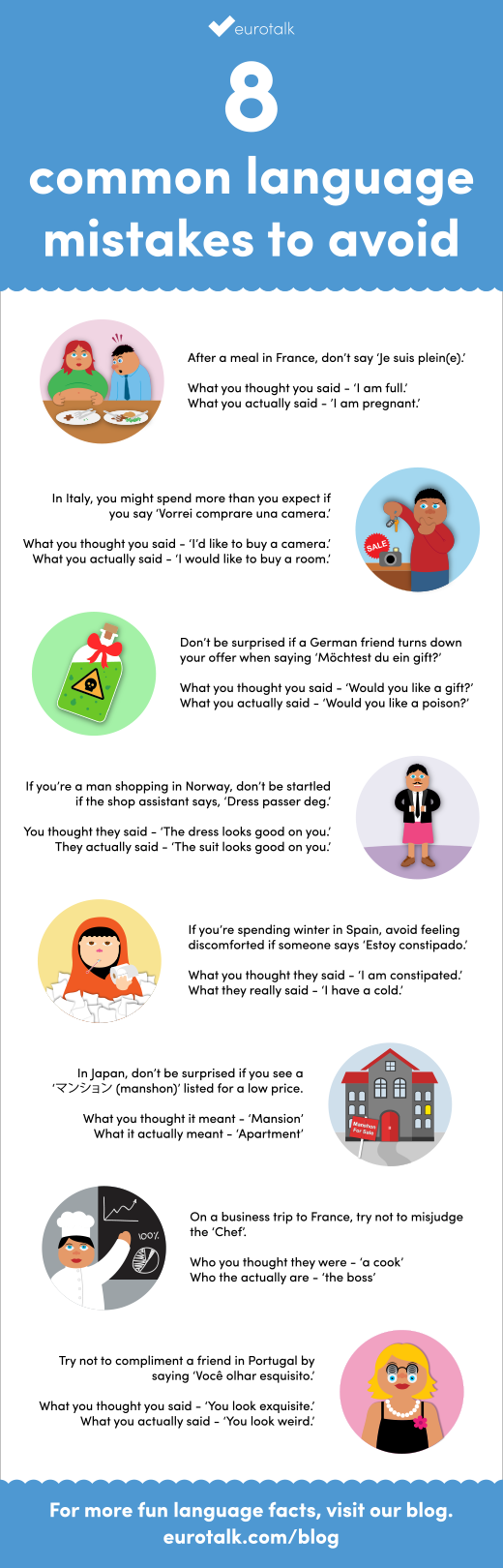
Infographic created by Adam (research) and Luke (design)
Embed This Image On Your Site (copy code below):
Quote of the week: 29 Mar 2014

For more like this, visit us on Pinterest.
Embed This Image On Your Site (copy code below):
