So, did you know you can speak Greek?
Today’s blog post is written by Konstantia Sotiropoulou, who’s been helping us to translate and record our Maths apps in Greek.
I bumped into the picture below a while ago and I thought this should be interesting. Undoubtedly, Greek is one of the richest languages in the world and is distinguished by an extensive vocabulary. In the past, the Guinness Book of Records ranked the Greek language as the richest in the world with 5 million words and 70 million word types!
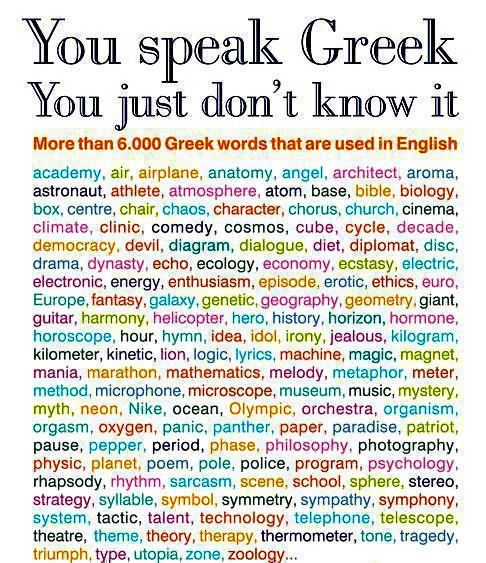
The front cover of You speak Greek, You just don't know it, a book by Annie Stefanides (Ianos, 2010)
Well, many of these words have been widely borrowed into other languages, including English. Greek roots are often used to coin new words for other languages, especially in the sciences and medicine. Mathematics, physics, astronomy, democracy, philosophy, athletics, theatre, rhetoric, baptism and hundreds of other words are Greek. Moreover, Greek words and word elements continue to be productive as a basis for coinages: anthropology, photography, telephony, isomer, biomechanics, cinematography, etc. and form, with Latin words, the foundation of international scientific and technical vocabulary, e.g. all words ending with –logy (“discourse”). Interestingly, an estimated 12% of the English vocabulary has Greek origin. Greek has contributed to English in several ways, including direct borrowings from Greek and indirectly through other languages (mainly Latin or French).
In a typical 80,000-word English dictionary, about 5% of the words are directly borrowed from Greek; this is about equivalent to the vocabulary of an educated speaker of English (for example, “phenomenon” is a Greek word and even obeys Greek grammar rules as the plural is “phenomena”). However, around 25% are borrowed indirectly. This is because there were many Greek words borrowed in Latin originally, which then filtered down into English because English borrowed so many words from Latin (for example, “elaiwa” in Greek evolved into the Latin “oliva”, which in turn became “olive” in English).
Greek and Latin are the predominant sources of the international scientific vocabulary. Greek is often used in coining very specialized technical or scientific words, however, so the percentage of words borrowed from Greek rises much higher when considering highly scientific vocabulary (for example, “oxytetracycline” is a medical term that has several Greek roots).
In education, an excellent way to build vocabulary is teaching students how to find roots in words. Since many words have their base in the Greek language, beginning with the roots from this ancient language is a good place to start. This list of English words with Greek origin will give students a basis for further exploration into the roots of the English language.
Now you that you have seen how many Greek words you know, I am going to teach you some more common ones like “kalimera” which means “good morning”, “Ya sou” which means “hi”, “Me lene” which means “my name is” and “efharisto” which means “thank you”. And if you are interested in learning more and discovering how many you already know, try EuroTalk’s uTalk Greek app.
And who am I to be talking about the Greek language? I am the Greek intern of EuroTalk, who translated and recorded into Greek their new Maths apps for young children. An interesting and fun experience for a young translator like me. I have to say that I really enjoyed working in this office, which gives you the sense of a family home. People here are calm and friendly, the kitchen is fully equipped with all kinds of snacks and during the day we get to listen to nice music while working! How amazing is that?
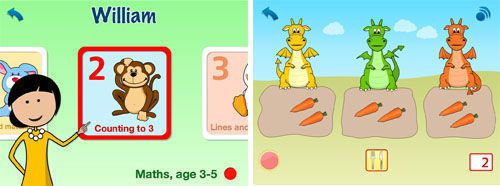
Maths, age 3-5 and Maths, age 4-6 - the apps I translated and recorded during my time at EuroTalk
I started towards the end of January by translating the scripts of the app and soon after I recorded the first topics. I caught myself playing the app more than I needed to, as the games are really fun! I am sure young kids will truly enjoy it while learning basic Mathematics rules. And I know that my three-year-old niece, who will be playing the app in a few weeks, will at least have a constructive and educational first contact with technology!
So, whether you want to take up a new language or help your child have a nice start with Maths, you know that EuroTalk is here for you!
* There is an interesting video on YouTube that explains the History of English and the influence that it had from other languages!
Konstantia
Don’t give up: New Year’s Resolutions
We’re now a week and a half into the New Year, and it’s safe to say a lot of people will already have given up on the promises they made to themselves when the clock struck midnight on January 1st. Whether you’re trying to lose weight, quit smoking, learn a new skill or save money, here are our tips to help you stick with it.
1. Set yourself manageable goals. Instead of saying ‘I’m going to lose weight’, decide how much you want to lose in a set time frame, and reward yourself when you get there.
2. Focus – don’t try and do everything at once. Choose one or two changes you want to make to your life and concentrate on those.
 3. Write your resolutions down. Seeing them in black and white will help you to establish exactly what you want to achieve.
4. Only set targets that you really care about. If it’s not important to you, it’s so much easier to lose interest. Think about why you’re doing it – if you can’t think of a reason, it’s probably not worth doing.
5. Tell friends and family what you want to achieve. It’ll be harder to give up if other people are keeping an eye on you.
6. If you do have a wobble, don’t use that as an excuse to give up. Put it down as a one-off and start again.

7. Take your time. You don’t have to achieve all your goals on the first day. If your goal is to exercise more, start by going for a run to see how you feel, before you rush out and spend lots of money on a gym membership.
If you didn’t set any New Year’s Resolutions this year, it’s not too late! If you want to make some changes in your life, you don’t have to wait for January 1st to roll around again. Why not make a start today?
Learning a language is often a popular New Year’s Resolution, so if you’ve decided 2013 is the year to brush up on your German, or start learning Japanese, have a look at our website to see how we can help you get started.
Good luck!
A Year in the Life of EuroTalk
There’s no doubt 2012 has been a pretty special year for the UK and the world, but it’s also been quite an eventful one at EuroTalk.
Maths
In January we released a new app, the first in a series to teach maths to primary school age children.

This is a part of our mission to reach a billion children with fantastic educational apps, to get them off to a great start in life. The most exciting thing about the apps is that we’ll be translating them into 200 languages so they can literally be used by any child, anywhere.
Maths, age 3-5 was an instant hit with parents and children all over the world, and we were delighted with the response. Ever since then we’ve been working hard on the next app, for 4-6 year olds, which has just this week been released to the App Store. The whole series will cover all the years of primary school and we’re really excited about the future!
Malawi
Our work in Malawi has continued this year. In February, Andrew, Jamie, Zane, Alan and RoseMarie, who’s the author of the maths apps, travelled to Malawi to install iPods with the app translated into the local language of Chichewa, in primary schools. They also trained teachers and pupils on how to use the devices. The project is being run in partnership with the Scottish government, and last month Andrew and Jamie returned to Malawi, where they met with Michael Russell, the Scottish Education Secretary. He was delighted with the project so far, which has been declared a success!
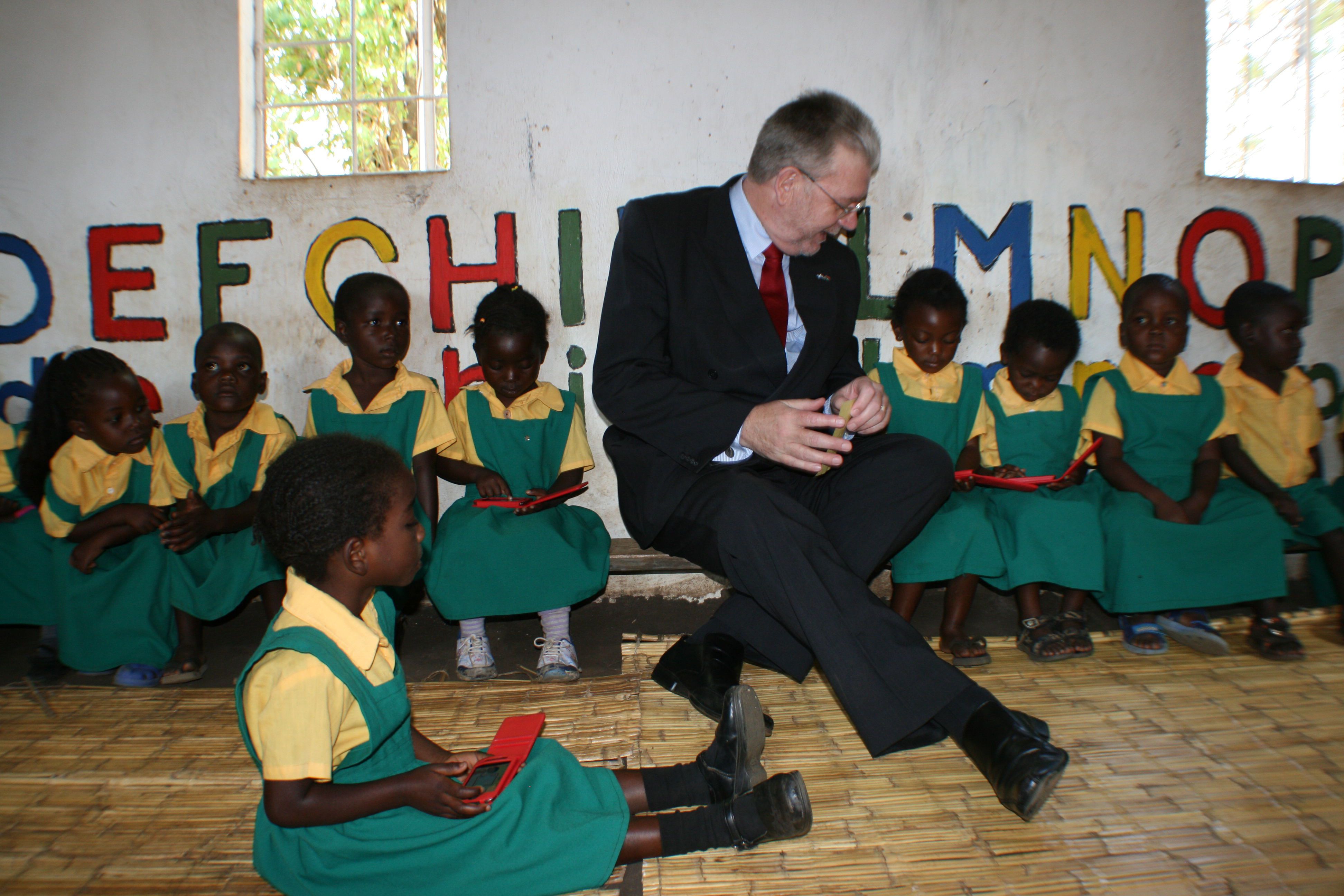
Michael Russell joins children at the Kumbali kindergarten in Malawi
Languages
We’ve also been really busy with our language learning programs. In October we released Talk More, Talk the Talk and Talk Business as downloads, as well as the Instant USB, which combines Talk Now and Talk More on one handy and portable USB drive, so it works with all the new computers that don’t have CD drives.
Baby boom!

This year, Zsolt, Olga and Chelsey all welcomed new babies – and brought them in to the office so we could all have a cuddle! Zsolt’s little boy Barnie even became the new ‘face of EuroTalk’ for a while when we posted this photo on our Facebook page.
Arrivals and departures
Sadly over the year we’ve had to say goodbye to a few people as Lotta, Ryan, Katie and Sheila all moved on to new challenges. But we also welcomed some new team members: Fiona, who looks after all our customers (and us) brilliantly; Pedro and Michal, our new app developers; Nat and Alex, who are busy getting our new products translated into hundreds of languages; and Tom, who’s only with us for a year but is already a hugely valued member of the team, helping with customer orders and product testing among many other tasks.
Marathon men – and woman
In October, Al, Franco, Glyn, Jamie, Zane and Zsolt all ran the Royal Parks Foundation Half Marathon in London in aid of some great charities. They all worked really hard training, and of course on the day itself, and are already talking about taking part again next year…
And that’s all for 2012! But we’ll be back in 2013 with more plans and exciting new products. Thanks for reading our blog this year, and we look forward to bringing you more news, opinions and guest posts next year! And as always if you have anything you’d like to share, do get in touch.
Have a great Christmas and New Year, everyone!
Liz and the EuroTalk team
Join the revival – learn Cornish
Today we have a guest post from Elizabeth Stewart, from the Cornish Language Partnership, on why Cornish is a great language to learn.
The Cornish language, or Kernewek as it is known by those who speak it, is enjoying a hugely successful revival. Those who are fortunate enough to live in the Duchy, or visit it on holiday, have only to look around them to see proof of this, with bilingual road signs springing up on street corners and businesses proudly asserting their origin by naming their products in Cornish. It’s an exciting era for the language, and learning has just become easier and more enjoyable with the release of three new EuroTalk resources in Cornish.

Cornish is a Celtic language and is most closely related to Welsh and Breton, though it also has strong links to the other Celtic languages of Irish Gaelic, Scots Gaelic and Manx. Up until the mid sixteenth century it was the main language spoken across Cornwall but pressure from English caused Cornish to decline and retreat to the far west. By the beginning of the nineteenth century Cornish had all but died out as a community language, but in 1904 Henry Jenner published a Handbook of the Cornish Language which kick started the revival of Cornish as a living, spoken language.
Since then the number of people learning and using the language has escalated, with Cornish receiving official recognition as a minority language in 2002 under the Council of Europe’s Charter for Regional or Minority Languages.
Skol Veythrin Karenza - Pre-school in Pool (photo Emilie Champliaud)
Today Cornish is one of the fastest growing languages in the world, and this is set to accelerate with more schools than ever choosing to teach Cornish, from pre-schools (including a fully bilingual one that teaches through the medium of both Cornish and English) right through to secondary schools.
Businesses are also embracing the use of Cornish. Local enterprises such as Polgoon Vineyard have made a point of choosing Cornish branding as a mark of local origin and several of their products are named in Cornish. Meanwhile national companies such as JD Wetherspoon have a policy of putting up bilingual signage in their Cornish pubs, as well as giving them names in Cornish such as “Try Dowr” (Three Rivers) in Truro and “Chapel an Gansblydhen” (Centenary Chapel) in Bodmin.
Cornish is also used in the community, with Scouts and Guides learning their motto and promise in Cornish, gig rowers naming their gigs in Cornish and an increasing number of individuals using Cornish for everything from house names to children’s names, wedding vows to tattoos.
If you would like to join the growing number of people who are taking an interest in Cornish, order your copy of either Talk More (suitable for adult beginners) or Talk the Talk (suitable for younger beginners) from EuroTalk today, or if you’ve already been learning for a while try taking your Cornish a bit further with Talk Business.
For more information about the Cornish language, visit www.magakernow.org.uk.
Don’t be shy, get talking!
A recent poll has found that only one in ten British travellers learn any of the language before they visit another country. Some claimed this was because English is now so widely spoken, while others blamed shyness and a fear of saying the wrong thing.
I understand the second excuse much more than the first. Just because we can get away with speaking English doesn’t mean we should. Learning just a few words can make a huge difference, not only to those you’re speaking to but to your own holiday experience. And you don’t have to learn anything complicated. Five per cent of people surveyed said they just learnt the absolute basics, like hello, please, thank you, water and beer. Sometimes all it takes is a friendly greeting in someone’s native language, and they see you in a whole new way – as someone who respects their culture and has made an effort, however small. And that will come across in the way they treat you, making your time in the country a lot more fun. Not only that but you’ll feel pretty good about yourself – I remember several years ago on a school trip to Spain, a friend of mine ordered an ice cream in Spanish. An ice cream – it was as simple as that. But she was so proud of herself when the vendor understood her and she completed the purchase in a language not her own.

Benny Lewis, who’s known as the Irish polyglot, has spent nine years travelling in different countries, learning languages as he goes. Every few months he announces a new challenge, learns some vocabulary and then – he just goes to the country and starts talking. He doesn’t worry about making mistakes or getting his grammar slightly wrong.
Obviously we’re not all as brave as Benny. I’m certainly not. But there does come a point when you have to stop being scared and just take a risk. People are not going to point and laugh if you don’t pronounce something quite right. As a general rule they’ll be so pleased to hear you trying to speak their language that they won’t mind at all, and will probably go out of their way to help you get it right next time.
So let’s be brave! Next time you go on holiday try learning a few basics before you go, and see what a difference it makes…
Liz
