From Advanced Course to “um …” and “er …”
Our post this week is by Lisa Erne from Germany, who’s spending a few months with us at EuroTalk as an intern. Lisa’s been in London now for six weeks, and here she shares some of her experiences so far.
When I arrived in London a few weeks ago I expected a tough start but people here made it very easy for me to feel comfortable. I moved to Brent where I supposed to live with four other housemates, I was really nervous, but there was no reason for that. I was very welcome.
I noticed really fast that the English are always easy-going like always saying sorry, even when you hit them by accident. Every day in the morning on my way to the tube I got like three “Good-Morning’s” from people, who are just passing my way. And everyone here is always pleased to help.
When I started school in the Central School of English near Tottenham Court Road I made easily friends with people from all over the world.
I felt quickly that I “improved” my English. After a few days I lost the habit of saying “um…” and “er…” all the time when thinking about the right words when having a conversation. I mean, home in Germany at my school I was in advanced course of English but you never had like a real conversation situation. The teacher asks you something and you will answer in a few sentences. There has never been real circumstances like this for me. When you’re here you’re forced nearly all the time to speak English. Even a little chat with the cashier in the Tesco supermarket can be a good practice.
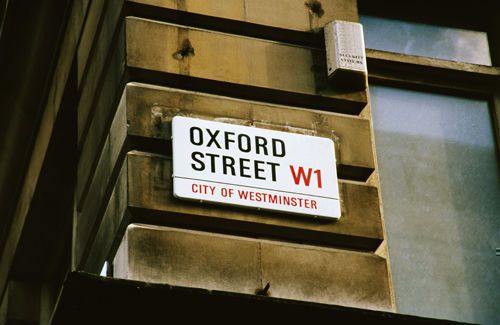 London is a varied city, even if I didn’t do any sightseeing yet, I saw a lot of different attractive areas here. There is Camden Town, where you can find a lot of markets and Tattoo & Piercing Shops. Oxford Street became one of my favourite places to be. When the temperatures were still warm, my friends and me walked from our school over Oxford Street to Hyde Park to enjoy the sun. While walking we did window shopping a lot, or just enjoyed everything else around. Also one of our favourite places became the Thames in general, just sitting at the water hanging out.
I already love London, but there are things that drive me mad. One of these things are the tubes. Tubes are always crowded and always late and they stop driving around midnight, but I got already used to it. Buses are the essential alternative to that, but I couldn’t really make friends with them either, because the timetables are sometimes very confusing. And the prices such as for tube tickets and cigarettes are an essential difference to for example in Berlin. Now I’ll really appreciate the prices there when I come back.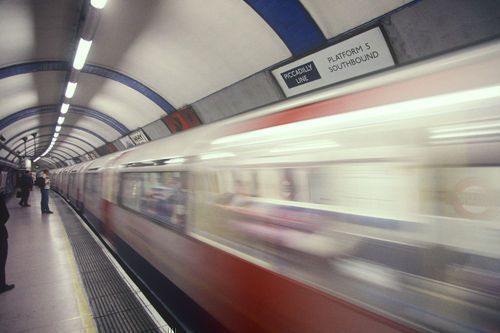
A great difference to Berlin is that shops here are opened on every Sunday, even till late hours. In Germany we have just a few weekends when the shops are open on Sundays like some weekends before Christmas, so people can do their last minute present shopping.
As well I enjoy the pubs pretty much. We don’t have a lot of them in Germany, but if it is no spot for young people, more for elder people who want to have a drink on their own after a stressful working day. Here it is a lot more fun, you always get to know new people. My favourite became The Green Man near Oxford Street, because you can also dance there, and The Crown, where many students of the Central School go on Fridays and the drinks are also very affordable.
After all this adventures and experiences yet I can say that London is a place, where I never learned so much about people and life.
Since the six weeks that I’m here I feel pretty much adapted to the lifestyle here and also a little bit of a part of London. I can already say that I won’t forget the time here ever.
Lisa
Has anyone got any suggestions for places that Lisa should visit while she’s in London?
French – champion of the language learning world?
I remember the moment when we knew we were officially grown up in primary school – during French lessons with the headmaster.
MFL lessons are the norm nowadays but back in my time, French lessons were a weekly highlight, as they meant me and about a dozen classmates spent half an hour learning something the rest of the school did not already know.
As I moved onto secondary school, languages were eventually deemed ‘uncool’ and those who took French or Spanish past GCSE – myself included – were thought to be insane by their peers.
When I think about it, only French got a shoo-in at primary school. Spanish was introduced in the first year of secondary school but even then, all efforts were concentrated on learning and teaching French.
No-one seemed to care about German or Italian and everyone thought Mandarin was a fruit.
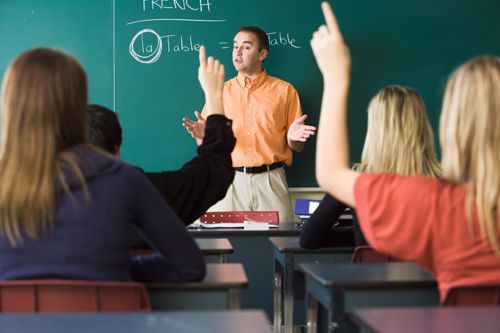 This makes me wonder – when did French become the ‘go-to’ foreign language at school?
Learning French is a current requirement in UK primary schools and the possibilities of school trips, exchanges and overseas partnerships are endless, but knowing how to speak it may not be as impressive as learning more obscure languages such as Swedish, Polish or Japanese.
The number of people learning a language nowadays relies on how influential it is in popular culture – just look at how many people have started to learn Na’vi, just because it was featured in James Cameron’s 2009 epic Avatar – and this can only be aimed at the younger generation, when ‘cool’ is key.
This is the aim of our annual language competition for primary schools, the Junior Language Challenge. Parents have commented that the competition has fuelled their children’s passion for learning new languages and has inspired them to take up different ones as options for GCSE.
I am hopeful that more unusual languages will be featured in the National Curriculum, but unless Justin Bieber turns around and starts learning Mandarin, whether pre-teens take language learning to the next step is debatable.
Where do you think today’s language learning is going? Where can there be room for improvement? And ask yourselves, in ten years or so, will French reign supreme or can Spanish or Mandarin take the crown as Most Popular Foreign Language to Learn at Primary School?
Katie
A Goulash guy in foggy London
If you ever go to Hungary, and you happen to ask someone about a  restaurant where exceptional goulash soup is served, don’t be surprised if 8.5 people out of 10 reply, “I don’t speak English” (even if they do). The reason is not related to our average IQ, which is fortunately relatively high, but it’s based on our Eastern European bringing-up.
In Hungary people are very shy and inhibited thanks to 40 years of strict Communist breeding. We have been taught to keep quiet and we are very good at this. Even today, a couple of generations later, it’s still coded in our genes and it is a difficult task to laugh and enjoy something without asking permission before doing it.
In our schools the expectations are very high. If you cannot pronounce the “th” sound perfectly by pinching your tongue with your teeth, you fail and go to jail.
No, just kidding, but it’s still not easy to pass English exams.
Teachers compliment-wise are very stingy. They usually don’t say anything laudatory, as it would be harmful pedagogically (based on Russian scientific researches from the 70s, which we have to take really seriously).
If you want to have a certificate in English in Hungary, prepare for the worst – you have to talk about the blue jay’s ritual dancing habits or paraphrase the rules of Malay football in English, subjects that you’ve never heard of in your life and probably you couldn’t say a word about even in Hungarian.
For this reason when a typical Hungarian goes to a different country, it is a challenge to her/him to start speaking confidently in the language of the country she/he visits. We always can see the little guy in the black jump-suit with the pitchfork on our left shoulder, saying, “Don’t even think about saying anything, your pronounciation is horrible, you might even hurt someone.”
Don’t be afraid, the little guy is wrong, take courage and speak!
Zsolt
Sorry Mickey! Dedicated Ben chooses JLC over Disneyworld
Nine year old Ben Fawcett will be cutting short his family holiday in Disneyworld to take part in this month’s Junior Language Challenge final.
Ben, who is the first pupil from Oakwood School near Chichester to get through to the final, had been due to be in Florida when the final of EuroTalk’s JLC takes place on October 21st.
His mum, Anna, says: “The timing couldn’t have been worse for us. We’re taking the children to Disneyworld for two weeks but Ben and I are only going for one week because the final is in the middle of our planned holiday.
“He’s disappointed but we gave him the choice and he said, ‘No Mummy, I’ve come this far – I want to do it,’ and I’m happy to fly back with him. But the timing couldn’t have been worse. We arrive back the day before the competition so he’ll probably be jet-lagged…”
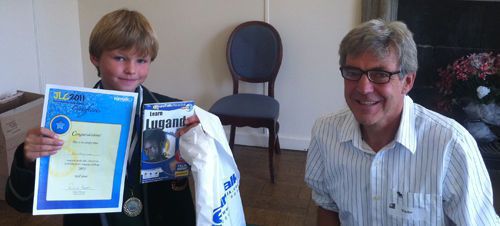
Ben and EuroTalk chairman Dick Howeson
Holiday plans apart, entering the competition has been a good thing for the Fawcetts.
Anna adds: “Children from Oakwood have made it through to the semi-finals before but not to the finals so Ben’s as proud as a peacock! It’s been really good for his confidence not just with languages but generally. He’s thoroughly enjoyed the competition and I’ve hardly had to remind him to look at the games.”
Having picked up some of the basics of Portuguese and Kazakh in the first two rounds of the competition, Ben is now one of around 40 finalists trying to get to grips with the last JLC language, Luganda.
Anna adds: “I’m obviously extremely proud of him but it’s completely nerve-wracking as well!”
We’re looking forward to seeing Ben and Anna at the final, which will be held at the Language Show next Friday.
Ben’s even made the local paper!
Are there any other semi-finalists out there who’d like to share their JLC story?
Turku – Europe’s Culture Capital 2011
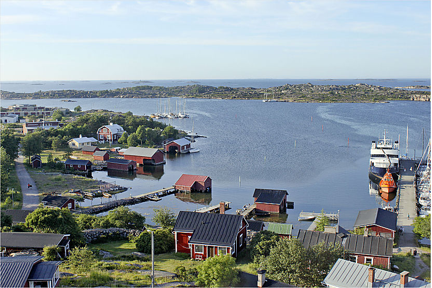
Kökär in the Turku archipelago, one of a series of settings for the Lights Concert Series, part of the Turku 2011 programme. Photo: Esko Keski-Oja
Since 1985, the Council of the European Union has annually chosen a European Capital of Culture, to “highlight the richness and diversity of European cultures”, and to “bring people from different European countries into contact with each other’s culture”. My Finnish hometown of Turku, nestled in the midst of the picturesque archipelago of some 10,000 islands in the Baltic Sea is, along with the beautiful medieval town of Tallinn in Estonia, the European Capital of Culture for 2011.
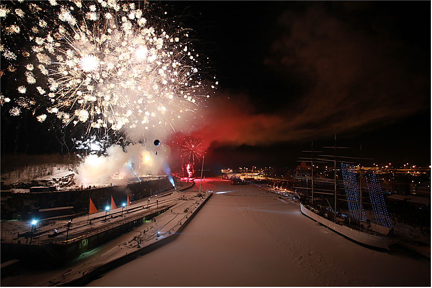
And what an exciting year it has already been for Turku. Commencing with a spectacular opening ceremony, involving flying dance troupes, hundreds of lantern-bearing school children and a 350-strong choir parading the cobbled streets of Finland’s oldest town, Turku’s 2011 cultural calendar has embraced thousands of individual events, performances and productions.
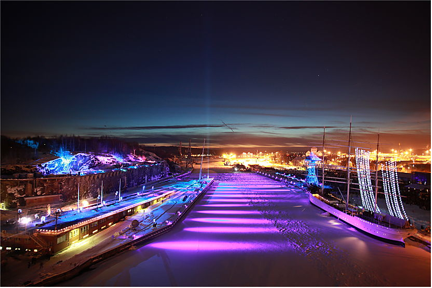
The opening ceremony of the Turku’s Culture Capital year. Photo: Lauri Paasio.
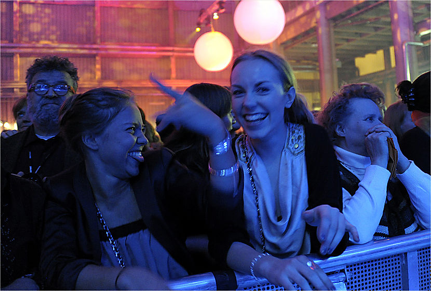
Festive spirit at the opening celebrations. Photo: Samuli Saarinen
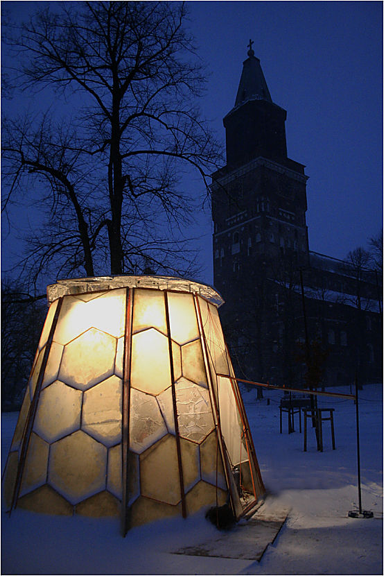
The individual events have ranged from the beautifully ethereal exhibition 876 Shades of Darkness, contemplating the long dark nights of the Finnish soul, to the alfresco performances of the Opera d’Alvilda in Abo, an Italian opera written in 1692, being performed in the grounds of the imposing Turku Castle.
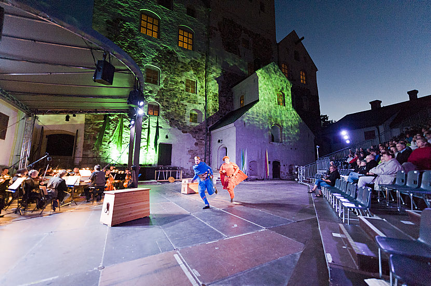
Opera d'Alvilda in Abo. Photo: Kari Vainio
Historically Turku has embraced culture in all its forms, whether it be through a vibrant music scene centred around two annual music festivals occupying the town centre and nearby island of Ruissalo, or the numerous art and archaeological museums and impressive number of amateur theatres (I counted 13).
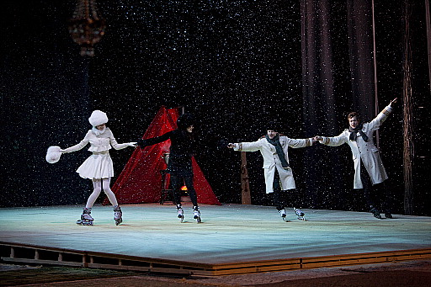
Anna Karenina by Turun Kaupunginteatteri. Photo: Robert Seger
This tradition of theatrical performance in Turku is embodied in the rather bulky 60s concrete façade of the much-loved municipal theatre. Offering productions of both homespun and international favourites, the theatre’s Anna Karenina has been extremely well received this year, earning accolades like the prestigious Thalia award for the 2011 Best Theatrical Performance.
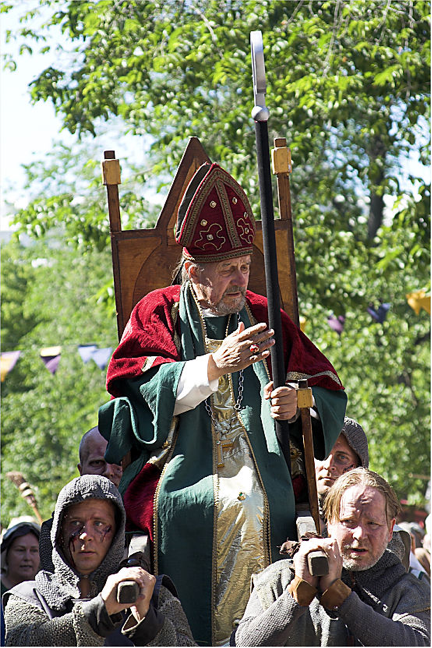
Every summer, the spirits of the medieval possess the cobbled streets of Turku’s old town with the Medieval Market fair that habitually attracts around 100,000 visits over four days. Re-enacting everyday street life as as it might have been lived in the alleyways and squares of medieval Turku, this entertaining and informative fair arrives every year, complete with rope twisting competitions, fearful knights and mischievous jesters (see here for a photo album – click on the links on the left to view more pictures).
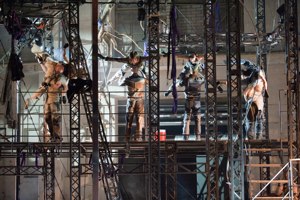
Tanssiva torni – The dancing tower by Aurinkobaletti. Photo: Kari Vainio
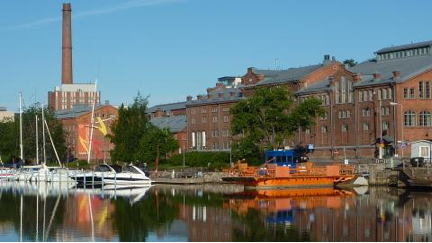
At the sympathetically restored and historic quayside, an old waterside factory now houses productions by the internationally acclaimed modern dance group Aurinkobaletti.
Next door, the prestigious (and always oversubscribed by aspiring undergraduates) Turku Academy of Art overlooks the symbolic heart of the city, the river Aura. The adjacent city ferry “Föri” takes passengers on a cultural voyage across the river: its distinctive yellow deck has acted as the setting for more than one art performance in the 90 seconds it takes to cross the river.
The 2011 European Capital of Culture award has stimulated Turku’s cultural heritage in new and novel ways, as the variety and sheer volume of productions and performances are acting to bring a new flavour, as well as a renewed vigour, to an already rich cultural landscape.
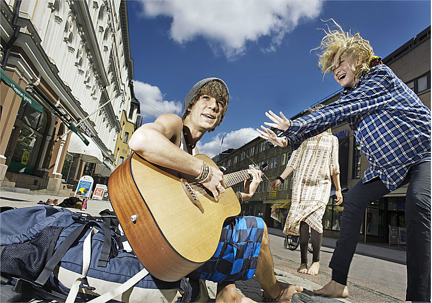
A Turku street busker visited by a fan. Photo: Perttu Saksa
We must not forget that Turku and Tallinn will pass the mantle of the European Capital of Culture to the towns of Guimarães and Maribor in 2012, and all Turku residents would urge their fellow Europeans to embrace the fascinating cultures of these towns with the same enthusiasm and interest that have been visited upon Turku and Tallinn over the past year. The spirit of the occasion, and the genuine, absolute honour the locals express on being bestowed the award, will stay with Turku for a long time to come.
Hanna
-
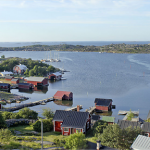
- Kökär in the Turku arcipelago, one of a serios of settings for the Lights Concert Series, part of the Turku 2011 programme. Photo: Esko Keski-Oja
-
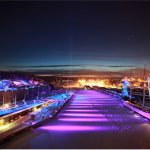
- The opening ceremony of the Turku’s Culture Capital year. Photo: Lauri Paasio
-
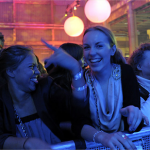
- Festive spirit at the opening celebrations. Photo: Lauri Paasio.
-
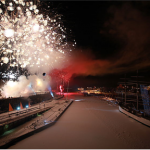
- The opening ceremony of the Turku’s Culture Capital year. Photo: Lauri Paasio
-
- 876 Shades of Darkness. Photo: Reino Koivula
-
- Opera d’Alvilda in Abo. Photo: Kari Vainio
-
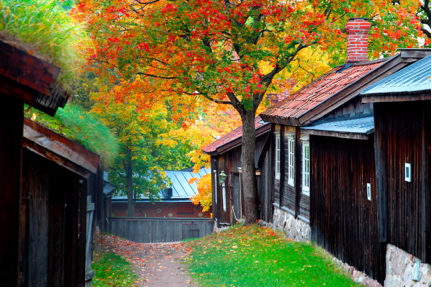
- Luostarinmäen käsityöläismuseo / Luostarinmäki Handicrafts Museum. Photo: Johannes Lahti / Turun kaupunki
-
- Anna Karenina by Turun Kaupunginteatteri. Photo: Robert Seger
-
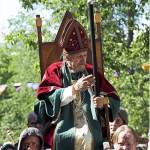
- Turku Medieval Market fair. Photo: Esko Keski-Oja
-
- Tanssiva torni – Dancing tower by Aurinkobaletti. Photo: Kari Vainio
-
- The town ferry ‘Föri’. Photo Markku Salo – Yle
-
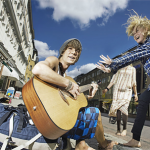
- A Turku street busker visited by a fan. Photo: Perttu Saksa
-
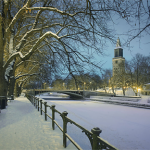
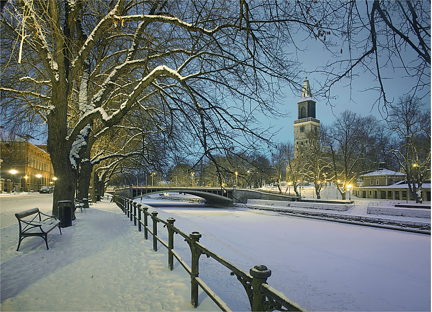
- Turku Cathedral at dusk. Photo: Perttu Saksa