10 Years with the JLC – a Teacher’s story!
Here at EuroTalk we love hearing feedback from participants of the Junior Language Challenge! So when runner-up Aalaya Sanjeeva’s teacher Jackie Gliniecka from The Hawthorns School sent us this wonderful message about how she’s found being involved in the competition over the years, we had to share it with you 🙂
10 years ago, in 2005, we received a flyer from EuroTalk telling us about this competition, and we encouraged the children to enter it. It was an exciting adventure and we have repeated the experience every year since.
I remember so clearly, when we reached the semi-finals and I met Dick Howeson for the first time. His passion for languages and education, together with his compassion and drive to change the world, completely bowled me over; when talking about the competition to anyone and everyone who stands still for long enough to listen, I feel compelled to try and include a description of Dick. The best I can manage, to convey his wonderful energy, enthusiasm and gentle treatment of these young children combined with the fantastic difference that he encourages them all to make in the world, is a sort of cross between a kindly mad professor and a true saint! And what a fantastic team he has built up around him, too; Liz, who is always there to answer all queries in an incredibly efficient and kindly way so as to not scare the teachers and parents; Franco, who has the unenviable task of running the semi-finals and the finals with a rod of iron, yet maintaining a kindly, gentle, friendly demeanour so as not to scare the children; and countless others who make taking part in this competition a real joy.
Over the years, so many of my pupils have benefitted in so many ways from this wonderful competition; not only do they get the chance to try lots of different languages, thereby deepening their general knowledge of language and developing language learning strategies, but also it opens windows onto the world, helping to turn them into good global citizens, sowing the seeds that will encourage them, like Dick, to make a difference in the world. It is all done in such a gentle, fun way, encouraging independent learning, allowing the children to push themselves as far as they want to and at the same time helping the amazing work of the charities that the JLC support.
Aalaya has entered this competition 3 years in a row and has made the final each time. She was ecstatically happy to have come second this year and the whole school is so proud of her. This competition requires so much more than just the ability to acquire huge amounts of language in a very short space of time; you need a brilliant memory, a very cool head, nerves of steel, the ability to stay calm and focused and the faith to persevere under extreme pressure. What a brilliant set of skills to develop, and, although Aalaya has all these skills in bucketfuls, it has been so rewarding for me to see her develop and hone them enable her to achieve such a high standard in your competition.
The great thing is, though, as Dick always tells them, just to have entered makes them winners because of the good they are doing for others and the fun they have along the way!

Jackie (left) with Aalaya and her parents, alongside JLC champion Tudor Mendel-Idowu and fellow runners-up Cassandra Emmanuel and Isobel Eason
Look out for next week’s blog post to find out what second place finalist Aalaya and her mum Priya think about the Junior Language Challenge!
If you were part of the Junior Language Challenge in 2015 – or any previous year – and you’d like to share your story, please email us at jlc@eurotalk.com; we love hearing from our JLCers 🙂
What languages mean to me
Interview with Alexandra Turner – translator, writer, editor
Alex left her London life a few months ago to go and travel around the world. She is passionate about culture and languages and has traveled to 26 countries up to now. At the moment she lives in Stockholm, Sweden (and we deeply envy her for that).

EuroTalk: What made you start learning languages?
I started learning German and French when I started secondary school because it was compulsory. Straight away I loved both of them and they became my favourite lessons. Outside of school I was interested in watching movies or looking at books in those languages and continuing to learn (I know, so geeky!). Then two years later I started to study Spanish too as an optional subject for GCSE (the exams we do aged 16) and I loved that too – my lessons made me think about sunny Spain instead of depressing London 😛 I was starting to get pretty interested in languages so I also took Japanese lessons after school (again, yes, I was a geek…) So I kept on with those language for a few years. I started learning Italian just two years ago because I met my boyfriend who’s Italian, so I learned just by listening to him talking, by watching Italian TV with him and later on by going to Italy. Finally my other language is Ukrainian, which I started learning because I was living in L’viv, Ukraine, and I really needed the language to get around day to day.
ET: What gives you motivation to continue learning?
To be honest I mostly learn for fun. I am really fascinated by languages, how they are different and yet sometimes similar. If I have spare time I am as likely to grab one of my language apps or watch a foreign movie as I am to surf Facebook or watch TV. And in fact if I DO surf Facebook, Twitter etc, half my feed is in other languages anyway.
I also learn for work because I’m a translator and I feel like I need to keep improving. And travelling of course is a motivation because I need languages for practical things.
ET: What do you find to be most rewarding about language learning?
Earning money is one thing! But the best feeling ever is navigating a practical situation using one of your languages, or having a real conversation for the first (or second, third…) time. I get so psyched when I talk to an Italian person and they actually understand what I’m saying. Or just doing something simple like buying some tomatoes at the market in Ukraine, I feel pretty cool!
ET: What were some of the challenges you faced and how did you overcome them?
Loads! When I was at school I found grammar boring and I just wanted to learn loads of words (I was pretty naïve!!) So later on my grammar was a total mess and I had to go back and try to put it into place. So I still have a pretty terrible knowledge of some fundamental things like genders in German, which can only be fixed by hard, hard study later on. So if you want to reach a decent level in a language, I recommend to get the grammar in place ASAP, which I’ve done with Ukrainian (older and wiser) and it’s helped soooo much. Also I now find grammar amazing, like doing a Sudoku puzzle 😀
Another challenge is that I am shy and afraid of speaking to new people in new languages. This is incredibly hard to overcome, but the only solution is, like Nike says, Just Do it! Start with easier situations like buying a beer or a stamp and progress to harder ones. Or stick yourself in an environment where you are forced to use the language. For me that’s spending time with my boyfriend’s family who speak NO English, or by living in Ukraine where many people know no English at all. Another helpful thing is to organise a language exchange or find a conversation teacher/partner who will give you one on one help. You gain confidence just by doing it over and over and over…
ET: Tell us your favourite word/expression in your favourite language.
Wow there are so many! There are loads of amazing expressions in Italian although most of them are too rude to write here now… The best things are the gestures, there’s a funny one you can do to show that you’re being left alone or ditched, where you make the shape of an artichoke (for some reason…) with your hand. In German I like the expression ‘das geht mir auf den Keks’ – ‘it gets on my biscuit’, which means something annoys you. I also really like using the word ‘pobrecito’ (poor thing) in Spanish whenever I’m being sarcastically sympathetic to someone.
ET: Any funny/weird/awkward situation that happened with a native or another speaker?
Too many awkward situations to count. At the moment I keep accidentally using Spanish words when I speak Italian, which is quite awkward when people stare at me and say ‘what does that mean?’ In Ukraine I had silly situations every day, such as trying to order food and having to make animal noises when I didn’t know the name of the type of meat, for example. Luckily people found it fun rather than being annoyed. Also I’d get really annoyed when I went into a продукти to buy milk or bread – I’d so proud that I’d remembered the right words, then they would ask me some silly question like ‘which type of bread?’ which I clearly had no chance of answering. Last time it happened, I replied to the woman ‘Я не знаю’ (I don’t know) in exasperation, and she laughed at me for about five minutes…
Read more from Alex at wanderlustlanguages.com or tweet her at @alexa4912
Junior Language Challenge 2015 – The Final!
On Friday 16th October, our 33 Junior Language Challenge finalists came to London to battle it out to win the trophy. The children have learnt three languages during the course of the competition, with Portuguese being the first language, moving onto Mandarin for the semi-finals and Arabic being chosen as the final language.
All three heats at the final were extremely close, with several children having nearly perfect scores! Once all three were completed we paused for a lunch break, where a second competition took place… This year we decided to give the parents and teachers a chance to experience the JLC for themselves, and to see how they got on with the tricky Arabic language. This was as tense as the children’s rounds (with the parents obviously feeling pressure to do well!). It was clear to see many parents had been practising with their children, as some of the scores were amazing – congratulations to Sarah, who did brilliantly and definitely earned the bottle of champagne she took home with her!

The final round for the children got away and the top five places were constantly changing. Our resident evil genius, Franco, added to the suspense by keeping the top two scores a secret, so the winner wouldn’t be known right until the end. We were extremely lucky this year to have the winner of Channel 4’s Child Genius, Thomas Frith, to announce the winner of the JLC 2015….
Congratulations to Tudor Mendel-Idowu, the winner of this year’s Junior Language Challenge! Tudor gained over 300 points during the final round and won the top prize of a family trip to Malawi. This gives Tudor and his family the opportunity to see the excellent work that our charity, onebillion does there. Tudor, who like Thomas has been on Child Genius, has entered the Junior Language Challenge three times, coming third in 2013. “I’m very proud,” he told us afterwards. “All the hard work has paid off, because it’s been quite a long time! My favourite language this time was Mandarin, because I enjoyed the way it related to other languages I’d learnt before.”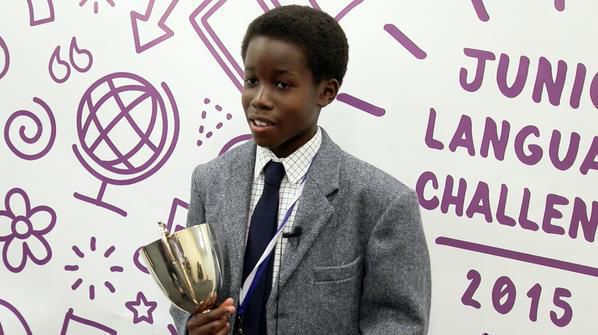
Tudor’s prize was awarded by 12-year-old Thomas, who knows exactly how he feels after winning Child Genius earlier this year. Thomas also presented a cheque for £5,545 to Andrew Ashe from our charity, onebillion. The money will go towards the development of a solar-powered projector for teachers to use in primary schools in Malawi.

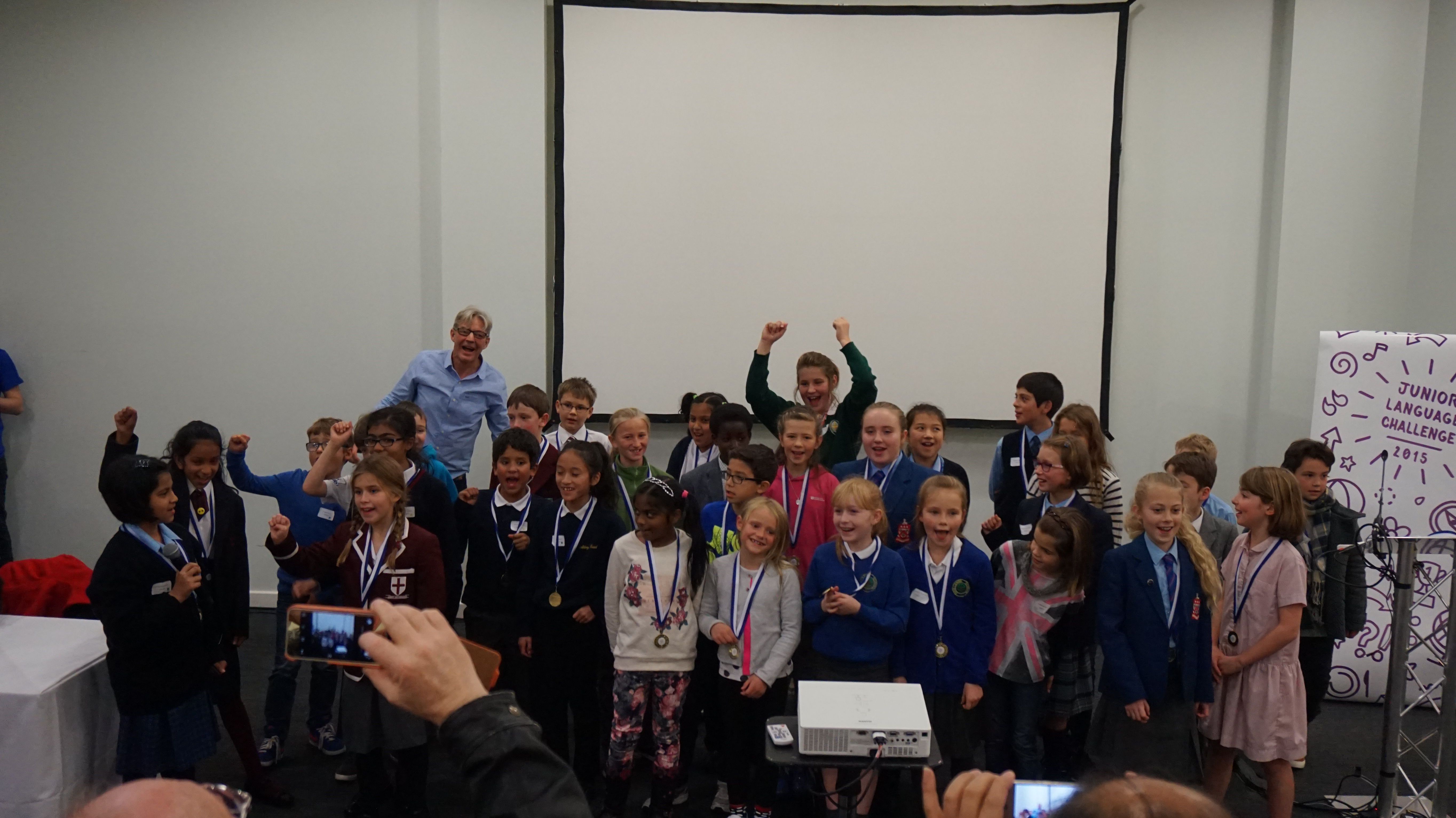
Our runners up this year also did amazingly in the final, with Aalaya Sanjeeva who came second and Isobel Eason who was just behind in third. The final was an excellent example of how brilliant all the children who took part in the JLC are at picking up languages – and also of the importance of perseverance; our top three had all taken part in the JLC in previous years. Every one of the 33 children that made it to the final should be so proud; you were all incredible! So thank you to: Olivia, Severin, Benjamin, Andrey, Gavin, Farah, Ritisha, Leyah, Saskia, Isobel, Aalaya, Nithya, Cristina, Cassandra, Anais, Isabella, Laura, Jamie, Reuben, Lydia, Aurelio, Rona, Ethan, Abigail, Monisha, Ben, Benitto, Grace L, Grace B, Louis, Sumayyah, Emma and Tudor, for taking part and putting so much effort into the JLC!
If you would like to know more about the Junior Language Challenge and how to take part in 2016, please sign up to our mailing list on the JLC website; you can also find out more about the JLC there too, or email us with any questions.
In the words of our brilliant guest, Thomas: “Languages are really important, they’re fun, they stretch your mind and let you talk to other people, which I feel is polite, rather than expecting everyone else to learn English.” We couldn’t agree more.
The JLC will return in March 2016 and we hope it’ll be bigger and better than ever!
Icelandic is not like chicken
by Patricia Ochman
My initial reason for taking on Icelandic was pretty pragmatic: I had started riding Icelandic horses and purchased a friendly Icelandic gelding, Léttfeti. I felt that picking up some Icelandic would allow me to get access to a treasure chest of information about my favorite breed and help me better understand my Icelandic best friend.
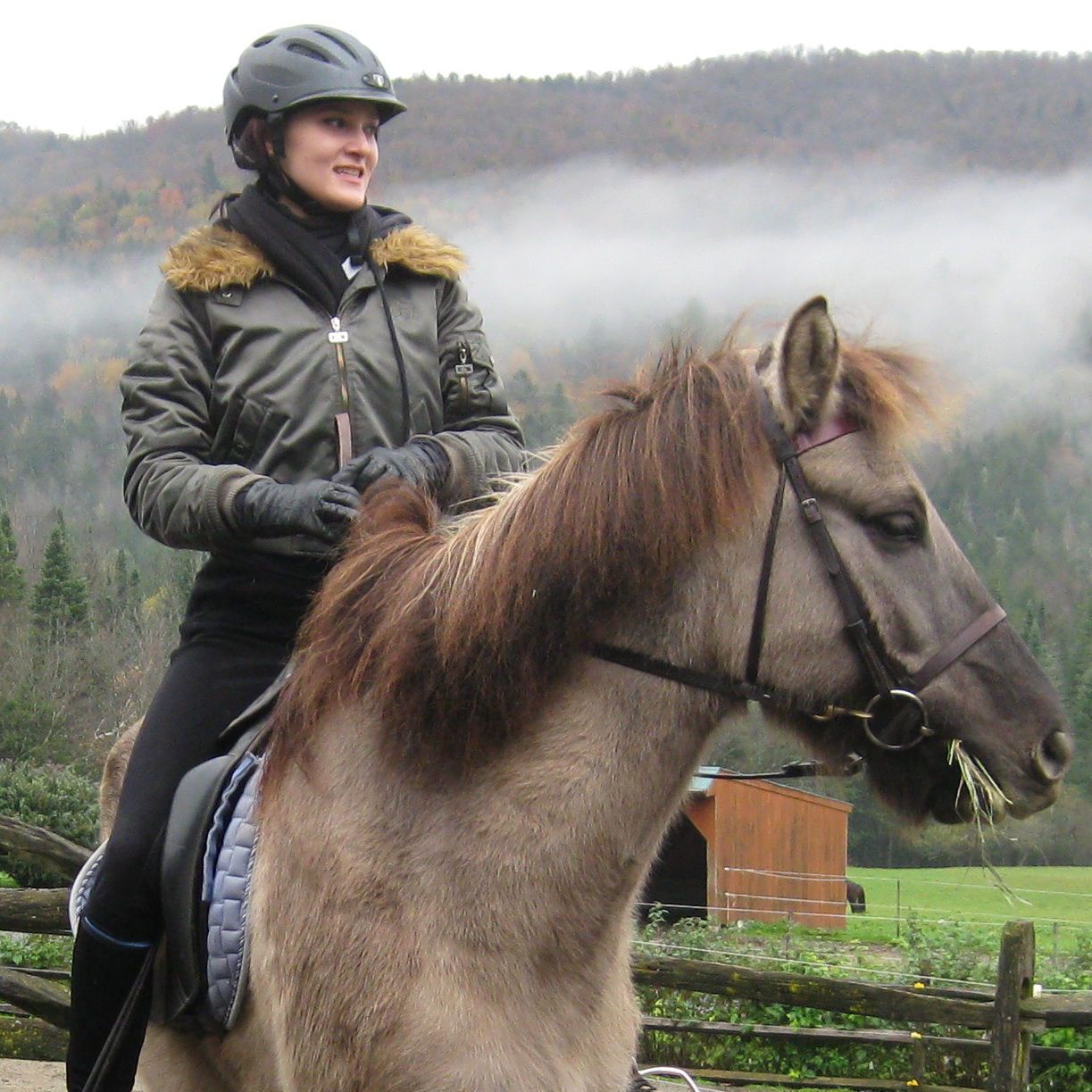
I took on a uTalk challenge and started learning Icelandic. Since I know Danish, I figured, how hard could it be? I would have this down in 30 days, no problem.
Well, fruits and vegetables were fine… but then it got thorny. Very thorny, very fast. Icelandic, it turns out, is not that similar to Danish. My initial enthusiasm turned into frustration because I thought this was supposed to be easy. Why were there three genders, four declensions, unusual pronunciation, weird words in weird places?
I gave up. It was too complicated, too different. Sorry Léttfeti, we’ll have to stick to English.
Until one day, I remembered that when I was younger, I refused to learn declensions in Polish because English and French (languages I already spoke) had no declensions. That’s when my teacher said, “That’s just the way it is; Polish has declensions and you’re going to have to learn them.” That response later resonated in my head when my Latin teacher made us repeat “rosa, rosam, rosae, …”. That’s just the way it is in Latin, I thought. I learned Polish and I learned Latin and I accepted declensions. I even started thinking that declensions add richness to a language, just like the pluperfect subjunctive tense adds richness to French.
Later on, I learned Finnish and because I had been told that Finnish is unlike any other European language, I just started from scratch, not assuming I would know anything at all. Hyvää päivää, olen Patricia. It went well and I progressed at a satisfying pace. It was unfamiliar and beautiful.
So then, why was I so frustrated with Icelandic? Could it be that my frustration had nothing to do with the language and everything to do with the fact that I was trying to fit a square peg in a round hole? It is certainly a very comforting feeling to think that something that is new to us is similar to something we already know. After all, we are regularly told “try it, it tastes just like chicken”… But doesn’t that just defeat the whole purpose of trying something new? How about “try it, it’s nothing like chicken, it’s totally unique and your mind may just be blown”?
I was trying to make Icelandic seem similar to something I already knew when it really wasn’t, and that’s what hindered my progress. I tried to put myself in the same mindset I had for Finnish and just told myself that this would be different. I’d have to let go of the buoy I was apparently desperately hanging on to and I’d simply have to embrace Icelandic for all its… well, Icelandicness.
I started focusing on the things I already knew in and about Icelandic and built on that. I tried to figure out its internal logic, its particularities, its flow. I started repeating out loud the words and sentences I learned and slowly made sense of them. Eyjafjallajökull is really not that scary when you understand that it’s just a juxtaposition of “islands”, “mountains” and “glacier”. Icelandic started to make sense and I started loving it. I’m still a beginner, but I’m now an excited beginner, unafraid of straying from what I already know. Vel gert!
I believe learning languages expands one’s mind, and this may be a reason why. Learning a new language means getting out of that familiar English, French, German, etc. playpen and discovering new ways of organizing and expressing thoughts. Scary at first, sure, but oh how rewarding.
The Language of Chocolate
Ah chocolate, that little sinful delight that you can pretty much find in every corner of the globe. Eat it, drink it, wear it or even play with it, you simply can’t get away from it. Since it’s National Chocolate Week I was curious to find out where the word ‘chocolate’ actually comes from.
Unfortunately there isn’t really a concrete answer that states its exact origins. Some believe it comes from the Aztec (Nahuatl) word ‘chocolatl‘ which referred to a substance produced from the seeds of the cacau tree. Others believe the Spanish coined it from the Mayan word ‘chocol‘ (hot) and the Aztec word ‘atl‘ (water) when early explorers came across a beverage made from the seeds.
It only goes to show how far back the beginnings of chocolate as we know it are embedded into our history. If you’re looking for interesting ways to use the word chocolate in other languages, here are a few to start you off with.

If you ever come across something or someone that you find utterly useless, then the expression ‘as much use as a chocolate teapot‘ might come in handy. Science has even proven how useless a chocolate teapot really is.
In French, you might use the phrase ‘tablettes de chocolat‘ to refer to a particularly svelte and toned looking man. There are some things about the French language that I just love.
‘Es el chocolate del loro‘ in Spanish literally translates to ‘the parrot’s chocolate’, but is in fact referring to the insignificance of a small amount of money when compared to a much larger amount. I’m still trying to work out where the parrot comes into this, though.
And if you find yourself in a particularly confusing situation that defies all sense of logic and cohesion, don’t hesitate to swap the English idiom ‘it’s all Greek to me’ for the Dutch ‘daar kan ik geen chocola van maken’ which translates to ‘I can’t make chocolate of that’.
Do you know any other chocolate based expressions? Do let us know! I’m sure they’ll be positively delicious…
Safia
