Why I’m learning German in January
In a few weeks, I’m taking on the uTalk challenge – using the app to see how much I can learn in the 31 days of January.
I’ve been trying to decide which language to go for; there wasn’t any particular one that I needed for a holiday or work trip, so I had the full choice of 100 languages in the app to pick from. Having the opportunity to learn something just for the pure fun of it is great, although 100 is a lot of options for someone as indecisive as I am.
My first thought was to learn Catalan, so I’m prepared for my next trip to Barcelona, whenever that may be. But as I already speak Spanish, it seemed like a bit of a cheat. Although there are significant differences between the two languages, on the whole they’re similar enough to give me an unfair advantage over my colleagues!
So then I decided to use the power of Facebook, and asked my friends which language they thought I should learn. I got various suggestions – Japanese, Navajo, Lithuanian, Welsh…
I was tempted by them all, but in the end I think I’ve finally made a decision. So this January, I’ll be having a go at German.
There were a few reasons for this. Firstly, I never got the chance to learn German at school, because we had to choose either Spanish or German. I’ve never regretted choosing Spanish, which I went on to study at A-Level and university, but from time to time I’ve wondered what might have happened if I’d gone for the other option.
Secondly, German looks quite tricky, and I figured if I was going to take on a challenge, I might as well do it properly. I’m a bit fascinated by the language, too, with its hugely long words; from what I can tell, you can come up with a word for just about anything by sticking others together. And it has some great proverbs.
Also, Germany’s close enough for me to pop over for a long weekend if I want to practise, whereas some of the other options, like Japanese and Navajo, are spoken a bit further afield. Maybe next year…
Finally, one of my favourite words is German. Backpfeifengesicht means ‘a face badly in need of a fist’. And as far as I’m concerned, a language that can come up with a word to describe that has to be worth a look.
Anyone want to join me?
Liz
10 reasons to visit… London
I’m really excited about this one, London is my absolute favourite city and not only because it has been my lovely home for more than a year but because it’s truly one of the best places in the world.
Here are 10 reasons you should choose London as your next destination for a city break or a longer vacation.
1. The people and the vibe
I’ve put these two reasons together because I think they are related to one another. The first thing that made me have the warmest feelings for this great city is the kindness and friendliness of the people. When I first came here I thought it is very endearing that people here say ‘thank you’, ‘sorry’, ‘I apologise’ as often as they can, and that matters more than you’d think when you are in a city with 8 million other people.
I promised I’d be specific so let’s get down to actual locations of things to see in London. Now, I won’t bore you with Big Ben and the London Eye… If you’ve never been here before, I suggest reserving a day just for the Central London attractions so you can tick them off your list, ’cause, you know, #BigBenSelfie.
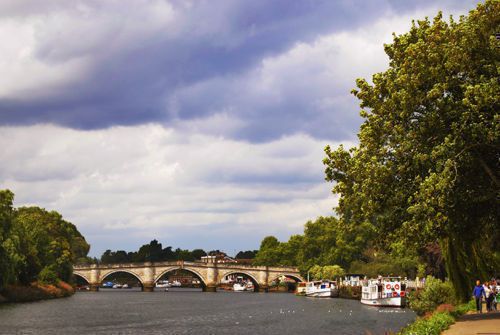
2. Richmond
When you get there you’ll be in a different world. Richmond Park, the largest of the capital’s eight Royal Parks and the biggest enclosed space in London, is home to the beautiful Isabella Plantation, Pembroke Lodge and herds of Red and Fallow deer.
The city centre is very beautiful as well – take a walk near the river, the bridge and on the high street. If you are lucky to be there on a sunny day, have a look at the local farmers market, the lovely boat restaurants and terraces along the river.
3. Holland Park & Kyoto Garden
Holland Park is a district and a public park in the Royal Borough of Kensington and Chelsea, in central London. It has a reputation as an affluent and fashionable area, known for attractive large Victorian townhouses, and high-class shopping and restaurants. The park itself is very beautiful and quiet, with squirrels and peacocks walking around. Inside the park you can find the Kyoto Garden, which is a Japanese garden and can be described as an oasis of tranquility, where you can relax and watch the waterfalls and the rather large orange fish swimming in the pond.
4. Kensington Palace and Hyde Park
These two locations are close together so I reckon this would be the perfect place for spending a lovely relaxed day starting with brunch in one of Notting Hill Gate’s posh cafés and continuing with a walk to Kensington Palace and its amazingly beautiful gardens (no really, the Brits have a special talent when it comes to ridiculously good looking gardens). Passing this, you will find yourself in the biggest park in central London, Hyde Park.
5. Notting Hill Gate and Portobello market
Head to the famous Portobello Road Market for everything from antiques and vintage accessories to street food and fresh veg stalls. If you like walking around aimlessly in an unfamiliar area, I definitely recommend a walk on the streets of Notting Hill, to discover nice boutiques, cafés, restaurants and colourful houses. If you are there on the Sunday and Monday of the last weekend in August you can even take part in the famous carnival that takes place there.
6. Camden Town and Regent’s Park
Camden is renowned for its markets that date from even the 1970s, some of them. It used to be just a small food market serving the local community, but by 2013 all the foodstuff and produce stalls had gone, leaving only touristy stalls. In the vicinity there is the lovely Primrose Hill (also nice cafés in the area), where you can get a beautiful view of the city while sitting on the grass. Going south from there, you will reach Regent’s Park.

7. Theatreland
You can’t come to London and not check out a West End show. From the classic shows like Les Misérables and Phantom of the Opera, to new hits like The Curious Incident of the Dog in the Night-time, there’s something for everyone. It’s not cheap, but it’s the kind of thing you have to experience at least once in your life. Or if Shakespeare’s more your thing, and you’re in London between April and September, visit the Globe for an open-air performance (only £5 for a standing spot in the yard), and hope it doesn’t rain…
8. Greenwich
Notable for its maritime history and for giving its name to the Greenwich Meridian (0° longitude) and Greenwich Mean Time. It is located in South East London and is the home of the National Maritime Museum and University of Greenwich, which has very nice architecture and gardens that go till the Thames bank, and the chance of seeing a great sunset over the river are pretty high. If you feel active, take a walk into the Greenwich Park and go up the hill to get to the Royal Observatory where, besides the renowned Prime Meridian, you get to see a beautiful view over the city skyline.
9. Covent Garden Market
This is a great place especially around winter holidays. It is a covered market, very nicely decorated, with shops, cafés and restaurants. Almost always you’ll see street performers doing their act, some of which have proved to be quite impressive. During winter time you can get mulled wine and other hot drinks and food; during summer you can chill with a glass of wine or pint of beer at one of the outdoor terraces.
10. Thames South Bank
On a day with pleasant weather, take a walk on the river’s south bank, starting from the London Eye (Waterloo) and continuing along the river. There is a beautiful view of the buildings in The City, ships on the river, cafés and terraces. You will pass the Millennium Bridge that leads to St. Paul’s Cathedral, Tate Modern museum, London Bridge (you can stop for a snack or a meal at the Borough Market behind Southwark Cathedral), London Bridge City Pier (great spot for photos with the city in the background), London City Hall and finally get to the wonderful Tower Bridge which has recently opened an exhibition for its glass floor in the upper side of the bridge (the bit between the towers). This is a great experience, as you can see from the photo below.

Before you come to London, don’t forget to install uTalk so you can properly order fish and chips and a pint of beer, or nonchalantly refer to the underground as ‘the tube’.
Ioana
Quote of the week: 6 Dec 2014
“If someone offers you an amazing opportunity and you’re not sure if you can do it, say yes – then learn how to do it later.” Richard Branson

For more like this, find us on Pinterest.
Embed This Image On Your Site (copy code below):
Scire linguas: Why knowing your Latin can help your language skills
Thanks to London Translations for today’s blog post about the value of learning Latin!
Latin, a language that is more than 2,000 years old and is still spoken in the Vatican today, has shaped modern European languages like no other. Who would’ve thought that this medium of communication, which spread through the power of the Roman Empire, would influence language as we know it, speak it and understand it worldwide?
But why bother with learning Latin? If you don’t want to work in the Vatican, why should you learn a dead language? Surely you might as well focus on learning a modern language that actually helps you to communicate with other human beings, whether you’re travelling the world, writing emails or letters, or having business meetings with international clients.
However, despite being so old, Latin can give your language skills a real boost and help with a range of tasks, including consecutive interpreting. Why? Let’s take a closer look.
Better vocabulary
It’s a fact that almost 50 per cent of English vocabulary comes from Latin and 20 per cent from Greek. So if you know your Latin, you can derive an array of English words and improve your vocabulary in general. This applies to other European languages as well.
Better grammar
By getting to grips with Latin grammar, you can gain a better understanding of what grammar is about and how to apply that knowledge to other languages, making it easier to identify grammatical differences in a variety of languages.
Better learning of modern languages
If you know your Latin, it will be easy for you to apply your grammar and vocabulary skills to the modern Romance languages, such as Spanish, French, Portuguese and Italian. In fact, around 40 languages are connected to Latin. That is a big pool of knowledge.
Better performance in tests
People who know Latin generally outperform people who don’t in standardised tests. This may be because a language that has so many rules can help to shape logical thinking and cognitive skills in general.
Better foundation for different career paths
Knowing Latin and Greek can help to enhance your chances of succeeding in different career paths. In some professions, it is especially beneficial. Think of medicine, the law and philosophy.
As you can see, learning Latin has numerous advantages. It is not only a language for old, sophisticated men who sit in libraries all day. It is a language we should not forget and something that is well worth teaching future generations.
(In case you wondered what ‘scire linguas’ means, it translates as ‘learn languages’.)
If you’d like to try out a bit of Latin, you can find a free demo on our website.
Quote of the week: 29 Nov 2014
“You did not come here to be normal, you came here to be you.” Robert Holden

For more like this, find us on Pinterest.
Embed This Image On Your Site (copy code below):
