Can uTalk a new language in one month?
Happy Thanksgiving to all our friends in the USA, and around the world! Before we know it, it’ll be Christmas, and then we’ll be into 2015. Time flies!
Here in the EuroTalk office, we enjoy a bit of healthy competition, and with the new year approaching, we’ve decided it’s a good time to take some of our own advice and try learning a new language, using our uTalk app. We’ll all be taking on different languages, and competing against each other to see who can learn the most in the 31 days of January. What could possibly go wrong?
The rules are simple:
1. The winner will be the first person to score maximum points on uTalk in the language of their choice, or the person with the highest score on 31st January.
2. The language chosen can’t be one we already speak.
3. Competitors must start from zero points on 1st January.
4. To join the challenge, we’ll need to have access to an iPhone or iPad with the free uTalk app installed.
Through regular check-ins, we’ll be keeping an eye on and reporting our progress both here and on our Facebook and Twitter, and we hope you’ll be there too, cheering us on.
If you fancy taking up the uTalk challenge for yourself, we’ll be very glad of the company, so drop us an email with the language you’ve chosen, and we’ll send you over a code to unlock the Essentials upgrade (worth £6.99) so you can get started completely free on January 1st.
And in the meantime why not let your friends know which language you’re planning to learn? (There are 100 to choose from, but don’t panic – you’ve got a month to think about it!)
So far, our competitors include:
Ioana, who’ll be learning French
Nat, taking on Icelandic
Steve, who fancies a go at Thai
Al, tackling Chinese (Mandarin)
Symeon, who’s torn between Greek and Turkish
… and Liz, who took a while to decide but eventually settled on German.
Wish us luck!


Book review: Through the Language Glass
Ever wondered what us language geeks do for fun in our spare time? Reading books about languages, of course! Well, not all the time – but I recently read the very interesting Through the Language Glass by Guy Deutscher, and would recommend it to anyone else who is interested in how different languages work, and how our mother tongue affects our thoughts and behaviour.
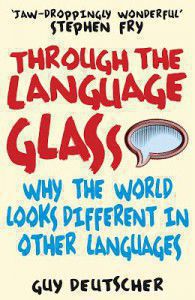 Through the Language Glass is all about the ongoing linguistic debate about whether our native language affects our perception and the way we think about the world around us. A large portion of the book is dedicated to a rather in-depth discussion about the differences between colour vocabulary in various languages. You might already know that Russian and Italian have two words for ‘blue’ (light and dark blue). But you might not know that the famous Greek writer Homer didn’t have any words for blue, and instead used mostly red and black to describe the scenes of the Iliad. This led to a long debate about whether people in the past lacked our modern ‘colour sense’ and saw the world in only a few shades. You’d probably have to be pretty dedicated to trying to understand the evolving debate on the development of linguistic terms for colours to plough through this rather long section, but it is rather interesting if you’ve got the patience.
The rest of the book moves on to some interesting discussions of smaller tribal languages in Australia and elsewhere, and how their unique features either reflect the requirements of the society/location, or affect the behaviour of the speakers. For example, the Aboriginal language Guuguu Yimithirr has no words for left and right. Instead, speakers must develop an acute sense of North, South, East and West, as it’s impossible for them to say ‘the tree is on my left’ – instead they must say ‘the tree is North of me’. Experiments have shown that even if speakers of the language are driven to new locations blindfolded, they retain their incredible sense of direction and can still describe location based on the compass directions.
And how about grammatical gender? For us English speakers, referring to a table as ‘she’, as a Spanish speaker would (la mesa), or a girl as ‘it’, as a German would (das Maedchen), seems rather odd. But for most Europeans, using a blanket ‘it’ for everything doesn’t really feel right either. So what does this mean for all those speakers of languages with grammatical gender? Do they somehow see a table as girly and feminine, and a phone (el teléfono in Spanish) as macho and masculine? Well of course not… that would be silly! But there may be subtle ways in which these distinctions affect us. Think about how we can tell a story in English being vague about the gender of the person involved. Yesterday, I had dinner with my friend. Whether that friend is male or female is none of your business! But in Spanish, you’re rather forced to disclose that ‘la amiga’ was of course a girl.
We might find the idea of a ‘gender’ for inanimate objects strange and funny, but Deutscher traces this back to at least an original logical starting point. It might surprise you to know that there are many more genders in language, beyond the masculine, feminine and neutral genders you might already know. Some languages even have a ‘vegetable’ gender, which even includes things like aeroplanes. Why, you might ask? Well, it’s simple really. The ‘vegetable’ gender may have started off for only plants. This would have included wood, and anything made from wood, such as a boat, perhaps. It’s then not such a jump to having other vehicles in the same gender.
If any of this sounds intriguing and you’d like to know more, I recommend that you pick up Deutscher’s book. It’s not quite beach reading, but it’s accessibly written, not an academic tome that’s only for linguists. I can guarantee that you’ll learn something new about languages and maybe gain a different perspective on how your native language affects your perception.
Alex
How much do you know about languages?
How much do you know about languages? Try our quiz to find out!
The top reported score so far is 11 – can you do better? Let us know how you got on in the comments 🙂
Quote of the week: 15 Nov 2014
“Laughter is the brush that sweeps away the cobwebs of the heart.” Mort Walker

For more like this, find us on Pinterest.
Embed This Image On Your Site (copy code below):
