The uncertain nationality of The Artist
On 26th February, The Artist swept the board at the Academy Awards, winning five of the twelve categories it was nominated for. This included Best Picture, Director (Michel Havanavicius) and Actor (Jean Dujardin).
However, something has bothered me since the release of this picture.
 It is a film with French actors in the two leading roles, made by a French director and with the support of several French film studios. Yet it is a ‘silent’ film and any dialogue from the characters – audible or otherwise – is in English. So with this in mind, can The Artist count as a foreign language film?
At first glance, it is easy to assume it cannot. The film features English as the ‘main’ language and the characters appear to speak, albeit muted, English dialogue.
But that’s only to the perspective of English-speaking audiences.
News reports on The Artist’s success at award ceremonies describe it as the most awarded French film in history and, at the 2012 César Awards (their equivalent of the Academy Awards), it won the award for Best Film, yet English-speaking films such as Black Swan and The King’s Speech were seen as foreign language films.
To me, it seems confusing that it can be seen as both an American and French film, but how can you define a film, which can only be surely described as ‘silent’ – a genre that hasn’t been on our screens in over 70 years?
The Artist has been seen as Havanavicius’s homage to silent cinema and as a result, it has revitalised the genre for a new generation. Can silent films make their way in the world, or will language be the key player in a film?
Katie
Encouraging English learners in Ethiopia
Our guest post today is by Elizabeth Horsefield, a volunteer with the VSO in Ethiopia.
Ethiopia was perhaps not the intended market for a EuroTalk Interactive Learn English CD-ROM. But it’s going down a storm. I work as a VSO volunteer in a Teacher Training College in a rural area of Western Oromia, Ethiopia. We have an English Language Improvement Centre (ELIC) which recently acquired two new desktop computers complete with headphones and speakers. Perfect.
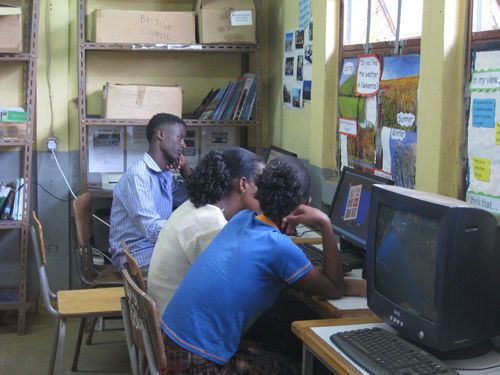 The students are desperate to improve their English. For most of them this usually involves sitting silently in front of an old copy of some estranged grammar book and making notes. Others even read the Oxford dictionary in the hope that it will one day magically transform their communication skills in English. Many of them went to school in remote areas with very few educational resources. Often their experiences in the ELIC provide a first opportunity to use a keyboard and mouse, so operating an interactive CD-ROM in their second or maybe third language might have been beyond their capacity. It would appear not.
 Every afternoon (hours scheduled for computer use outside of their regular classes), the students come and learn. Sitting alone or in pairs, I allow them half hour slots to navigate around the different activities and keep score. The cultural context of the material is apparent. These Ethiopian students are not familiar with eating roast chicken, going sailing or playing the trombone. But this only serves to highlight how culture and language are two halves of the same whole and they are quick to overcome any misunderstandings with the help of the pictures and a little guidance from the native speaker (me).
The local language in the area I live and work is Afan Oromo. I have been making a concerted effort to speak and understand something of this wonderful language with its complex history and rich sense of identity. If only an interactive CD-ROM existed for Afan Oromo, I suspect I would be making nearly as much progress as my students.
Elizabeth Horsefield, Nekemte, Ethiopia
Dinner starts with family
For most people, ‘Chinese food’ would represent the customary weekend or end-of-the-month takeaway, which could include chicken fried rice, spring rolls or even barbeque spare ribs. It is a fact – little known as it may be – that many Chinese families do not eat these dishes on a regular basis. Most of them are probably cooking meals like these daily and are sick of it! 🙂
 Ever since I was young, my parents have stressed the importance of traditional Chinese cuisine, and as chefs, they know it’s all about the flavour. Dinner is the most important meal, as this is the time when all the family sits down to eat.
The main ‘ingredient’ to a usual family dinner is steamed rice or ‘fān’– always white long grain rice, never wholemeal or pre-boiled, and it is always cooked in a rice cooker. Each person at the table has their own bowl of rice and they each pick some ‘sūng’ – dishes that are laid out in the middle, so everyone can have a bit of everything. ‘Sūng’ can be things such as steamed fish with ginger and spring onions, cured meats or mixed leafy green vegetables with oyster sauce. My father does most of the cooking so he sometimes creates his own dishes, such as stir-fried tofu with pork and sweetcorn or marinated chicken wings.
The number of dishes available varies to cater for however many people are at the table, and dinnertime is only over when all of the dishes are eaten – it is sometimes a tough job but it has to be done!
Since living in London, I have tried a number of different cuisines, such as Greek, Lebanese and Japanese, but nothing seems to fill in the gap of a family dinner. Regardless of whether it is Chinese New Year or even just to celebrate the fact that it’s Sunday, I have been unable to indulge in the comforts of a close-knit family dinner as often as I would like to and the idea of resorting to a takeaway, just to fill the void, seems like a somewhat empty substitute.
Has the family dinner gone out of fashion or to some people, is there no place like home?
Katie
Christmas celebrations!
Today is our last day in the office before the Christmas break. It seems like it’s crept up on us this year but now with just two days to go, we’re starting to look forward to our various celebrations. I asked a few people how they’ll be celebrating this year.
Lotta:
My mother is Finnish so we (my three siblings, partners, niece and nephew) have our Christmas meal and presents on Christmas Eve at her house, which is always beautifully decorated Scandinavian style (no tinsel!). That means Christmas Day is like Boxing Day where we just chill out, watch TV and have left overs.
On Boxing Day (26th December) I will cook at my house and have some of my husband’s cousins over, who are from Albania and don’t really celebrate Christmas, but like to get together – and will hopefully like my cooking!
Katie:
I go to my parents, who live up north, and because they live in the middle of nowhere, it’s a nice, quiet setting to celebrate. On Christmas Eve, I help prepare the veggies and set the table so all my Dad has to do is cook the dinner on the day! We exchange presents at midnight and on Christmas Day, we have dinner around 2pm before settling into playing some mahjong with the family.

Zsolt:
We usually buy a Christmas tree, then we spend about two hours in squeezing the Christmas tree into the previous year’s Christmas tree stand which is usually much smaller than the current one. After realising how many things we haven’t bought for the Christmas dinner, we start to decorate the tree and then get a surprise when we see that the cheap Christmas tree lights that we bought in the market for £0.99 don’t work.
When we have enough stress, we start cooking and feel happy because we have a lot of time until our guests arrive, then suddenly someone rings the door bell. Our uninvited guests enter the flat and start consuming half of the food we planned to serve for the dinner.
Hanna:
I’ll be celebrating in Finland by eating too much Christmas ham, going to a Christmas concert, and listening to the Declaration of Christmas Peace. I wanted to go skiing but there’s no snow 🙁
Sheila:
I am trying to make a Trinidadian rum cake for Christmas this year… this is the first time I’m trying to make it – it’s an old family recipe. When I was younger my Gran used to send one in the post every Christmas. Preparations started in August! Step 1 is soaking lots of fruit in rum and cherry brandy for a few months…
Peter:
In the Ukraine we celebrate Christmas on 7th January. Children go from house to house and when people answer the door the children throw a handful of grain then sing a song in exchange for sweets or money (sort of a combination of Halloween and carol singing).
We’d love to hear how you plan to celebrate the holiday. Have a lovely Christmas and New Year everyone. We’ll be back in 2012!
Liz
The Footballer’s Hidden Skills
‘Footballers are a bit dumb.’ This is a general assumption that has existed for as long as I can remember. It also makes it a little easier when you think about the vast sums of money that most get paid. However, what would happen if they suddenly stopped receiving these large weekly amounts? This may sound a little bit of an irrelevant question but this is exactly what happened to many footballers on the continent earlier this year. With arguments about television rights in Spain many of the smaller clubs from La Liga (Spain’s equivalent to the English Premier League) owed players over three month in wages. It would have been a stark realisation for many of these young players that it did not matter if you earned €100,000 a week or €100, rent and mortgages still need to be paid on time, whether you are a footballer or not.
In this case a players’ strike at the start of the season garnered support and action for many of the affected footballers. It got me thinking however, what other attributes do these players have to use in the ‘real’ world? Could a job in languages be a realistic goal?
 If you take the Premier League for instance, there are 72 different nations represented. Now remove Britain, Ireland, America and a couple of other Commonwealth countries; that leaves representatives from 64 separate countries without English as their first language. Considering that the vast majority are now bilingual this is already an impressive item to add to their CV, but if you look at a select few they could shine in a multilingual environment:
Thierry Henry (NY Redbulls) – 4 – English, Italian, Spanish and French
Cesc Fabregas (Barcelona) – 4 – English, French, Catalan and Spanish
Zinedine Zidane (France) – 3 – English, Spanish and French.
The most I can seem to find, however, goes to our local Fulham centre back and Swiss international Philippe Senderos, who speaks six languages (English, French, Spanish, German, Italian and Portuguese), a total that many professional linguists would struggle to contend with.
In a small attempt to dispel the notions that the British are completely monolingual I would like to mention Gary Lineker (English, Japanese and Spanish), Owen Hargreaves (English and German), David James (English and Spanish) and Sol Campbell (English and French).
The variety of languages in the English League alone can lead to problems within teams and especially within management. Chelsea is a prime example where language skills have come to the forefront of the players’ regime. With a multitude of spoken languages, the first ruling of Andre Villas Boas (the current Chelsea manager) was to state that only English was to be spoken at the club, to bring a common language to the players who would otherwise separate into groups based on their mother tongue.
With Villas speaking four languages himself, it has become an integral part of his management style. New Spanish signing Juan Mata stated that understanding the instructions in English is challenging to begin with, but the squad helps out any new team mates who are struggling. With personal problems, however, Mata says that the manager would take him to one side and have any personal conversations in Spanish to allow him to fully express himself; this demonstrates the diversity an extra language can give, especially in management roles.
There is one English based Chelsea induction that the Spaniard could not escape – the tradition of Chelsea’s karaoke initiation, where a song has to be sung in English in front of the entire squad. Mata’s choice? The Macarena… It seems that although we may not be able to write off footballers as talentless off the pitch, due to the language skills that many have learned, we may be able to continue with the assumption that they have some terrible taste.
Glyn
