The challenges of translation
Over the last six months we’ve had our new free app uTalk translated into over 30 languages, and dealt with over 120 native language speakers who’ve either translated or performed the scripts. Along the way we’ve confronted many challenges which really emphasise how one language can be ambiguous whilst another is precise, and vice versa.
In English, for example, we can go to the shop and ask for a pepper without having to specify the colour, or order a boiled egg without stating whether it should be hard or soft; we refer to brothers and sisters without having to qualify their age; we talk about grandparents, uncles and aunts without saying which side of the family they are on and, perhaps most infuriatingly for non-native speakers (those inclined towards a bit of juicy gossip), we can refer to friends and partners without having to say whether they are male or female. We can be elusive and a little bit mysterious through the vagueness of the English tongue. This is not always the case in every language, and here are a few examples of what we’ve learnt so far:
 – In Vietnamese, you don’t just have a brother or sister: there is no general word. Instead, you specifically have an older or younger brother or sister. In Basque, too, there is no generic word, but the difference depends on the gender of the speaker rather than age: my Mum’s word for her brother (neba) will be different to my Dad’s word for his brother (anaia).
– Danish has two words for a wall, depending on whether it is an outdoor, brick-built wall or an interior wall.
– In Polish, we debated the straightforward English phrase He scores (a goal), which can be translated with a variety of terms depending primarily on whether he scores visibly, in the eyes of the spectators, or definitely, after verification from the referee.
– The Romanians use two words for snow – one to describe the falling droplets, one to refer to the layer already on the ground.
As well as these difficulties in trying to get different languages to correspond to each other, we’ve come across some interesting stylistic issues which don’t exist in English:
– In languages such as Czech and Slovak, our translators worried over the best way to tell the time, since it is common to express twenty-five past two as five to half past two, a construction which may initially confuse learners who have never encountered it. (English speakers may also be surprised when they first learn the time in many Slavic languages, where quarter past four is, literally, quarter of the fifth, the implication being that we are in the fifth hour).
– In Chichewa, our translators opted for entirely different and equally valid counting systems: one went for the traditional Chichewa way of counting based on the numbers 1 to 5, followed by increasingly complex and lengthy sums which require quick thinking and an aptitude for arithmetic in everyday transactions; the other opted for the commonly used English loan words- twente eiti (28), faifi (5) etc. Both systems are equally used, understood and widespread in Malawi.
 – Our Honduran consultant objected slightly to the inclusion of the word ketchup in the Latin American Spanish script, saying that la salsa de tomate would be more appropriate in his country. But this clashed with our Peruvian consultant’s advice, since ketchup is a widespread word in Peru and the salsa de tomate could refer to any other tomato-based sauce. Our Mexican translator chipped in that in Mexico ketchup is indeed commonly used, though catsup would be equally widespread… In the end, we settled on ketchup as the most generally acceptable in the largest number of places.
– In Polish, there is no good way to translate the phrases at the top of the stairs and at the bottom of the stairs: they would just say on the stairs in both cases. Part of the reason for this is the strange repetition you get if you specify at and on – na górze na schodach. The same odd-sounding repetition caused problems in the Spanish translation of I’m leaving tomorrow at eight in the morning, since the words for tomorrow and morning are identical, thus Me marcho mañana a las ocho de la mañana. It sounds so strange that people would prefer to leave out the first mañana.
These are just a few of the little points of interest we encounter on a regular basis in our translation project, and we’re looking forward to finding more and sharing them with you!
Nat
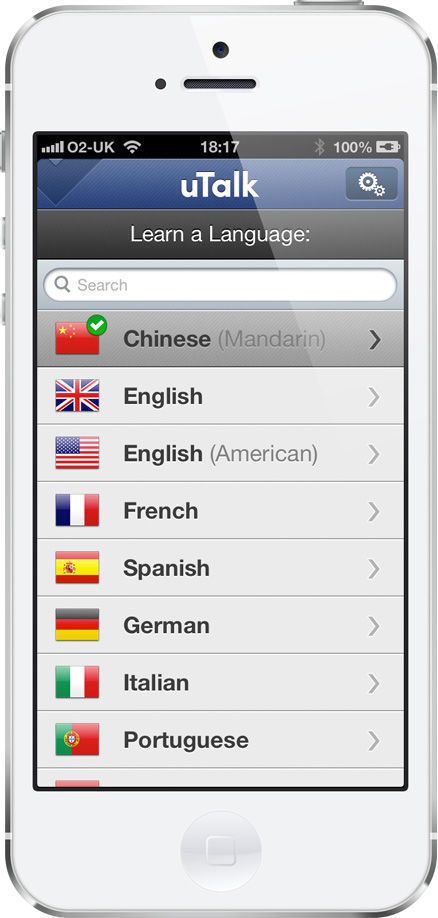 uTalk is now available from the App Store – it’s free to download and includes basic words in 25 languages, with options to upgrade for more vocabulary.
Something Borrowed: when one language just isn’t enough
After reading Konstantia’s post a few months ago about how many of our everyday words come from Greek, I started to think about where some of our other words came from. You might think that we are the ones influencing everyone else (words such as wifi in French, surfear for surfing the net in Spanish, and a lot of business jargon in German – downloaden, ein Workshop, ein Meeting and so on…), and of course that’s true. Most new inventions (the Internet, computers and related tech such as wifi) are named by Americans, and therefore the English word is often passed along to other cultures and absorbed into their languages. You’ll also find many non-English speakers throwing in English phrases amidst their native tongue. Any other Borgen fans will probably have noticed the way that characters casually use phrases such as ‘on a need to know basis’ whilst otherwise conversing in Danish. Clearly our language, especially in the business, IT and entertainment domains, has a huge global influence.
 However, if you look a little further back, you’ll find us doing exactly the same thing. It might seem incredibly cool to Europeans now to use English or merely ‘English-sounding’ words day to day, but we’re just as guilty of language-envy or just pure laziness with French, especially. How to describe that annoying feeling of being sure you’ve already seen or done something? Déjà vu, of course. Not to mention dozens of other words and phrases we all use on a daily or regular basis: laissez faire, enfant terrible, a la carte, a la mode, arte nouveau, en route, faux pas… I could go on for pages. You’d probably struggle to go through a day without using at least one or two obviously French words. It’s almost as if we simply couldn’t be bothered to think of our own words for some of these things, although I also suspect it has a lot to do with our associations with French as chic (another one!) and sexy. This is especially true in the beauty industry, which explains the proliferation of products labelled visage or with names like touche eclat remaining in their original alluring French guise.
French is the best example, as they are our nearest geographical neighbours, and historically one of our closest political connections, which explains the huge interconnection of our languages. However, as soon as you think about it, there are hundreds of other words that have crept into our parlance from other languages. Words like Zeitgeist and one of my favourites Schadenfreude have come over from German, whilst our food vocabulary owes a lot to Spanish (salsa, jalapeno, tortilla, nacho, paella…) We’re also becoming ever more familiar with words and especially foods from China and Japan. Sushi, sake, kimono, karate, karaoke and so on are everyday words to us, whilst we happily order bok choy, chop suey and chow mein without even thinking about it, not to mention concepts like yen, zen and feng shui. Taekwondo has made its way over from Korea, whilst we’ve taken words like bamboo and paddy from Malay.
This is just a quick look at some of the more obvious ways that our language has spread globally, and how many words we have absorbed from nearby European countries, but also from more distant Asian cultures. We’re such a global country, and it’s strongly reflected in our language. We’d love to hear more examples of English words creeping into other languages or other foreign words you’ve noticed in English, so feel free to leave a comment below!
Alex
Utility versus Beauty
Cristina Mateos is our Catalan intern here at EuroTalk, working on translating and recording our maths apps. In her blog post she explores a reason for learning languages that is often forgotten.
Utility versus Beauty.
Utility: Hammers, zips, kettles, light bulbs, electricity, mobile phones.
Beauty: Handwritten postcards, dawns, coffee smell, lovers looking into each others’ eyes, handknitted scarves.
 The world where I live stores useful belongings in closed wardrobes and turns on the radio so as not to listen to the silence around. As a Spanish teacher, I sell my courses by reminding these ‘utility users’ of the fact that 500 million people speak Spanish around the world. It is therefore extremely practical to be able to communicate in this language and to display that knowledge (especially if it comes with an official certificate) on one’s résumé. And I really believe that… and I am more than pleased with zips and light bulbs. But I feel sorry for the dawns. I feel sorry for the dawns and for language learners turning into language users. I would like my students to be able to ask for directions in Sevilla, complete a business deal with a big enterprise in Buenos Aires or get a train ticket in any Spanish train station, but I also want them to be fascinated by the beauty of my language.
Los rinocerontes no pueden leer. This is probably the most pointless sentence ever, unless you meet a woman crying in disappointment because a rhino isn’t answering her love letters, and you find it necessary to clarify for her that rhinos cannot read. But the sentence itself: its sonority, the combination of the ‘e’ letters together, the way grammar is used in it, the choice of the masculine gender instead of the feminine… it moves language away from usefulness and places it closer to poetry. Don’t you find it amazing how it’s possible to play with a language and build nonsense sentences? Making up words – and this is something, as language learners, that we constantly do when trying to refer to concepts we don’t know the name for – just by using common lexical rules? (Like The mugness of a morning, or This dog is so killable when it starts barking in the middle of the night.) Have you ever fallen in love with a word in your own language just because of the way it sounds, as if it were a piece of music with no meaning at all apart from the feelings it causes for you? If not, I can suggest one in English that I love: wibble. And I can provide one in Spanish too… barítono. Beautiful as a handknitted scarf.
Let me come back to the point. As a Catalan speaker, I feel also sorry for my second first language. Catalan has been left apart so many times in the name of utility that too often I need to make a real effort to keep on using it. I have been told that Spanish is more practical. More and more parents in non-English speaking countries choose a school for their children taking into account nothing but the number of hours their children are going to be taught English, because English (and now probably also Chinese?) is the Future.
Then, in Utility’s name… we can close small shops and open more and more supermarkets. We can burn poetry books and publish more instruction manuals. We can forget about nice roasts and pies and cheesecakes, and ingest vitamins and protein pills every morning.
But if, like me, you feel sorry for the dawns, then learn another language.
Cristina

Beware false friends
Learning a new language is a great experience: familiarising yourself with a new culture, discovering a new way to express yourself, and hopefully enabling yourself to order a beer in one more country. However, as a language-learner, you also need to be aware of the pitfalls that await you. The dreaded ‘false friends’ that lurk within every language, waiting to trip up the unsuspecting learner.
So what, you may ask, is a ‘false friend’? Well, would any non-Spanish speakers care to hazard a guess as to what decepción means? Bizarro? An éxito? Or even the verb pretender?
 Ok, I’ll admit, one of the great things about learning Spanish is how often you can put an ‘o’ or an ‘a’ on an English word and get a Spanish one – dentista, artista, famoso, precioso… However, unfortunately for us English speakers, it doesn’t always work.
Rather than meaning deception, decepción is actually a disappointment; bizarro is not bizarre, but brave; un éxito is a success, not an exit; and pretender does not mean to pretend, but to try. It may be quite embarrassing to make a mistake like this, but resist the urge to describe yourself as embarazada – it actually means you’re pregnant!
German is just as bad. The Chef doesn’t cook (they’re the boss), someone brav may well be a coward (brav actually means nice/good), and, as many Brits have found out the hard way, asking for the Menü won’t get the waiter to bring you a list of available meals (they will probably bring you the day’s set meal). If you’re ordering food, also watch out for pepperoni – I’ve seen many a disappointed face when someone realises they’ve ordered a little green pepper instead of a salami pizza; and expect a funny look if you ask for a Rezept in a shop – this is a recipe not a receipt!
False friends, generally speaking, are words in another language that sound deceptively like a word in your language. Many a learner has found themself hazarding an (incorrect) guess as to the meaning of a word on the basis of its seeming familiarity, and sometimes when grasping for a word you can’t quite remember, you end up with something that sounds right, but unfortunately isn’t.
If you’re thinking of learning a new language though, please don’t be put off by these examples! False friends are just one of the many interesting things about learning a new language, even if they can occasionally lead to misunderstandings. There is definitely no need to be embarrassed about making a mistake, as that is the best way to learn, and most native speakers will find it funny, rather than annoying.
If anyone else has any weird or funny examples of false friends they’ve encountered when learning another language, please share them with us!
Alex
The Art of Interpreting
Kana Tsumoto has just finished her internship with us, translating and recording our maths app into Japanese. In this post, she explains why she’s excited about her chosen career in interpreting.
The other night when I stayed at a youth hostel, I had an uncomfortable conversation with one of my roommates. I told her how I just finished a university course in Translation and Interpreting and how I am about to embark on my new career as a translator/interpreter. Then, in a not so roundabout way, she started to criticise my future profession, describing it as a boring task; merely repeating what has already been stated but in a different language! I shouldn’t have let her get on my nerves, but she did. I endured this for three days, and on the fourth she left. The initial joy felt at her absence soon descended into shame. It suddenly dawned on me that I had been a massive coward! I had failed to stand up for my profession, failed to defend it against a misinformed foe! Since then, I have been composing in my mind a grand speech on how wonderful translating and interpreting is. I would like to take this opportunity to share this speech, and dedicate it to my roommate in 303.
 Interpreting is, in fact, very exciting and very demanding! You definitely do need an extremely good command of the language you are interpreting into/from, but surprisingly more important are other skills including for example research management skills, communication skills, a sense of conciseness and even drawing skills! I was flabbergasted myself by this when I first started the course. Let me go through some of these skills with you.
Communicating skills: Interpreting belongs to the service industry. So as a service, being able to communicate with your clients is a vital skill. Interpreters need flexible communication skills to survive in many different environments, such as court rooms and their tense atmosphere, to the bonhomie found at sales talks, or the acute technical details found at academic conferences.
Researching: Interpreters spend a significant amount of time on research. This takes place prior to the actual performance. An hour long session of interpreting can require days, even weeks, of research for it to be successful. Research allows the interpreter to familiarise themselves with the terminology and theories that are going to be employed during a speech or conference. Interpretation without research is in some cases impossible. If you don’t know what is being said then how can you translate?! A good interpreter immerses themselves within their particular field, becoming expert in their chosen subject.

Drawing skills: We interpreters are artists when it comes to taking notes. During consecutive interpreting, we usually make quick notes of the speech. But of course we don’t have much time for writing down stuff, nor can we spend much time looking at the notes when performing; we have to talk to the audience, not to our notes! So we take notes through the medium of drawing, or rather, in symbols! The symbols need to be simple enough to scribble down and meaningful enough to allow us to understand the logical flow and the details in just one glance.
Last but definitely not least…
Sense of conciseness: This, I find most difficult to improve (I’m going to have trouble explaining conciseness concisely, oh dear!… But here I go!). The best translation that suits the context and the intention of the speech may not be the translation you find in the dictionary. A good interpreter never burdens the audience with the task of trying to understand the interpretations; they are like a guide on a cruise liner, taking with them passengers for a seaside tour in the greatest of comfort. A bad interpreter however, forces their passengers to balance out the back of the boat on water skis, whilst showing them the same scenery. Exercising the skills of conciseness in the midst of interpreting is not an easy task, and it comes only through lots and lots of practice. It is an art form, and when it is done right it is beautiful!
As you can see, interpreting can be a very demanding job. It comes with everyday hard work. The process of striving for something and then accomplishing it is definitely exciting. Now put that in your pipe and smoke it, my roommate from the hostel! 😉
Kana
